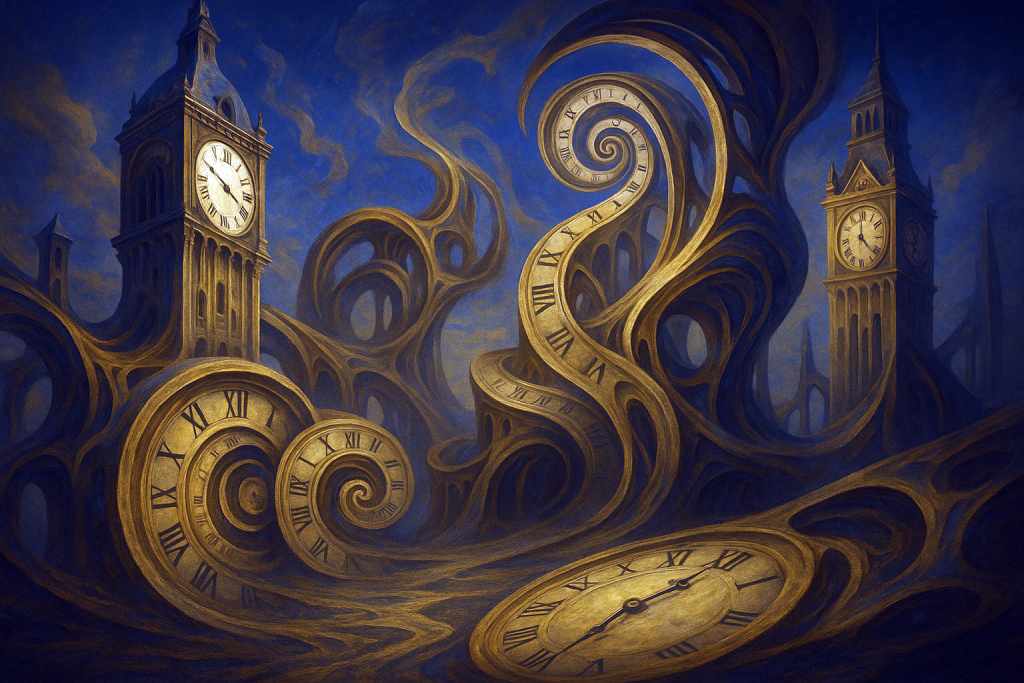
Every work of fiction is, in some form, an architecture built to house time. Unlike painting, sculpture, or even photography, which can depict movement yet remain fixed in their frame, a fictional narrative is always progressing. Even a story that takes place in a single moment must choose how that moment lives across paragraphs, how it stretches or contracts in the telling. Fiction is not just about time; it makes time.
The most fundamental distinction is between the order of events and the way those events are told. This is often reduced to the terms “story time” and “narrative time.” The first refers to the sequence in which things happen to characters or, more precisely, the fictional chronology of their experience. The second refers to the structure through which the author arranges and delivers these events. These two are rarely identical, and the tension between them can produce suspense by withholding information, irony through dramatic contrast, or complexity by presenting events out of sequence.
Some novels follow a straightforward progression from beginning to end. Others leap between decades or drift in the mind of a character caught in a single minute. The manipulation of time is not a trick of structure; it is the structure. And because time in fiction is designed rather than dictated, it becomes one of the most expressive dimensions available to a writer.
This article examines how fiction manages time through three primary techniques: linear sequencing, the compression or expansion of duration, and structural reorganization. These techniques are not tied to any single genre or period. They serve as fundamental tools through which fiction constructs chronology, organizes perception, and controls the flow of events.
Chronology as Structural Control
Linear Time and the Illusion of Simplicity
For much of the nineteenth century, the prevailing form of the novel favored a clear, forward-moving timeline. Events unfolded in the same order in which they were presumed to occur, offering a sense of cohesion and inevitability. This structure supported the developmental arc of the bildungsroman and the detailed reconstruction typical of historical fiction. The reader moved with the character, step by step, through the world and across time.
For example, Charles Dickens’ Great Expectations (1861) begins with Pip’s childhood and moves gradually through his life toward self-discovery. Time in the novel is measured through the accumulation of events, transitions between stages of life, and the eventual settling of consequences. The architecture is linear, but not mechanical. What appears straightforward is carefully controlled with each chapter building from the last, and the future is made to seem dependent on what has come before.
Similarly, Jane Austen’s Emma (1815) moves steadily from one moment to the next, tracing the heroine’s misjudgments, revelations, and eventual transformation in linear fashion. The novel begins in the present moment of its protagonist and progresses through social events and emotional discoveries without structural interruptions or shifts in time. When prior events are referenced, they are recounted within dialogue or exposition rather than re-enacted through non-sequential scenes.
This form of storytelling establishes a dependable temporal rhythm. It does not demand the reader to piece together timelines or reorient with each chapter. Yet, its apparent simplicity is not the absence of design. The appeal of a linear structure lies in its ability to simulate cause and effect, to show how one moment gives way to another. Even the most straightforward chronology is an act of design, a series of choices about pace and duration, with emphasis on a structure that mirrors the unfolding of a life.
Time Anchors and Temporal Markers
Even in fiction that follows a linear timeline, writers often introduce explicit references to time, not as structure but as orientation. These markers signal where the reader is in the story’s chronology and how quickly or slowly time appears to move. Anchors may take the form of dates, seasons, ages, holidays, historical events, or even repetitions of routine. They provide coordinates within a larger temporal map.
Time stamps can be overt, as in Leo Tolstoy’s War and Peace (1869), where battles and campaigns are dated according to real-world history. They can also be embedded in character aging, as in Jane Eyre (1847) by Charlotte Brontë, which follows its heroine from childhood to adulthood with clear divisions between school years, governess employment, and marriage. The structure remains chronological, but each phase is signposted by the passage of time.
Other novels achieve similar orientation through more subtle means. In Marilynne Robinson’s Gilead (2004), a dying father writes a letter to his son. The narrative follows a linear path but is grounded through references to specific Sundays, changing weather, and anniversaries. These elements stabilize the story’s temporal setting and direct the rhythm of thought. Even when the narrative drifts briefly into memory, it returns to the fixed present of the letter’s composition.
Time anchors serve multiple functions. They help situate the reader within the timeline, reinforce pacing, and support the development of themes such as aging, change, or anticipation through temporal markers. When a novel is structured around months or years, time begins to register not only as motion but as atmosphere. A brief reference to a year can compress long stretches of experience into a single moment of recognition.
Such markers, whether explicit or implicit, are among the most discreet tools of temporal construction. They guide the reader seamlessly, giving fiction a sense of location within duration.
Monotemporality vs. Multiperspectival Chronology
While some novels build their structure around a single continuous timeline, others construct time across multiple perspectives and reveal events from different vantage points or in overlapping sequences. The difference is not simply one of viewpoint but of temporal logic, whether time in the novel moves along a shared axis or splinters into parallel and sometimes conflicting chronologies.
Monotemporal fiction traces a single temporal thread. In Ethan Frome (1911) by Edith Wharton, the narrator recounts a sequence of events that belong to one past, told in a linear order, unified by a consistent frame. Even though the story opens with a frame narrator and later transitions to a historical retelling, the internal timeline it recounts is unbroken. The world of the novel obeys a single order of cause and consequence.
In contrast, novels with multiperspectival chronology often present time as being refracted across voices or sections. Events may be repeated with variation, withheld in one thread but revealed in another, or reordered depending on who tells them. Ian McEwan’s Atonement (2001) begins with a sequence from one character’s perspective, then replays the consequences of those same events from other angles and timelines. The reader must reconstruct the chronology across layers of perception, as the stability of the events themselves is constantly being questioned.
This kind of structure requires attention to how time unfolds across viewpoints. In monotemporal fiction, events move forward along a single, continuous path. In works with multiple perspectives, that path breaks into separate tracks, each delineated by a distinct position in time. The reader must keep track of not only what happened, but also when it is disclosed and whose version is being presented. Sequence may seem clear on the surface, yet often conceals a more intricate arrangement beneath.
Compression and Expansion: Elasticity of Narrative Time
Compression of Time into a Single Frame
Having considered how fiction stretches time across long chronologies or multiple perspectives, we now turn to a different kind of structure. Some novels limit their scope to a single day or a brief stretch of hours, concentrating instead on the immediacy of perception. In such works, the emphasis shifts away from plot development and toward the fine-grained texture of thought and sensation.
For example, Virginia Woolf’s Mrs. Dalloway (1925) progresses within the span of one day, from morning preparations to an evening party. The compressed frame creates a sense of unity, but within that boundary, time behaves differently. Thought drifts between present and past, sometimes condensing years into a single impression. Clarissa Dalloway’s movement through London is continuous, yet her internal experience counters such alignment. The novel does not expand its reach by adding more events but by deepening the texture of the moment.
This method of temporal compression creates a paradox. Time appears to pass quickly such as in a day or in a few hours, yet what fills the pages is not the action but the density of perception. Another example: in Nicholson Baker’s The Mezzanine (1988), the entire novel takes place during a man’s lunch break. A ride on an escalator becomes the occasion for dozens of nested reflections on vending machines, shoelaces, and office routines. There is almost no forward movement, but the novel stretches a few minutes into the span of a full-length book.
Such narratives demonstrate that time in fiction is not measured by clocks or calendars but by how much attention is given to it. The fewer the external events, the more the internal world expands to occupy the available space. In compressed temporal structures, duration becomes a container for thought rather than for incident.
Ellipsis, Compressed Narration, and the Omission of Time
If some novels linger over minutes, others sweep across decades in the space of a paragraph. This technique, often executed through ellipsis or compressed narration, makes it possible for fiction to span long intervals without representing every scene. Instead of showing every moment, the writer selects which events to render fully and which to abbreviate or omit. The result is a structure built not from continuity but from strategic gaps.
In One Hundred Years of Solitude (1967), Gabriel García Márquez moves through generations of the Buendía family with sentences that contain the rise and fall of entire lifespans. A line might begin with a birth and end in old age, with the intervening years marked only by a passing phrase. The density of time is flattened to accommodate a broader sweep of events, thus enabling the narrative to span generations without lingering on transitional detail. Temporal omission becomes part of the novel’s rhythm, matching the mythic tone of its events.
Arundhati Roy’s The God of Small Things (1997) also employs ellipsis, though its effect is more intimate than panoramic. The novel skips across decades, circling around a central catastrophe that is disclosed gradually rather than directly. Time does not advance in linear steps; instead, it gathers around memory, atmosphere, and withheld knowledge. What remains unsaid carries equal magnitude to what is revealed, and long intervals are left unspoken. Time arrives in pieces, arranged by emotional pressure rather than order.
Ellipsis and compressed narration are not simply techniques for efficiency. They function as structural principles. By omitting certain stretches of time, the writer reorganizes chronology to highlight specific scenes while bypassing others. Fiction in this mode does not document every moment; it selects, condenses, and moves forward with only what serves its design.
Expansion and Slowness: The Inflation of Moments
Fiction does not only leap across time or compress it into tight frames, it can also slow time down from within, extending brief moments across long passages. This expansion modifies narrative rhythm by pausing action and directing focus inward. Through detailed observation, reflection, or psychological elaboration, fiction can dwell in a single instant without advancing the plot.
In The Magic Mountain (1924), Thomas Mann stretches time across a setting already detached from ordinary life: a sanatorium in the Swiss Alps. The novel follows Hans Castorp’s visit, initially intended to last three weeks, which becomes an extended stay of seven years. But within this broad timeline, the pacing of events is uneven. Days pass with little incident, while entire chapters are given over to conversations, sensations, and digressions that unfold in what feels like suspended time. Mann expands philosophical dialogue and internal contemplation until the boundaries between moments blur. The result is not stasis, but gradual accrual, as each page intensifies the atmosphere instead of driving it towards resolution.
This dilation can also be found in fiction that employs stream of consciousness or close interior narration. A character pauses before opening a door, and in that pause, the mind revisits entire histories, private associations, or unspoken fears. External time holds its position, while internal time fills the frame. Expansion of this kind draws out what would otherwise be imperceptible, such as the fine-grained motion of thought as it turns over itself.
Disruption and Temporal Fracture
Fractured Time as Structural Device
Not all fiction seeks continuity. Some novels break chronology on purpose by fragmenting time to reflect psychological stress, historical discontinuity, or thematic tension. In these structures, disorder is not a surface feature but an organizing principle. The broken sequence reflects an internal fracture, where events refuse to follow a stable or predictable line.
Toni Morrison’s Beloved (1987) exemplifies this kind of structure. The novel opens with facts already broken apart: a haunting, a lost child, a past that presses into the present. Time moves in uneven steps, cycling between memory, trauma, and partial revelation. Events are not ordered by cause and effect but by recurrence and emotional gravity. The story returns again and again to the same moments, each time reconfigured by what has been remembered or withheld. The result is a structure that mirrors the experience of trauma, where time does not proceed but recoils, stutters, and repeats.
This use of broken time modifies the narrative’s logic. The reader is not moved from beginning to end but drawn into a field of cyclical return, where chronology bends around what has not been resolved. In Beloved, the past intrudes on the present. It splinters conversations, distorts perception, and shatters the continuity of daily life. The broken timeline does not simply reflect trauma; it embeds that trauma into the very structure of the novel.
Recursive Structures and Loops
Some works of fiction do more than fracture time. They circle back to the same repeatedly, building their structure through cycles rather than sequence. These recursive designs form loops in which a single event may reappear with slight variation, or a character may re-experience the same situation under altered conditions. These patterns do not aim to resolve the past but draw attention to its persistence, to what remains unsettled and continues to resurface.
Kurt Vonnegut’s Slaughterhouse-Five (1969) constructs its entire framework around this principle. The protagonist, Billy Pilgrim, becomes “unstuck in time,” moving between moments in his life without control or linear order. The novel jumps from wartime Dresden to mundane scenes of suburban America, from alien abduction to childhood memories. These shifts are abrupt and disorienting, yet they form a consistent pattern, one in which time does not unfold but recurs. Death scenes, especially, are repeated with minimal variation, punctuated by the refrain “So it goes,” turning finality into something strangely ordinary.
This looping structure dissolves the distinction between past and present. Billy’s wartime trauma is not confined to a single chapter or stage of life; it reappears as part of his ongoing condition. What was once an event becomes a state. Time in Slaughterhouse-Five is less a sequence than a condition of being, where experience is scattered across locations rather than arranged along a path. The structure itself performs this dispersal, treating chronology as something fragmented and circular rather than cumulative.
Multiplicity and Temporal Disorientation
In certain novels, time does not unify the story but breaks it apart. Characters move through separate chronologies that do not align, and settings shift across centuries without transition. Events echo across generations with no fixed point of origin. What holds these narratives together is not chronology but recurrence with thematic variation and convergence. Time functions as an unstable field, not as a mere backdrop, where continuity fragments into overlapping traces.

David Mitchell’s Cloud Atlas (2004) is built from six interlocking narratives, each set in a different era, each told in a distinct voice. The structure moves forward in time, from the nineteenth century to a speculative future, then reverses back to the origin. Each storyline breaks into the next and is later resumed, creating a mirrored structure that defies conventional flow. While the book moves through centuries, it also blurs temporal boundaries by threading similar dilemmas, behaviors, and consequences through each narrative.
This structural design does more than organize the narrative. It changes how time is experienced throughout the novel. Some chapters proceed with compressed narration; others linger in detail or divide into distinct sections. These shifts disrupt the sense of steady progression and make the flow of time variable. Rather than structuring a continuous sequence, the book moves in broken segments that revisit familiar tensions in altered contexts.
Asynchronous Chronology and Dislocation
Some novels go further still, not only fragmenting or multiplying timelines, but withholding any clear temporal framework altogether. Events unfold without reliable sequence. Scenes appear without dates or orientation. The effect is more than a break in sequence. It creates a disorienting structure in which time lacks clear markers, and the reader cannot easily tell where or when events are taking place.
William Faulkner’s The Sound and the Fury (1929) is one of the most studied examples of this technique. Its first section is narrated by Benjy, a character with no consistent sense of temporal order. Past and present collide into one another without signal or transition, and entire scenes unfold without clear reference points. The novel’s structure mirrors this disorientation, requiring the reader to piece together the chronology from fragments. This disjointed form reflects the instability of the characters’ inner lives and makes the dislocation of time a central feature of the novel’s design.
In fiction established by asynchronous chronology, disorientation becomes a structural element. Time is presented without familiar markers and events appear in fragments that shift unexpectedly. The sequence does not build toward resolution but reflects a world in which memory is unstable and perception lacks fixed boundaries. Instead of tracing a clear path through time, the narrative disturbs it, and the resulting order is provisional and open to reinterpretation.
For a more detailed exploration of these techniques across a range of works, see our related analysis of nonlinear narrative.
Time as Theme vs. Time as Structure
Thematic Use of Time
Many works of fiction engage with time not only as a formal device but as a subject. Novels built around memory, aging, or historical reckoning often explore time explicitly through their content. These themes define the emotional and philosophical dimension of a story, even in cases where the structure remains conventional.
In Swann’s Way (1913), the first volume of Marcel Proust’s In Search of Lost Time, time is not simply an element of plot but the central object of reflection. The novel opens with a meditation on the experience of waking, the shift from sleep to consciousness, and the instability of temporal awareness. The taste of a madeleine triggers a cascade of involuntary memory, contracting years into an unbidden moment of recollection. Here, time functions as both subject and atmosphere, something the narrator returns to, describes, and struggles to understand.
Similarly, in Never Let Me Go (2005) by Kazuo Ishiguro, time is framed through retrospection. Kathy H. recounts her life at Hailsham and beyond, narrating with a calm tone that contrasts with the underlying horror of her fate. Time, in this novel, is felt through what is not accounted for or just simply surrendered. The chronology remains intact, yet the passage of time is felt in each scene through what is recalled, what goes unsaid, and what has already slipped beyond recovery.
Thematic uses of time draw attention to its passage, its distortions, or its meaning in the lives of characters. These works do not always challenge linearity, but they do position time as something to be examined, as a subject defined by emotion, change, and reflection.
Structural Use of Time
While some novels explore time through memory or reflection, others go further by constructing their entire structure around the mechanics of time. In these works, time is not only examined as a subject but integrated into the formal design of the narrative. Structure becomes a way of expressing how time progresses, breaks apart, circles back, or remains unfinished. The reader experiences not just what time means within the story, but how it moves, stalls, or shifts from one point to another. Structure and temporality become inseparable.
Ali Smith’s How to Be Both (2014) offers two distinct sequences of the same book: one version begins with the story of a contemporary teenager grieving her mother, the other with the voice of a Renaissance artist observing the world from beyond life. The publisher released the novel in two editions, each with a different order. There is no fixed sequence. Time in this novel is restructured to allow for dual entry points and overlapping perspectives, undoing the idea of a single, authoritative timeline. The form does not support one direction; it makes structure itself a function of temporality.

In Catch-22 (1961), Joseph Heller breaks the narrative timeline to reflect the absurdity of war. Scenes appear out of order, and key events are disclosed gradually through repeated accounts from different perspectives. This disjointed rhythm matches the atmosphere of the novel, where circular logic, institutional absurdity, and delayed understanding influence every decision. The narrative’s cyclical nature ultimately drives recognition, as the accumulation of details grants new meaning to previous events.
These are not simply narrative experiments. The structure of time on the page becomes the story’s central gesture. Structure does not mirror time; it constructs a version of it. How a story is arranged becomes inseparable from what it expresses about time’s distortions and limitations. For readers interested in how temporal strategies intersect with broader questions of story construction, our companion article on understanding narrative structure examines how time, causality, and perspective work together to construct fiction’s overall architecture.
Time, Character, and Perspective
Psychological Time vs. Plot Time
Fiction often reveals that time is not experienced uniformly: a minute can stretch, a decade can be easily expended, and a single event can linger across chapters. While plot time moves externally by tracking what happens and when, psychological time unfolds through the consciousness of characters. It is dictated by memory, attention, and emotional intensity, not clocks or calendars.
Woolf’s To the Lighthouse (1927) offers a clear contrast between these two dimensions. In the first and third sections, time is filtered through the interior experiences of the Ramsay family, moving slowly and closely, bound to the rhythm of thought and perception. In the central section, years slip by in a few pages. The house deteriorates, characters die, and history passes by unnoticed. Plot advances quickly, but consciousness is absent. Woolf draws out the difference between time lived and time recorded, which shows how fiction can separate duration from presence.
This contrast between inner and outer time appears in many modernist and contemporary literature. Internal time is often irregular, expanding under pressure or breaking apart when emotion overwhelms the structure. Fiction that emphasizes psychological duration often avoids the fixed pace of plot. It creates room for hesitation, obsessive focus, or wandering. It shows how a character feels time, rather than how a clock measures it.
Character-Specific Chronologies
While psychological time isolates duration within a single consciousness, some novels extend this fragmentation across multiple characters. These works do more than vary perspective. They construct separate timelines that follow distinct patterns of memory, attention, and pacing. Chronology no longer forms a single thread but breaks into divergent paths developed by the rhythm of each voice.
Faulkner’s As I Lay Dying (1930) is structured around this kind of temporal fragmentation. The novel is told through the interior monologues of fifteen narrators, each reflecting on the death and transport of Addie Bundren. Some narrators speak from within the immediate action, while others drift into rememberings or philosophical musing. The timeline becomes difficult to fix because each voice carries its own temporal logic. What one character dwells on, another ignores. What is central to one is peripheral to another.
This structure avoids a unified perspective and instead emphasizes divergence. Time unfolds in parallel but uneven tracks, each reflecting a different consciousness. The result is not a single, cohesive timeline but a field of overlapping durations that may contradict or obscure one another. In these novels, simultaneity does not produce coherence. Sequence shifts depending on who speaks, what is remembered, and how attention moves.
Fiction as a Temporal Instrument
Time in fiction is never neutral. Whether stretched, fractured, condensed, or made to loop, time is determined by choices of structure, pacing, and perspective. Writers do not simply depict time as it passes; they build it into the architecture of the story. Each decision to advance chronologically, to omit, to repeat, or to pause constructs a particular version of how time is felt, remembered, or withheld.
The difference between story time and narrative time is not only technical. It marks the distinction between what happens in the fictional world and how that world is arranged, disclosed, and experienced. When a novel moves through decades in a paragraph or lingers over a moment for twenty pages, it is not distorting time but composing it. Fiction models time according to its own design, constructed not by external chronology but by the demands of its own story.
Further Reading
Rachel Beanland on Managing Time in Fiction by Rachel Beanland, Literary Hub
Fonda Lee’s Advice On Writing Time Jumps In Fiction by Aspiring Reader, Medium
Marking Time with the Viewpoint Character by Beth Hill, The Editor’s Blog