Explore This Topic
- The Short Story as a Way of Seeing: A Reader’s Perspective of the Form
- How the Short Story Works: A Reader’s Guide to the Form
- The Reader’s Experience: What It Feels Like to Read a Short Story
- What Short Stories Help You See: Themes of Human Experience
- The Short Story Collection as a Field of Vision
- Short Story Writers as Teachers of Seeing: Ten Masters of the Form
- The Short Story Canon: Who Gets to Stand for the Genre?
- The Short Story Today, in an Age of Screens and Divided Attention
- A Reader’s Practice: How to Train Your Eye for Short Stories
My Reading Note
I read Joshua Ferris’s The Dinner Party and Other Stories over a single weekend, cover to cover, in the order the author had arranged—I did not skip ahead or sample the shorter pieces first, but trusted the sequence. When I finished, I realized that I had not approached any other collection in this way; this one had made me read it as a whole.
A short story collection is a sequence of stories, and the order often carries as much significance as the stories themselves. Yet readers frequently approach collections as though the sequence were incidental. They dip in and skip around. Reading a collection straight through reveals connections between stories that you would miss otherwise. The whole becomes something more than the sum of its parts.
This article examines how collections work—how they cohere, how their order affects perception, and how reading them as whole objects reveals dimensions that no single story can offer.
What Makes a Collection Cohesive?
A short story collection can feel like a unified work, or like a random assortment. The difference lies less in the quality of individual stories than in the presence of a governing principle that ties them together. That principle can take several forms.
One obvious principle is thematic unity. The stories return to a shared subject—love, loss, displacement, childhood—and the collection gains coherence through repeated variations on that subject. Nam Le’s The Boat (2008) moves across continents and characters, from a Vietnamese refugee to a New York artist, yet the book coheres through its sustained engagement with displacement and the ethics of storytelling. The settings and characters change, but the core questions—about belonging, survival, and who gets to tell which stories—recur.
A second principle is tonal unity. The stories may address different subjects, but they share a common mood, a characteristic voice, or a consistent narrative register. Bora Chung’s Cursed Bunny (2017) gathers ten stories that move between horror, science fiction, and fairy tale, yet a consistent fabulist sensibility—darkly absurd, deadpan, attentive to how everyday cruelties blossom into the grotesque—runs through them all. The collection coheres through that shared tonal space, where the fantastic is treated as matter-of-fact and allegory slides into nightmare.
A third principle is structural unity. The stories are arranged in a sequence that creates a larger arc. Junot Díaz’s Drown (1996) gathers stories about Dominican and Dominican-American characters that can be read individually, yet in order they trace the history of one family’s migration and the coming-of-age of the recurring narrator, Yunior. The collection coheres through recurring characters and settings, but the sequence also gradually fills in a timeline, so that each new story reorients the ones before it.
In my experience, thematic unity can be the trickiest of these principles. A collection of stories all about the same subject can feel repetitive and predictable, while a collection held together by voice or structure can feel endlessly varied. Le’s The Boat works because the subject shifts but the questions persist—and that persistence, more than subject alone, is what gives the collection its coherence.
These principles are not mutually exclusive. A collection can draw on two or all three. What matters is that some principle is at work. Without it, the collection dissolves into a mere gathering of stories, and the reader finishes with the sense that they have read a random selection rather than a coherent whole.
The Anthology vs. The Single-Author Collection
Not all collections are the same kind of object. The distinction between an anthology and a single-author collection is obvious at the level of authorship, but the consequences for reading run deeper. An anthology is assembled by an editor who selects from multiple writers, often working from an external principle: a theme, a time period, a region, or a movement. A single-author collection is assembled by the author (or by an editor working with the author’s body of work) and coheres through a unified voice or set of preoccupations.
An anthology asks the reader to encounter a range of voices. The pleasure lies in the variety, in the juxtaposition of different styles and approaches, in the sense of a conversation or a debate unfolding across the collection. The editor’s principle of selection becomes a lens through which to see the stories. In Helon Habila’s The Granta Book of the African Short Story (2011), the stated organizing principle is largely generational and chronological: the stories are ordered by author generation, from the youngest writers to the oldest, so that contemporary voices appear first and are then set against earlier generations. The anthology ranges across the continent, from North to Southern Africa, and presents younger, “post-nationalist” writers alongside more established figures, creating a sense of a tradition in motion.
A single-author collection asks something different. It requires the reader to inhabit one mind, to track the variations on a set of recurring concerns, and notice how the voice shifts and yet remains recognizable. Chimamanda Ngozi Adichie’s The Thing Around Your Neck (2009) gathers stories about Nigerians at home and abroad, attentive to migration, dislocation, and the gaps between expectation and reality. The book can be read as unified by certain motifs, but it is less a survey of a theme than a sustained exploration by one intelligence. The reader encounters not a range of authorial sensibilities but the range of a single voice working through different situations and narrative stances.
I have often wondered whether the anthology is the more honest form. A single-author collection can pretend to unify even when the stories were written years apart for different occasions. An anthology makes no such claim—it announces itself as a selection, an arrangement, or a construction. The reader knows exactly what they are getting.
The form of the collection—anthology or single-author—changes what we look for. In an anthology, we look for the editor’s argument, the principle that makes these stories belong together. In a single-author collection, we look for the author’s preoccupations, the obsessions that surface again and again. Reading one as though it were the other leads to confusion. To approach Adichie’s collection as a survey of Nigerian writing would be to miss the unity of voice that gives it coherence. To approach Habila’s anthology as a unified vision would be to miss the variety that gives it its scope.
The Collected Works: Retrospectives and Posthumous Collections
A retrospective collection is not the same as a single-author collection, though both bear the same author’s name on the spine. A single-author collection is often a unified work, written in a concentrated period and arranged with a specific design in mind. A retrospective, by contrast, gathers stories from across a writer’s career, sometimes spanning decades, and arranges them in an order that may be chronological, thematic, or something else entirely. The author may have had a hand in the selection, or the editor may have done the work after the author’s death.
Eudora Welty’s Collected Stories (1980) is a retrospective volume that Welty herself selected and arranged. It reprints in full her four earlier collections and adds two previously uncollected stories, bringing together all of her short fiction that had appeared in book form. The arrangement is not strictly chronological—Welty opens with stories from the 1930s, but instead of following a straight line through time she seems to group by mood and setting, creating a different rhythm than the publication history would suggest. The collection reads less as a simple record of her career than as an act of curation, a statement about which stories she wanted to stand as representative of her legacy.
I find the retrospective to be the most deceptive form. It looks like a single-author collection, but it is really an anthology in disguise—an anthology curated by the author herself. The author is acting as her own editor, and the reader may not even notice. The arrangement is not innocent; it is an argument about what the author’s work means.
Posthumous collections are another category entirely. When the author has no say in the selection or arrangement, the editor’s choices become the frame. The collection may be assembled from unpublished work, from stories scattered across periodicals, or from a mix of sources. The editor’s organizing principle may not be the author’s. The reader is left to wonder: would the author have arranged the stories this way? Would they have included these stories at all? The posthumous collection can be a gift, bringing to light a work that might otherwise be lost, but it is also a construction, and the reader must approach it with that awareness.
The difference between a retrospective and a posthumous collection is not always clear. Some authors leave detailed instructions; others leave nothing. Some editors work from extensive notes; others from guesswork. But in both cases, these types of collection are not unified works in the way that a single-author collection can be. They are selections made after the fact from a larger body of writing. The reader’s task is to read not just the stories but the frame around them—the organizing principle that determines what is included, what is excluded, and what order the pieces appear in.
The Problem of the “Filler” Story
Every collection has a story that readers skip. It sits between two stronger stories, or it appears late in the sequence when fatigue has set in, or it simply fails to announce itself with the same urgency as its neighbors. Reviewers call these stories “filler,” a term that suggests they serve only to pad the collection to a commercially acceptable length. But the concept of filler deserves a closer look. What we call filler may be doing work that we do not see.
The most obvious function of a less celebrated story is contrast. A collection of uniformly strong stories can become exhausting. The reader needs moments of relief, passages of lesser intensity that allow the stronger stories to stand out. Lorrie Moore’s Birds of America (1998) is a collection of consistently high quality, but certain stories—”Real Estate,” for instance—are less frequently discussed than “People Like That Are the Only Kind Here” or “Dance in America.” Yet those less intense stories serve a purpose. They lower the temperature and provide breathing room. Without them, the collection would be a series of peaks with no valleys, and the reader would feel the strain.
A second function is thematic extension. A story that appears to be filler may be extending the collection’s thematic range in a way that becomes visible only on rereading. It may address a subject or a mood that none of the other stories touch, and its inclusion expands the collection’s scope even if the story itself is not the strongest. The story may be the only one in the collection that treats a particular theme, and its presence makes the collection more comprehensive even if its execution falls short of the others.
I have come to suspect that the stories we call filler are often the ones that do the most work. They keep the collection from sounding a single note too insistently. The collection would be less without them, even if we cannot fully explain why.
A third function is structural. The placement of a weaker story can affect how the reader receives the stories that surround it. A story of lower intensity placed after a devastating one can act as a buffer; the reader can recover before the next strong story begins. A story that seems to be filler may be doing the work of pacing, of controlling the rhythm of the collection. The collection is a sequence, and the sequence requires variation. The “filler” story provides that variation, even if it does not stand out in isolation.
Our response to weaker stories reveals our assumptions about what a collection should be. To dismiss a story as filler is to read the collection as a competition rather than a sequence. It is to ask each story to earn its place on its own, without considering what it contributes to the whole. A story that falls short by the standards of the others may still be doing indispensable work. The collection is not a greatest-hits album. It is a composition, and every note serves the composition, even the less prominent ones.
How Order Changes What You See
The order of stories in a collection is not neutral. An author or editor arranges the sequence with purpose, and that purpose affects what the reader notices. The same set of stories, placed in a different order, can produce a different reading experience. The sequence is an interpretive act, and the reader who reads in order is following a path that someone has laid out with care.
The opening story is the most visible instance of this principle. It sets the tone for the entire collection, establishes expectations, and primes the reader for what follows. A collection that opens with a devastating story announces itself as serious, weighty, perhaps even grim. A collection that opens with a comic story signals a different register. The reader enters the collection through the opening story, and that entry point colors everything that comes after. The closing story, too, carries a special burden. It is the last thing the reader encounters, the note on which the collection ends. The author who chooses the closing story is choosing what the reader takes away.
I have often wondered whether the opening and closing stories are selected first, with the rest arranged around them. The logic of the collection seems to flow outward from those two poles. The opening establishes the territory; the closing defines the destination. Everything in between is a journey between those two points.
Between the opening and the closing, the sequence creates a rhythm. A collection that alternates long and short stories has a different feel than one that groups the long stories together. A collection that moves from realistic to experimental stories has a different arc than one that moves in the opposite direction. The sequence can create patterns of tension and release, of expectation and fulfillment, and of contrast and continuation. The reader who reads in order experiences those patterns as they unfold. By contrast, the reader who dips in and out is more likely to experience only the individual stories, missing much of the larger architecture.
A short story cycle by a single author makes this principle especially clear. In a cycle, the stories are ordered to follow characters across time, so that reading in sequence produces an unmistakable arc: early pieces show the protagonists in one stage of life; later ones confront the consequences of their choices. Read straight through, the cycle offers a continuous portrait of lives unfolding; read out of order, it more easily breaks into striking but disconnected episodes. The form itself—part collection, part emergent narrative—makes visible how ordering can create meaning from discrete, story-like units. Alice Munro’s Lives of Girls and Women (1971), often described as a coming-of-age short story cycle built around Del Jordan’s life, is one example of this form.
The Linked Collection (Or Novel in Disguise?)
Some collections blur the line between story collection and novel. They share characters, settings, or a chronological arc across stories, and the cumulative effect resembles a novel more than a traditional collection. The short story cycle, discussed in the previous section, is one type of linked collection. Other linked collections use looser connections without necessarily forming a chronological arc. These collections raise a question: are they collections at all, or are they novels in disguise?
Linked collections ask to be read differently than other collections. They offer a continuum of characters and events that reward reading in order. The sequence builds upon itself, and the stories depend upon one another for their full effect. Denis Johnson’s Jesus’ Son (1992) is a linked collection that follows a single protagonist across a series of episodes. The stories can stand alone, and many of them do, but the full picture of the protagonist’s descent and recovery emerges only when the stories are read together. The collection is not a novel, but it is not a traditional collection either.
I have always been skeptical of the linked collection as a category. It seems to exist mostly for the convenience of critics who want to talk about novels but do not want to call them novels. The distinction is not always helpful. What matters is not the label but what the sequence does.
The linked collection succeeds when the individual stories are strong enough to stand on their own and the connections between them are subtle enough to reward the attentive reader. It fails when the stories are too dependent on one another, when they cannot be read in isolation without losing their coherence. A collection that consists of excerpts from a larger work is not a linked collection; it is a novel chopped into pieces. A true linked collection gives the reader the best of both forms: the intensity of the short story and the scope of the novel, without sacrificing either.
Elizabeth Strout’s Olive Kitteridge (2008) is a linked collection that works because the stories do not require one another. Each story can be read on its own, but the collection as a whole offers a portrait of a woman and a town that no single story could achieve. The links are there, but they are not intrusive. The reader can choose to notice them, and the collection rewards that choice, but they are not a condition of enjoyment.
Reading a Collection Out of Order
The previous sections have assumed that readers read collections in the order the author or editor intended. But many readers do not. They skip around. They read the shortest story first, the one with the most intriguing title, or the one by a familiar author (if reading an anthology). This practice is common, and it is not wrong, but it comes with consequences that readers rarely consider.
Reading a collection out of order changes what you see in the collection as a whole. The connections between stories become harder to notice. The rhythm of the sequence disappears—the alternation of tones, the patterns of tension and release that the author built into the arrangement. The opening story no longer sets the tone, and the closing story no longer provides a final note. The reader gains the freedom to choose, but loses the architecture that the sequence provides.
I have been guilty of this myself. I used to read the shortest story first, as though I were warming up. Then I realized I was not reading the collection as the author intended, and I was missing something. Now I read in order, at least on the first pass. The second pass is for skipping around.
But the loss is not always significant. Some collections are designed to be read in any order. The stories are independent, and the sequence is incidental. George Saunders’s Tenth of December (2013) is a collection whose stories can be read in almost any order without diminishing the experience. Each story stands on its own, and the connections between them are thematic rather than narrative. The reader who skips around misses nothing essential.
The question is not whether reading out of order is wrong but whether the reader is aware of what they are sacrificing. The collection offers a path, and the reader can choose to follow it or not. But the choice has consequences, and those consequences are worth considering.
Short Stories in a Field of Vision
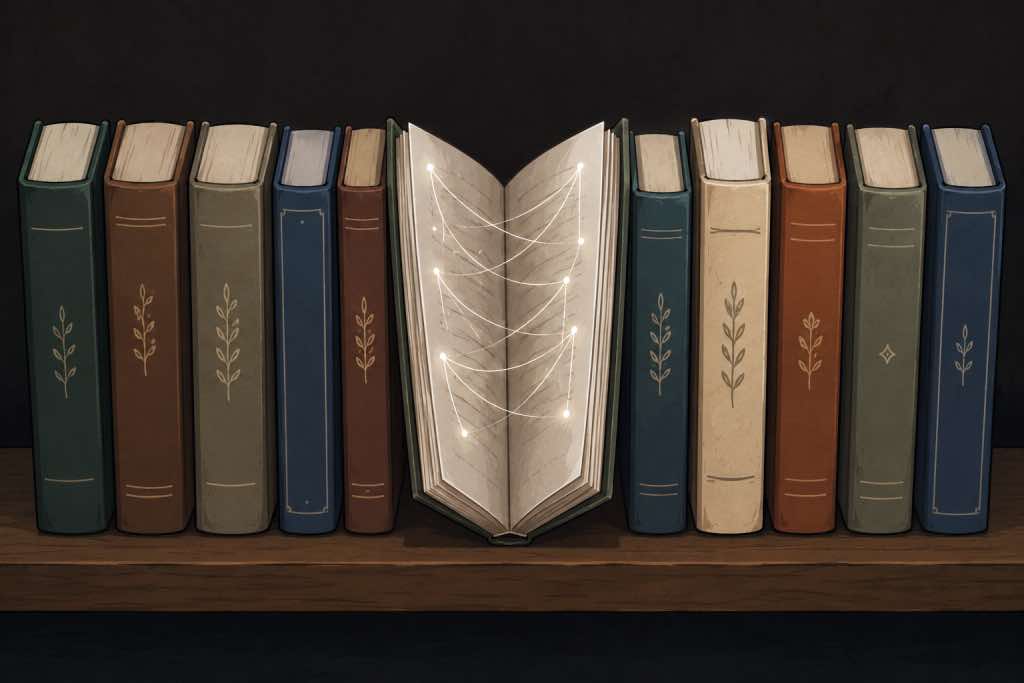
A short story collection is always more than the sum of its pages; it is a way of asking the reader to see connections that only emerge in sequence.
By this point, the reader has already entertained the possibility that a collection is not just “eleven good stories” or “nine strong pieces,” but a field of vision—an argument about what belongs together, what comes first, and what can be allowed to fade so that another element can stand out more clearly. The books and authors mentioned here serve only as examples, different answers to the same problem of how to make many stories contribute to a single, coherent work.
What matters, finally, is whether the collection’s guiding principle is allowed to come into view. Reading in order is one way of letting that happen. Another is to attend to what first appears as “filler,” or to consider how an anthology has been assembled and what patterns emerge across its selections. A collection is a sequence and a frame, a composition; to approach it as a mere assortment of stories is to decline the invitation it offers.
The next time you pick up a collection, you might try reading it as you would a novel: from the beginning, through the turns, to whatever end has been chosen for you. Then you can scatter, skip, and return. But at least once, give the book the chance to show you its own architecture. The stories will still be there, waiting, but the field in which they stand may look very different.
Diverse Collections of Short Stories
Short Stories from Classic to Modern Writers
A Manual For Cleaning Women: Selected Stories
While this article examines how short story collections function as compositions, my earlier posts listed above offer practical entry points into the form. The first surveys six distinctive collections that showcase the range of short fiction; the second introduces classic and modern authors, from Chekhov to Mueenuddin; and the third provides a deep dive into Lucia Berlin’s posthumously acclaimed collection. Reading these alongside this article gives you both the theoretical lens and the concrete examples to see how collections work in practice.
Further Reading
- Putting Together a Short Story Collection by Vaness Onwuemezi, Writers & Artists
- The Long and the Short of It: Linked Story Collections Bridging the Divide by Sonya Chung, The Millions
- Lauren Groff on Masters of Short Fiction by The New Yorker