Explore This Topic
- The Short Story as a Way of Seeing: A Reader’s Perspective of the Form
- How the Short Story Works: A Reader’s Guide to the Form
- The Reader’s Experience: What It Feels Like to Read a Short Story
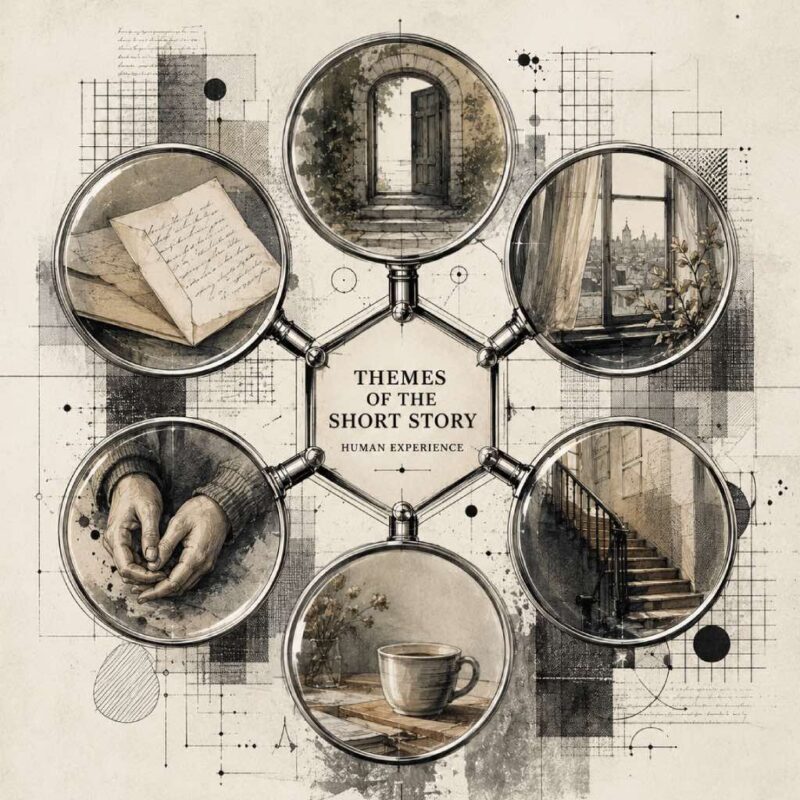
- What Short Stories Help You See: Themes of Human Experience
- The Short Story Collection as a Field of Vision
- Short Story Writers as Teachers of Seeing: Ten Masters of the Form
- The Short Story Canon: Who Gets to Stand for the Genre?
- The Short Story Today, in an Age of Screens and Divided Attention
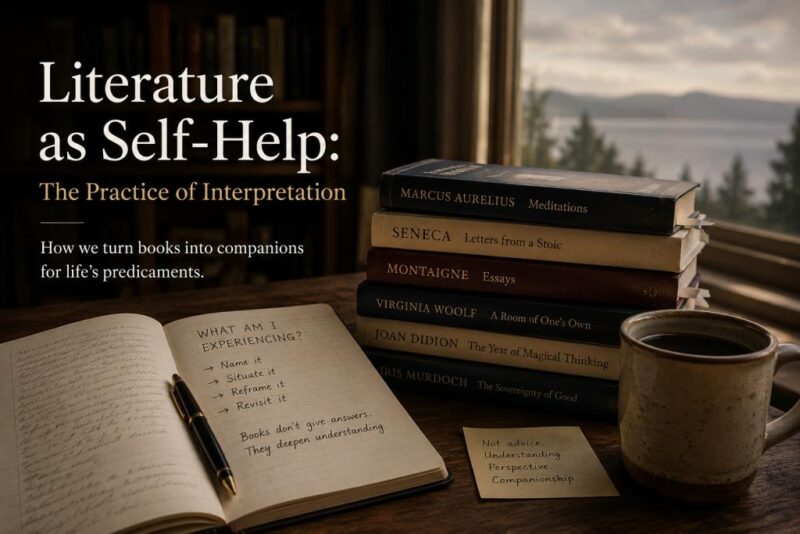
- A Reader’s Practice: How to Train Your Eye for Short Stories
My Reading Note
I came to short stories late, after years of novels. Carson McCullers’s “Wunderkind” changed my thinking about the form. The story follows a young pianist who loses her gift during a lesson, and I kept thinking about her long after I finished reading it. It taught me that a good short story does not end when you finish reading. It just keeps working on you afterward.
You have probably heard someone say, “I don’t read short stories because they end just when things get interesting”—a fair complaint, but one that misunderstands what the form is for. The complaint carries an implicit comparison, as if the short story were a novel that simply ran out of pages, a form that promises what it cannot deliver. But the short story is not aiming for the same effects, nor does it require the same patience or reward the same habits of attention accorded to the novel.
Most readers come to short stories through novels, carrying expectations formed by hundreds of pages: character development, sustained tension, and a payoff that feels earned. The short story does not aim to meet these expectations per se, nor does it offer room to settle in. It gives you what it can in a limited space and then withdraws. The experience can feel like a deprivation, which is primarily what the form intends to do.
What the short story offers instead is a different way of seeing. It teaches you to notice what matters in a single glance, to grasp a life in a few pages. And when it ends—often without the closure a novel would provide—it leaves you with something that persists. The accompanying articles in this series explore this way of seeing from a reader’s perspective, examining the form’s inner workings and its effects on those who encounter it.
The complaint that short stories “end just when things get interesting” assumes that the interesting part is what comes next. But in a short story, the interesting part is what just happened. The form asks you to look backward, not forward.
What the Short Story Does
The short story compresses, and this compression is not a limitation but the form’s enabling condition. Every element must serve the whole, so no sentence can afford to be transitional, and no detail exists for atmosphere alone. The pressure forces every component to do more than it would in a novel, where digression and expansion are permitted and often expected.
Consider the opening of James Joyce’s “The Dead” (1914), the final and longest story in Dubliners. The party scene unfolds with novelistic attention to social detail, yet Joyce structures those details so that they steadily converge on Gabriel Conroy’s final epiphany. Some critics note that the story’s sections become shorter toward the end, increasing the pace toward that climax. Joyce might have expanded Gabriel’s life into a novel; instead, he uses the short story’s focus to compress an entire moral and emotional arc into its final pages. The difference, then, is not length but focus: the short story form lets Joyce channel novelistic detail into a single, transformative realization.
This concentration produces effects the novel cannot replicate. A novel distributes its power across hundreds of pages, building slowly toward moments of recognition. The short story delivers its effects in concentrated bursts. You finish it and feel as though something has happened to you, not merely been described to you. The form works on the reader like a lens, focusing light onto a single point until that point ignites.
Most discussions of compression treat it as a technical problem—how to say more with less. But compression is not primarily a technique; it is a philosophy. It assumes that meaning is found in what the story shows and what it leaves out. This is why the short story can feel more accurate than the novel. Life does not unfold in neat narrative arcs; it arrives in moments that crystallize.
I find that the word “compression” is often misunderstood. It does not mean cutting away excess so much as it means choosing what to magnify. The short story does not remove details; it selects them with precision, and what it selects becomes more powerful precisely because it stands alone.
Four Effects of the Short Story
The short story produces effects that differ from the novel’s not in degree but in kind. Four categories capture these effects with some precision.
- The flash of recognition occurs when a detail (such as a gesture, an object, or a single line of dialogue) suddenly illuminates everything that came before it. Katherine Mansfield’s “The Garden Party” (1921) builds toward such a moment when Laura confronts the dead man’s body and, wearing her new hat, says only, “Forgive my hat.” The hat suddenly feels absurd and wrong against the reality of death. She does not reason her way to this realization. The understanding arrives fully formed, as if it had been waiting for the right moment to surface.
One test I use for a successful flash of recognition: can I point to the exact sentence where it happens? In “The Garden Party,” it is Laura saying, “Forgive my hat.” In other stories, it might be a gesture, a silence, or the absence of a detail. The form trains you to notice these hinges.
- The lingering unease settles in after the story ends. The narrative itself may seem straightforward, even resolved, yet something feels off. The reader cannot locate the source of the discomfort. Joyce’s “The Dead” achieves this effect through its final image of snow falling across Ireland, covering the living and the dead alike. The story concludes, but the unease does not.
- The withheld resolution denies the reader what the novel nearly always provides. Anton Chekhov’s stories often end in this mode. “The Lady with the Little Dog” (1899) finishes with two people who love each other and know that they must find a way to be together, yet have no clear plan for how to do it. The story stops; it does not conclude. The reader is left to imagine what might come next, a task the form intentionally assigns.
- The expanded moment takes a sliver of time and stretches it until it contains an entire life. Alice Munro’s “The Bear Came Over the Mountain” (1999) covers decades of a marriage, but its power lies in specific moments—Fiona losing her memory so she no longer knows who her husband is, Grant seeing her attach herself emotionally to another man in the institution. These moments contain everything that came before them. The story does not narrate a life; it shows you where to look for one.
These four effects emerged while I was reading short stories with others who kept trying to describe them in novelistic terms like character arcs and thematic development. Most good stories did not fit those categories. The ones that proved most difficult to categorize defied every framework I tried to apply. They worked on different terms, and I had to find a new vocabulary to describe them.
The Reader’s Role
Reading a short story requires something different from reading a novel. The novel provides context, backstory, and explanation; it tells you what characters are thinking and why they act as they do. The short story withholds much of this information, presenting a scene or a gesture and then withdrawing. The reader must supply what the story leaves out—motivations, backstory, and connections between scenes.
This active engagement is why the short story can feel more demanding than the novel, even though it takes less time to read. The story is not complete until you have filled its gaps and held its contradictions in mind. When you finish a short story, you feel that you have participated in its making. The short story offers fewer signposts and less context, with no obligation to explain itself, but it asks you to bring something to it.
The novel teaches you to receive, while the short story teaches you to construct. You cannot just read it passively and then expect it to work. The story requires you to invest in what is not said as much as in what is said. This investment creates a relationship with the story that is more intimate than the relationship with a novel. You cannot simply receive the short story; you must meet its demands.
I have sometimes wondered if this active participation explains why short stories feel more personal than novels. The novel does the work for you; the short story makes you do it. What you supply to the story becomes part of the experience, which is why two readers can have completely different responses to the same story.
The Articles in This Series
The eight articles in this series examine the short story from different angles, each building on the ideas introduced here.
- How the Short Story Works – The architecture of the short story, its openings and endings, and the difficulty of reducing any of these to a simple account.
- The Reader’s Experience – What it means to read a story in one sitting, to remember it wrongly, and to return to it years later.
- What Short Stories Help You See – The themes the short story addresses with particular power: loneliness, marriage, childhood, and the ordinary seen in a new light.
- The Collection as a Field of Vision – How order and arrangement affect what we notice when reading stories together.
- Writers as Teachers of Seeing – Profiles of the writers who have mastered the form, each offering a different lesson in perception.
- The Short Story Canon – The short story in its historical context, examining the canon and its omissions.
- The Short Story Today – What the short story looks like now, in an age of screens and divided attention.
- A Reader’s Practice – Practical ways to read with greater attention: how to read with a pencil, what questions to ask, and how to find the next story that will change how you look at the world.
The ideas introduced here are developed further in the articles that follow, each examining a different dimension of the form. Together, they examine what the short story can do and what it asks of its readers.
Why This Matters Now
The short story has never been less necessary and more relevant. In an age of constant information, the form asks you to slow down. It demands attention to a single scene, a single exchange, or a single image. It will not let you scroll past. This is not a pragmatic argument—the short story is not useful because it is short, and it offers no convenient solution to distracted reading habits. It offers something else: a way of seeing that stands against the very conditions that make it seem impractical.
The argument that short stories are “perfect for our distracted age” has always seemed misguided to me. It treats the form as a convenience, a quick fix for limited attention, but the short story does not accommodate distraction and confronts it instead. You cannot read a short story while scrolling, for the form does not allow that kind of engagement.
The short story trains you to notice what you would otherwise overlook. It teaches you to sit with discomfort and to hold uncertainty without demanding an answer. These are not skills that make you a better reader of short stories alone. They are skills that change how you encounter the world. The short story is not a retreat from distraction; it is a way of listening through it.
If you take only one thing from this series, let it be this: read the short story twice. The first time, read for the experience. The second time, read for what you missed. You will find that the story has changed, or you have.
Diverse Collections of Short Stories
For readers new to these distinctions, the posts “Short Story vs. Novella” and “Novel vs. Short Story” cover the formal basics. The third post, “Diverse Collections of Short Stories,” offers examples of the form in practice. This series builds on those foundations by examining the reader’s experience with the form.
Further Reading
- The world at an angle: reasons to love short stories by Daisy Johnson, The Guardian
- The Long Art of the Short Story by Elly Griffiths, Writer’s Digest
- Enjoying short fiction as a form on Reddit