My Reading Note
I read The Road Less Traveled in my early twenties. After finishing it, I stopped avoiding problems I had been pretending did not exist, began taking responsibility for decisions I had left to chance, and started paying attention to the present moment as I never had before. I have never been able to explain why that book taught me things I had already heard a hundred times.
Readers have long reported encounters with books that altered their sense of what is possible. In a study of 194 “pleasure-readers,” the researcher Catherine Ross found that approximately one third of cases described a reading experience that had made a significant difference in their lives. These readers spoke of books that offered “an enlarged set of possibilities,” models for identity, reassurance, and courage. The language they used was not about plot or style but about transformation.
Yet for all the testimony, the phenomenon remains oddly resistant to analysis. A book that transforms one reader may have no effect on another, and the same book that matters deeply at one stage of life may feel ordinary at another. Readers also hesitate to name the books that have mattered most to them: admitting to being changed by an obscure or minor novel feels more vulnerable than praising a recognized masterpiece.
This article examines the phenomenon of the life-changing book from three angles. First, it synthesizes what academic research has discovered about transformative reading. Second, it asks what that research leaves unexplored: the temporary nature of transformation, the reader’s reluctance to name the books that influenced them, and the difference between being moved and being changed. Third, it offers a set of diagnostic questions that readers might ask themselves about the books that have the most profound effect on them.
What the Research Found
The Three-Part Structure
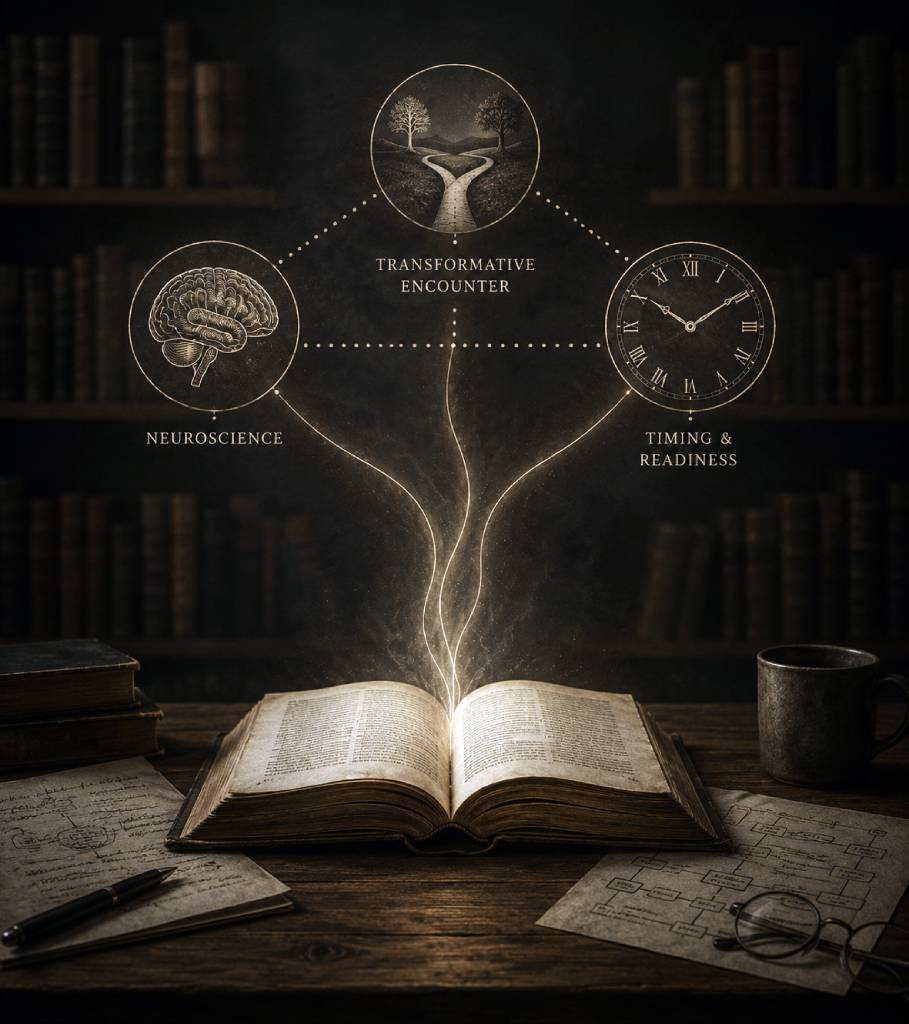
The researcher Thor Magnus Tangerås, in studying readers who reported transformative encounters with literature, identified a recurring structure. The experience began with a period of “readiness”—often a life crisis, a loss, or a state of openness. This was followed by a phase of “transaction,” during which the book seemed to speak directly to the reader’s condition. Finally came “consequences,” as the reader integrated the encounter into their life story. This structure matters because it shifts attention from the book to the reader. The transformative book does not act alone. It meets a reader who is prepared to receive it.
The Four Modes of Engagement
Olivia Fialho’s research on transformative reading identified four distinct modes of reader engagement:
| Mode | Characteristic |
|---|---|
| External enactment | The reader remains distant, often with negative evaluation |
| As-if enactment | The reader shifts from negative to positive judgment |
| Expressive enactment | The reader experiences self-realizations and vivid imaginings |
| Total enactment | The reader undergoes complex emotional engagement and a transformed sense of self |
Most reading is external or as-if. The reader processes information but remains unchanged. Total enactment is rarer, and it is here that the life-changing book does its work.
Ross’s Seven Categories
Ross found that readers described their life-changing encounters across seven categories:
- Awakening: Becoming aware of something previously unknown
- Models for identity: Finding characters who offered ways of being
- Reassurance: Discovering that one’s struggles are shared
- Connection: Feeling less alone
- Courage: Finding permission to act or change
- Acceptance: Learning to tolerate what cannot be changed
- Disinterested understanding: Gaining insight without immediate personal application
Lexithymia: Reading by Heart
Tangerås also coined the term “lexithymia” (from the Greek lexis for word and thymos for heart or emotion) to describe the mode of reading that characterizes transformative encounters. Lexithymia is reading by heart rather than by eye. It engages the body and the emotions as much as the intellect.
Lexithymia is not a skill to be acquired. It is a state that occurs when the reader is ready and the book arrives.
What the Research Does Not Ask
The research is valuable, but it leaves several questions unanswered, and answering those questions is where this article finds its purpose. The studies tell us that transformative reading happens, and they describe its structure and its modes. They do not tell us why the same book transforms one reader and not another, why a book that once mattered can lose its power, or why readers are often reluctant to name the books that have changed them. These are the gaps this article aims to fill.
The Shelf Life of Transformation
A book that changes a reader at one point in life may no longer resonate years later. Does this mean the change was not real? Or does it mean that the question the book answered has been resolved, and the reader has moved on to other questions?
The research describes transformation in the reader but does not follow its arc over time. A longitudinal study might find that most transformative encounters have a shelf life. The book that saves you at nineteen is not the same book you need at forty. This is not a shortcoming of the book or the reader but simply the nature of living.
I first noticed that transformative reading does not always last when I reread a book that had struck me at twenty-two. At forty, the prose seemed clumsy and the insights obvious, but the change was not in me as a reader. I simply no longer had the question the book answered the first time I read it.
The Reader’s Embarrassment
Ross found that readers were not always eager to share the specifics of their transformative encounters. She observed in her interviews that participants were sometimes reluctant to disclose what the books were about or even to name the titles, a hesitation she linked to a desire for privacy. But the hesitation may be something else: the fear of judgment.
A reader who names George Eliot’s Middlemarch (1871) as a life-changing book receives a certain kind of approval, while a reader who names a forgotten paperback from an airport bookstore receives little of it. The life-changing book is often not the book the reader would choose to be seen with. This hesitation is rarely discussed, yet it influences which transformative reading encounters most would acknowledge and which ones they would simply keep to themselves.
Instrumental vs. Existential Change
A book can change the reader in two distinct ways. The first is instrumental: it can teach a skill, provide information, or shift an opinion. This kind of change is measurable and often intentional. The second is existential: it can shift the reader’s sense of self, reorient their values, or alter what they find meaningful. This kind of change is harder to measure, rarely intentional, and almost impossible to predict.
The research, at least in the studies surveyed here, tends to treat these two categories as one, but the difference matters. A reader who finishes a self-help book and starts a new habit has been changed instrumentally, while a reader who finishes a novel and finds that their sense of what matters has shifted has been changed existentially. The second kind of change is rarer and harder to talk about without feeling exposed.
Three Questions for the Reader
Readers trying to understand why certain books have affected them deeply can start with three questions. These questions will not supply final answers, but they can help clarify what happens when a book seems to matter more than others.
- Would this book have landed at a different time? If a book changes you, the timing of the encounter is not incidental. It is the cause. Ask yourself whether the book would have mattered ten years earlier, then ask yourself again whether it will matter ten years from now. You may not know the answer to the second question, but the act of asking it forces you to consider which parts of the book speak to your current situation and which parts might prove less relevant later.
- Has this book changed my behavior or only my feelings? Feelings are easier to produce than actions. A book that leaves you in tears has moved you, but a book that leads you to act differently has changed you. The distinction is not always visible in the moment, but it becomes visible over time.
- What does my inventory of life-changing books reveal about the questions I carry? The books that affect a reader most deeply are not random, for they cluster around questions the reader is already asking. For example, a reader who returns to stories about isolation may be struggling with connection, while a reader drawn to stories about justice may be wrestling with anger. The inventory shows where the questions lie.
The shelf of books I do not lend to others will remain unanalyzed and personal to me. I will not submit them to a typology or score them against Ross’s categories because they are outside the realm of data. They are a record of who I was when I read them years ago and who I became afterwards.
The Reader Who Is Changed
A life-changing book belongs to no single genre and follows no predictable pattern. The same volume that transforms one reader may leave another unmoved, and the difference depends less on the book’s quality than on what each reader brings to it. The book never acts alone, for it meets a reader who is ready or it does not.
This is where the philosophical tradition becomes useful. The Stoics argued that philosophy is not about learning new facts but about attending to what one already knows. A book that changes a reader, on this view, does not supply new information. It supplies attention. The reader who finishes Marcus Aurelius’s Meditations and starts examining their own judgments has not learned a new fact. The reader has been reminded of something already known but previously ignored.
The philosopher Pierre Hadot described ancient philosophy as a set of spiritual exercises designed to transform the practitioner’s way of seeing. Reading, for Hadot, was one such exercise. The reader does not simply absorb arguments but practices a different relation to the self and to the world. A life-changing book is not a text that conveys a doctrine but an instrument that permits a different mode of perception.
This explains why readers are often unable to say what a life-changing book taught them. The book did not teach a fact or a method but a posture, an orientation, or another way of looking at the world. These are harder to name than arguments, but they are no less real. The reader who tries to explain why Meditations mattered may stumble for words, and that hesitation is the whole story.
Is Reading Good for Your Brain? What Neuroscience Reveals About the Literary Mind
The Practice of Literary Attentiveness: How Deep Reading Alters the Experience of Fiction
I have written about related questions elsewhere in this blog, and those pieces helped me think through the arguments in this article. First, my piece about the “Neuroscience of Reading” examines how literature physically alters the brain, a perspective that clarifies why a life-changing book can feel different from any other. My investigation into “Narrative Inundation,” meanwhile, traces the precise textual conditions that produce somatic responses, which gave me the vocabulary for what happens when a book transforms the reader. Lastly, my essay on “Literary Attentiveness” argues that sustained attention changes the reader’s perception over time, a claim that helps explain why a book encountered at the right moment can reorient a life while the same book read later may not. Together, these three pieces address the physiological, architectural, and cognitive dimensions of transformation, which is the question at the heart of this article.
Further Reading
- Can a book change your life? by Siw Ellen Jakobsen, sciencenorway.no
- Can self-help books actually help? by Shona Hendley, Harper’s BAZAAR
- What was the most life changing book you’ve read? on Reddit
- What are some life-changing books to read? on Quora