Explore This Topic
- What is Cyberpunk? A Complete Introduction
- How Cyberpunk Genre Explores Technology in Fiction
- The Philosophy of Cyberpunk: Self, Knowledge, and Ethics in the Machine Age
- Cyberpunk and Critical Theory: Capital, Simulation, Ideology
- Hauntology in Cyberpunk: Gothic Materialism and The Haunted Future
- Global Cyberpunk: Afrofuturism, Techno-Orientalism, Indigenous Futurisms
- Postcyberpunk: Evolution of the Genre
My Reading Note
I came to cyberpunk backward—through Blade Runner as a teenager, then Neuromancer in college, and only recently through the academic criticism that treats the genre as something more than prediction. This guide is what I wish I had read first.
Cyberpunk is a subgenre of science fiction that examines the intersection of advanced technology and social breakdown. Its worlds are recognizably ours, only more so: the same cities, the same corporations, the same inequalities, but amplified until the underlying structures become visible.
The genre is defined by a central tension often summarized as “high tech, low life.” Extraordinary technological progress with artificial intelligence, neural implants, and global data networks coexists with degraded human existence: sprawling slums, lost privacy, bodies that can be bought and sold. The future arrives, but it arrives unevenly.
Unlike space opera, which sends humanity to the stars, or utopian science fiction, which imagines perfected societies, cyberpunk stays close to the ground. Its futures are near enough to feel imminent. Its concerns about surveillance, corporate power, and the meaning of personhood in an age of augmentation, among others, have become our own.
William Gibson once observed that “the future is already here—it’s just not very evenly distributed.” The line captures something essential about cyberpunk, though he never wrote it in any of his novels.
I came across that Gibson quote years ago and assumed it was from Neuromancer. When I finally searched for it, I discovered he first said it during a 1999 NPR interview, long after the novel appeared.
The Term: Cyber + Punk
The word “cyberpunk” joins two distinct lineages.
Cyber derives from “cybernetics,” the mid-century science of control and communication in animals and machines, pioneered by Norbert Wiener. Cybernetics asked how systems (biological, mechanical, social) regulate themselves through feedback loops. From this root, cyberpunk inherits its fascination with networks, information, and the boundary between organism and mechanism.
Punk names the rebellious, anti-authoritarian subculture that emerged from 1970s working-class Britain and the United States. Punk was loud, cheap, and deliberately crude. It rejected the pretensions of corporate rock and the optimism of the previous decade. From punk, cyberpunk inherits its attitude: suspicion of authority, sympathy for outsiders, and a willingness to find beauty in what the culture has discarded.
I have always thought the “beauty in what the culture has discarded” line applies as much to cyberpunk’s own history as to its content. The genre spent the 1990s being pronounced dead, only to have every discarded prediction resurrect itself as a twenty-first-century fact.
This compound word captures the genre’s central paradox. Technology can be an instrument of control, such as in surveillance systems, corporate monopolies, or weapons, but it can also be turned against the powerful. The cyberpunk protagonist is often a hacker, an outlaw, or someone who uses the system’s own tools to fight it. The word promises that the future will have a counterculture.
Bruce Bethke coined the term for his 1983 short story “Cyberpunk,” using it to describe a new kind of juvenile delinquent: computer-hacking, tech-savvy, and alienated. The editor Gardner Dozois popularized the label, and William Gibson’s Neuromancer (1984) cemented it. Within a few years, cyberpunk named not just a handful of stories but a movement, a moment, and a way of seeing.
Core Characteristics of Cyberpunk Literature
What makes a work cyberpunk? The genre has boundaries, but they are permeable. The following characteristics appear with enough frequency to define the form.
- Near-future setting: Cyberpunk does not look centuries ahead. Its futures are close enough to feel like destinations rather than fantasies. The cities are our cities, only more crowded, more polluted, more stratified. Tokyo, Los Angeles, London—these appear again and again, transformed but recognizable.
- Dystopian social order: The state has weakened or vanished. In their place stand corporations, megacorporations, and entities with more power than governments. Citizens become consumers, then assets. The gap between rich and poor is not incidental but structural.
- Human augmentation: Bodies can be modified, enhanced, or traded. Cybernetic limbs, neural implants, genetic engineering—these are not futuristic luxuries but necessities for survival in a competitive world. The question of where the person ends and the machine begins becomes urgent and unanswerable.
What interests me most about this question is how differently various cyberpunk authors answer it. Gibson leaves it open, unresolved, a wound that never heals. Stephenson, in contrast, seems to think the boundary was always an illusion. The difference tells you something about each writer’s deeper commitments.
- Ubiquitous information technology: Networks permeate everything. Cyberspace, in Gibson’s formulation, is a “consensual hallucination,” a digital realm as real as the physical world. Artificial intelligences are not metaphors but characters, with their own agendas and desires.
- Marginal protagonists: The central figures are not heroes in any conventional sense. They are hackers, criminals, couriers, bodyguards—people who work the edges of the system. They are complicit in the worlds they inhabit. Their victories, when they come, are partial and costly.
- Film noir influence: From the hardboiled detective tradition, cyberpunk borrows its visual vocabulary and its moral atmosphere. Shadowy streets, unreliable narrators, femmes fatales, and a sense that the world is corrupt and the best one can do is navigate it with eyes open.
- Thematic pessimism: Technology does not liberate but deepens existing structures of power, makes them more efficient, and harder to escape. The question cyberpunk asks is not whether progress will save us but whether we can survive what progress has already done.
A Brief History of Cyberpunk
I find that most timelines of cyberpunk start with Gibson, as if the genre sprang fully formed from Neuromancer. But the groundwork was laid by writers who asked different questions. Philip K. Dick’s androids dream, but they also question whether they are human. That question became the foundation for everything that followed.
Precursors (1960s–1970s)
Philip K. Dick’s novels established the philosophical ground. Do Androids Dream of Electric Sheep? (1968) asks what it means to be human when the boundary between organic and synthetic can no longer be trusted. His characters inhabit worlds where memory is unreliable, reality is contested, and empathy may be the only remaining evidence of soul.
The New Wave movement of the 1960s and 70s turned science fiction inward, away from technological optimism and toward psychological and social concerns. Writers like J. G. Ballard, Michael Moorcock, and Ursula K. Le Guin treated the future as a space for exploring present anxieties rather than escaping them. Cyberpunk inherited this orientation.
The 1980s Explosion
Gibson’s Neuromancer appeared in 1984 and changed everything. It won the Hugo, the Nebula, and the Philip K. Dick Award—an unprecedented sweep that proved cyberpunk was not a niche but a major development in the genre. Gibson introduced cyberspace, the console cowboy, the sprawl, and a prose style that felt like information downloading directly into the reader’s brain.
Bruce Sterling became the movement’s theorist and anthologist. His collection Mirrorshades: The Cyberpunk Anthology (1986) gathered the key writers—Gibson, Sterling, Pat Cadigan, Rudy Rucker, John Shirley—and articulated their shared project. In his preface, Sterling described cyberpunk as an “integration” of “the realm of high tech, and the modern pop underground”—a fusion of technical sophistication with street-level anarchy.
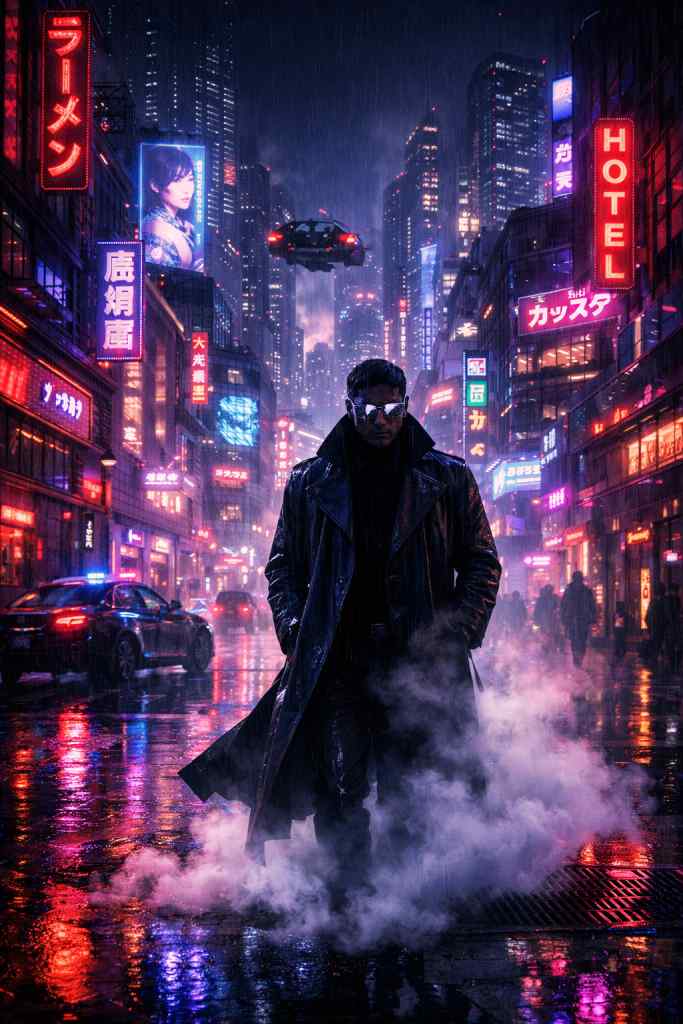
Ridley Scott’s Blade Runner (1982), adapted from Dick’s novel, established the visual aesthetic that would define the genre: rain-slicked streets, towering video screens, Asian-inflected futurism, a city that never sleeps because it cannot afford to. The film arrived before Neuromancer but became inseparable from it.
I first saw Blade Runner on a VHS tape recorded from television, pan-and-scan, with the voiceover that Ridley Scott later removed. For years I thought that compromised version was the film. Discovering the director’s cut felt like learning that my memories had been edited. That experience—of not knowing which version is real—is itself a cyberpunk theme.
Evolution and Diversification (1990s–2000s)
Neal Stephenson’s Snow Crash (1992) introduced a satirical, self-aware strain. Its protagonist is named Hiro Protagonist, its villain carries a virus that affects both computers and humans, and its metaverse—a virtual reality accessible to anyone with the right connection—anticipated the digital worlds that would emerge decades later. Stephenson kept cyberpunk’s concerns but dropped its solemnity.
The 1990s also saw the rise of postcyberpunk, which retained the technological focus but softened the dystopian edges. Works like Stephenson’s The Diamond Age (1995) and Sterling’s Holy Fire (1996) imagined futures where technology might produce genuine improvement, even if the costs remained visible.
Outside the Anglophone world, cyberpunk took different forms. Japanese manga and anime—Akira (1982–1990), Ghost in the Shell (1989–1991), Battle Angel Alita (1990–1995)—brought distinct philosophical preoccupations. Where Western cyberpunk focused on individual consciousness and corporate power, Japanese iterations emphasized collective identity, the nature of the soul, and the possibility of posthuman evolution.
The Western emphasis on individualism explains why so many cyberpunk protagonists are hackers and loners. The Japanese emphasis on the collective explains why Ghost in the Shell’s central question is not “What makes me me?” but “What makes us us?” Both are asking about identity. They just start from different places.
Contemporary Revival
The twenty-first century has seen cyberpunk return with a vengeance, not because the genre changed but because the world did. Surveillance capitalism, algorithmic manipulation, wealth inequality, biohacking, and artificial intelligence now dominate public discourse. Many headlines seem pulled from Gibson’s novel, written more than forty years ago.
Critics now treat cyberpunk as something more than a genre. Fredric Jameson called it “the supreme literary expression if not of Postmodernism, then of late capitalism itself” (1991). Scholars in political theory, technology studies, and cultural criticism have since taken up his observation. Cyberpunk became a lens through which to examine the present, not just a way to imagine the future.
The Cyberpunk Canon
These works provide the foundation. Each is essential, but they are essential in different ways.
| Work | Why It Matters |
|---|---|
| Philip K. Dick’s Do Androids Dream of Electric Sheep? (1968) | Establishes the human/machine boundary as the genre’s central philosophical question. |
| William Gibson’s Neuromancer (1984) | The ur-text. Introduces cyberspace, the console cowboy, the sprawl. No single work has done more to define the genre. |
| Bruce Sterling’s Mirrorshades: The Cyberpunk Anthology (1986) | The movement’s manifesto and its best early short fiction. Shows cyberpunk as a collective project. |
| Neal Stephenson’s Snow Crash (1992) | Satirical, fast, dense. Introduces the metaverse and treats Sumerian mythology as a hacking metaphor. |
| Masamune Shirow’s Ghost in the Shell (1989–91) | The manga that asked: if consciousness can be uploaded, what remains of the self? Its 1995 film adaptation is equally essential. |
| Neal Stephenson’s The Diamond Age (1995) | Postcyberpunk. Nanotechnology, social engineering, and a primer that teaches itself to a girl who should not have access to it. |
| Richard K. Morgan’s Altered Carbon (2002) | Cyberpunk noir. Consciousness is stored on cortical stacks and can be downloaded into new bodies. Murder becomes a property crime. |
Why Cyberpunk Matters Now
When Gibson published Neuromancer, cyberpunk felt like speculation at that time. Readers encountered visions of cyberspace, artificial intelligences, and global data networks as imaginative leaps, daring extrapolations of what might someday come to pass. Now, those technologies have arrived. Surveillance, inequality, and corporate dominance have become the background noise of ordinary life. What once required imagination now requires only attention to the news.
- Technology caught up: When Gibson wrote Neuromancer, the internet was not yet public. Personal computers were novelties. The World Wide Web did not exist. Now we carry networked devices in our pockets, stream our lives to unseen audiences, and worry about algorithms that know us better than we know ourselves. Cyberpunk’s exaggerations read as realism.
- Inequality became the story: The gap between rich and poor, the power of multinational corporations, the erosion of privacy, the conversion of every human activity into data. These are cyberpunk themes that became news headlines. The genre’s dystopias no longer seem like warnings. They now read as reporting.
- The questions are no longer hypothetical: Should we enhance our bodies with technology? Who owns the data we generate? What happens when artificial intelligence surpasses human intelligence? These are no longer questions for philosophers alone but more about policy, ethical, and personal questions. Cyberpunk has been asking them for more than forty years.
- The genre became a method: Critics now use cyberpunk to analyze postmodernism, postcolonialism, feminism, and critical theory. Terms such as cyberspace, the matrix, and the sprawl have entered ordinary language. To think about technology and society is, in some sense, to think within the framework the genre established.
A friend once complained that reading cyberpunk criticism feels like watching people use a hammer on everything they encounter. My response was that when your subject is technology and power, a hammer is exactly what you need. The genre gives us tools. What we build with them is our own responsibility.
Cyberpunk’s concerns did not end with the genre itself. They branched into related territories that reward further exploration. My post on “Biopunk Literature” examines what happens when the focus shifts from digital networks to genetic code. The compilation of “Fiction About AI” traces how writers have imagined artificial consciousness across seven decades, from Asimov’s logical puzzles to Ishiguro’s meditative androids. And the comparative study of “Utopian and Dystopian Fiction” provides the broader political context that cyberpunk inherits and transforms. Together, these three pieces map the literary landscape surrounding the genre.
Further Reading
Cyberpunk on Wikipedia
Cyberpunk Is Alive, Evolving, and More Relevant Than Ever by Lavanya Lakshminarayan, Gizmodo
Which one gives the best introduction to the world of Cyberpunk? on Quora