Explore This Topic
- Literary Theory: A Guide to Critical Frameworks
- Structuralism in Literature: Core Concepts and Analysis
- Reader-Response Theory and the Dynamics of Community Interpretation
- Poststructuralism: A New Approach to Knowledge
- The Death of the Author: Demolition of Author-Centric Criticism
- Marxist Criticism: Theory of Class and Ideology in Literature
- Feminist Literary Criticism: History, Theory, and Analysis
- Postcolonial Criticism: Theory and Analysis
- Ecocriticism: Theory, History, and Literary Analysis
- New Historicism: Reading Literature in its Cultural Moment
- Psychoanalytic Criticism: The Unconscious in the Text
Feminist literary criticism reconfigures the basic premises of literary analysis. This critical method systematically analyzes how literature produces, reinforces, and can potentially subvert structures of gender and power. It questions the authority of a literary tradition formed through the exclusion of women’s voices, and it examines the ideological mechanisms that condition representation.
The following analysis details this critical reconfiguration. It charts the method’s theoretical development, articulates its core analytical frameworks, and assesses its practice of analyzing patriarchal constructs. This assessment provides a structure for understanding a criticism that treats gender not as a marginal concern but as a central category of literary thought.
Genealogy of a Method
The development of feminist literary criticism is best understood not as a linear chronology but as an evolving intellectual argument. Its history comprises distinct phases of theoretical focus, each defined by a central question that expanded the scope and precision of the critical practice. This genealogical account traces the formation of these phases through their foundational texts and conceptual shifts.

The First Phase: Establishing the Critical Problem
The initial phase centered on a diagnostic question: what systemic forces exclude women from literary tradition? Virginia Woolf’s A Room of One’s Own (1929) offered a seminal modern formulation of this problem. Woolf analyzed the material and social constraints that historically prevented women from writing, such as lack of income, privacy, and education. She linked these to a tradition of anonymity and perceived inferiority.
Across A Room of One’s Own and later essays, Woolf argued that a woman writer required economic and intellectual autonomy to resist internalized ideals of self-sacrificing femininity. In “Professions for Women” (1931), she gave this ideal a memorable name, reworking Coventry Patmore’s Victorian figure as the “Angel in the House,” a phantom of compliant domestic womanhood that she insisted women writers must symbolically “kill” in order to write freely.
From this diagnostic foundation, Simone de Beauvoir’s philosophical treatise The Second Sex (1949) supplied a major theoretical cornerstone. Her existentialist analysis, crystallized in the dictum “one is not born, but rather becomes, a woman,” argued that what we call “woman” is produced through social and historical conditioning rather than fixed biological essence, anticipating later accounts of gender as socially constructed. This framework offered a critical vocabulary for examining how cultural and literary traditions naturalize that construction, repeatedly casting women as the relative and oppositional “Other” to the male subject.
The Second Phase: Toward an Autonomous Criticism
Building on this diagnosis, a subsequent phase asked a constructive question: how can criticism recover and define a distinct women’s literary tradition? This period, spanning the 1960s and 1970s, sought to establish feminist criticism as a discipline with its own methods and canon. Elaine Showalter’s work proved instrumental. In her essay “Toward a Feminist Poetics” (1979), she distinguished between two modes: “feminist critique,” which analyzes male-authored texts to expose patriarchal ideology (the “images of women” approach), and “gynocritics,” her proposed central project.
Gynocritics focuses on women’s writing itself, studying “the history, themes, genres and structures of literature by women,” along with the psychodynamics of female creativity, language, and literary careers, in order to construct a female literary culture not defined by male models. This shift from critique of male tradition to study of female tradition marked a decisive turn toward disciplinary autonomy. Concurrently, scholars like Sandra Gilbert and Susan Gubar, in The Madwoman in the Attic (1979), pursued a related project for nineteenth‑century British and American literature. They argued that female authors of the period engaged in a complex, often subtextual rebellion against patriarchal literary authority, encoding their dissent in metaphors of confinement and madness.
The Third Phase: Questioning Unity and Identity
The advancement of gynocritics provoked a new, more skeptical line of inquiry: does the category “woman” or “women’s experience” function as a unitary foundation for criticism? Theorists in the 1980s and 1990s, influenced by poststructuralist thought, challenged the presumed universality and coherence of these terms. This phase centered its analysis on difference and on the instability of identity.
One of the most consequential interventions came from legal scholar Kimberlé Crenshaw, who coined the term “intersectionality” in 1989. Developed within critical race theory, it argues that axes of identity such as race, class, and sexuality are not separate but interlocking systems of power that produce specific, compounded experiences of oppression and privilege that a singular analysis of gender cannot capture. This framework decisively challenged assumptions of a universal female subject and pushed criticism to attend to the specific textual and historical constructions of, for example, Black womanhood or lesbian identity. At the same time, French feminist theorists such as Hélène Cixous and Luce Irigaray, though divergent in approach, both questioned the possibility of women writing within a patriarchal language system. Cixous’s concept of écriture féminine called for a writing practice that would bypass phallogocentric logic, while Irigaray deconstructed the philosophical binaries that exclude the feminine.
The Fourth Phase: Materiality, Embodiment, and Global Context
Recent feminist criticism often synthesizes and extends earlier debates, guided by questions of scope and materiality: how can criticism account for the global, material, and embodied conditions of textual production and reception? This phase is characterized by a renewed commitment to historicist and materialist analysis.
Postcolonial feminist criticism, exemplified by Gayatri Chakravorty Spivak’s “Can the Subaltern Speak?” (1988), insists on analyzing gender within the specific histories of colonialism and imperialism and on questioning which subjects remain silenced even within liberatory discourses. Contemporary work also engages deeply with queer theory and transgender studies, further complicating the relationship between sex, gender, and textual representation.
Furthermore, digital and public humanities methodologies have expanded the archive. These approaches apply feminist critique to new media forms and popular culture, and they work to democratize scholarly access. This phase does not reject prior frameworks but insists on their application within concrete, situated, and often transnational contexts, examining the material circuits of publication, translation, and reception that condition a text’s significance.
Theoretical Frameworks: From the Gaze to Écriture Féminine
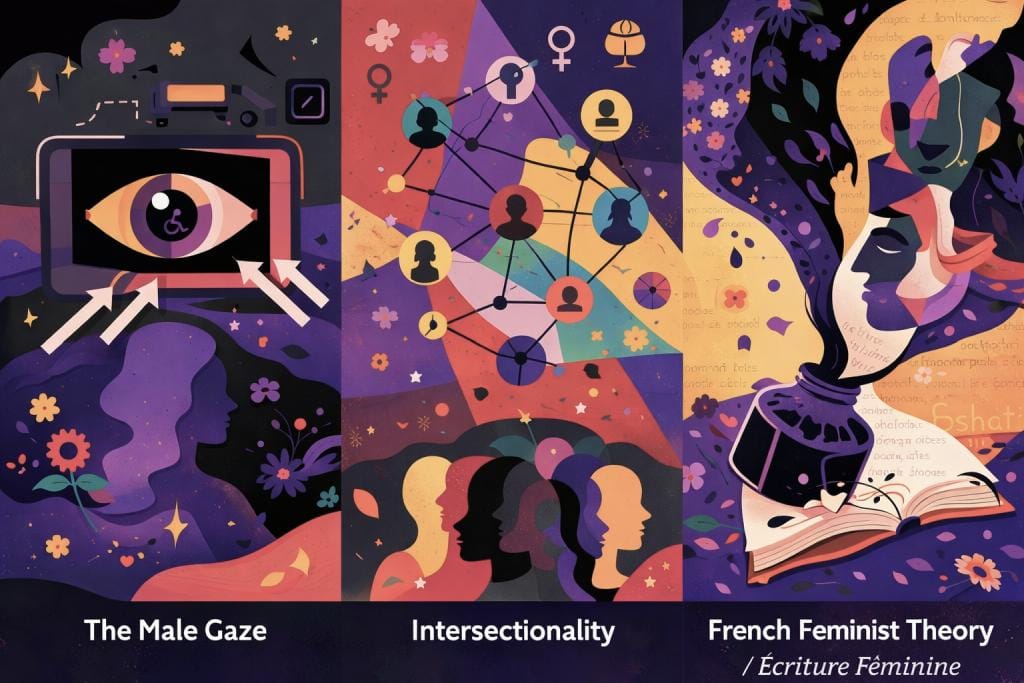
The evolution of feminist literary criticism produced distinct theoretical frameworks. These frameworks provide specific analytical tools for interpreting texts. They address the representation of women, the politics of authorship, and the relationship between language and identity.
The Male Gaze and the Politics of Representation
A primary framework analyzes visual and narrative representation through the concept of the male gaze. Film theorist Laura Mulvey popularized this term in her 1975 essay “Visual Pleasure and Narrative Cinema.” Mulvey argued that classic Hollywood cinema typically constructs the spectator as a heterosexual male subject. The camera and narrative logic frame female characters as objects of visual pleasure for this spectator, denying them subjective agency.
Literary criticism adapted this concept to analyze narrative point of view and descriptive language. It examines how texts position the reader to view female characters through a patriarchal lens, reducing them to symbols, objects of desire, or moral archetypes. This framework enables a critique of how representation itself can enact a form of symbolic power that conditions the reader’s perception of gender roles.
Intersectionality and the Critique of Universality
The framework of intersectionality profoundly complicated feminist analysis. For literary criticism, it demands that analysis account for the simultaneous operations of race, class, sexuality, and nationality alongside gender. It challenges the presumption of a universal female subject (often implicitly white, middle-class, and heterosexual) that underpinned some earlier feminist criticism. An intersectional reading examines how a character’s identity at the crossroads of multiple systems of power generates specific narrative constraints and possibilities. This framework necessitates a more precise historicism and has driven the recovery and study of literary works by women of color, queer women, and writers from the Global South.
French Feminist Theory and the Question of Language
A distinct framework emerged from poststructuralist thought in France during the 1970s. Often grouped as “French feminist theory,” its proponents shared a focus on the relationship between gender, language, and psychoanalysis. Cixous, in her manifesto “The Laugh of the Medusa,” argued that Western thought and language are structured by phallocentrism/phallogocentrism that privileges masculine subjectivity and authority. She called for an écriture féminine (feminine writing), a practice that would erupt from outside this system by foregrounding fluidity, bodily experience, and nonlinear expression.
Similarly, Irigaray, in essays collected in This Sex Which Is Not One (1977), deconstructed philosophical and psychoanalytic discourses to argue that femininity has been defined only as a lack or negative mirror of masculinity. She sought to theorize forms of female subjectivity and speech that would not remain confined to masculine models. While often critiqued for tendencies toward biological essentialism, this body of work raised enduring questions about whether a patriarchal language system can adequately articulate female experience or whether it must be subverted and reworked from within.
Acts of Reclamation: Rereading the Canon
Feminist literary criticism is fundamentally a critical practice. Its theoretical propositions achieve their full expression through applied acts of rereading. This practice re-examines established texts to expose their operative gender ideologies and to recover subversive potential within them. It also works to reconstruct literary history by centering marginalized authors.

Diagnosing Patriarchal Constructs in the Canon
A primary practice involves a critical dissection of canonical, often male-authored, literature. This reading strategy does not seek to dismiss these works but to analyze the specific mechanisms through which they articulate and naturalize patriarchal power. A foundational example is the re-evaluation of William Shakespeare’s The Taming of the Shrew. A traditional reading might frame the play as a farcical battle of the sexes culminating in comedic harmony. A feminist critique analyzes it as a dramatic representation of patriarchal domination by examining how the character Petruchio systematically breaks Katherine’s spirit through deprivation and psychological manipulation.
The critic interprets the play’s final speech on spousal duty as a performance of enforced submission that reveals its underlying logic of control. This diagnostic practice extends to analyze archetypes like the angelic heroine, which function as ideological containers to limit the representation of complex female experience.
Recovering Voice and Agency: The “Madwoman” and Beyond
A complementary practice seeks to recover voice and agency where previous criticism perceived silence or pathology. Gilbert and Gubar’s seminal work The Madwoman in the Attic established this model through its reading of nineteenth-century literature. They argued that female authors like Charlotte Brontë and Emily Dickinson wrote within a literary tradition that defined authorship as a masculine, god-like act of creation.
To enact this covert rebellion, Gilbert and Gubar created heroines who operated within and against narrative constraint. They reinterpreted the figure of Bertha Mason, the confined “madwoman” in Brontë’s Jane Eyre (1847), not as a simple villain but as the violent, repressed double of the novel’s civilized heroine, Jane. Bertha’s rage becomes a symbolic expression of the author’s own constrained fury against patriarchal confinement. This practice of recuperative reading identifies coded protest, subtextual anger, and strategic negotiation within texts by women, transforming characters once read as monstrous or passive into figures of latent resistance.
Excavating and Centering a Female Tradition
The most expansive reclamatory practice is the excavation and scholarly establishment of a female literary tradition. This work, initiated under the framework of gynocritics, moves beyond critiquing the existing canon to actively build a counter-canon. It involves several concerted efforts: the bibliographic recovery of out-of-print texts by women; the historical analysis of the conditions that enabled or inhibited women’s writing; and the formal analysis of themes, genres, and styles that recur across women’s literary production.
This practice has brought writers like Zora Neale Hurston, Kate Chopin, and Christina Rossetti from the periphery to the center of literary study. It has also redefined periods and genres, demonstrating how the nineteenth-century novel reflected the contributions of Jane Austen and George Eliot alongside those of Charles Dickens, or how the Gothic genre provided a vehicle for women to explore themes of female entrapment and transgression. By constructing this tradition, feminist criticism alters the very landscape of literary history, challenging the criteria of value and importance that once excluded these works.
Applying an Intersectional Lens
An intersectional analysis transforms the practice of reclamation by refusing a singular category of “women’s writing.” A critic employing this lens does not simply add the work of a Black author to a pre-existing feminist canon. The analysis instead examines how a specific axis of identity, such as race, fundamentally structures a text’s narrative concerns and literary form.
For instance, a reading of Toni Morrison’s Beloved (1987) through this lens would centralize how the legacy of slavery complicates motherhood, community, and selfhood in ways that a gender-only analysis could not capture. Similarly, reading Jean Rhys’s Wide Sargasso Sea (1966) involves understanding how the protagonist’s oppression is simultaneously gendered, racialized, and rooted in colonial economics. This practice prevents the homogenization of female experience and insists that reclamation must account for multiple, interlocking systems of power.
Limits and Horizons
The critical power of feminist literary criticism derives directly from its specific historical and theoretical commitments, which also delineate its boundaries. Its foundational premise, that gender is a constitutive category of analysis, can be challenged by perspectives that question the stability and universality of the categories “woman” or “female experience.”
Poststructuralist, queer, and trans theories argue that these categories are themselves discursive productions. An analysis anchored to them may inadvertently reinforce binaries or exclude non-binary and transgender subjectivities. Furthermore, the method’s traditional focus on textual representation can encounter a limit when addressing the material circuits of global literary production, including the economics of publishing and the politics of translation.
These acknowledged limits do not diminish the field’s achievements, however, but chart its necessary evolution. Contemporary criticism engages with queer theory, integrates materialist methods, and develops transnational frameworks. It also moves from a corrective project focused on a Western canon to a more expansive inquiry into how literature encodes power across diverse cultural formations.
Consequently, feminist literary criticism continues to operate as a dynamic and dialectical critical practice. It maintains its focus on gender and power while subjecting its own scope and assumptions to consistent examination. This capacity for self-revision secures its function as a necessary tool for analyzing literature and asserting the complexity of marginalized voices within the history of letters.
This essential critique of patriarchal structures and gender representation powerfully intersects with other political frameworks like Marxist and Postcolonial theory. See how these conversations connect in our definitive overview, Literary Theory: A Guide to Critical Frameworks.
Further Reading
- 40 Essential Feminist Books to Read for Women’s History Month by Lauren Hubbard, Keely Weiss and Chelsey Sanchez, Harper’s BAZAAR
- A Feminist Critique of Murakami Novels, With Murakami Himself by Mieko Kawakami, Literary Hub
- Literary Theory Series: Challenging Gender Dynamics in Literature by Daniela Sandoval, Arcadia
- Books about Feminist literary criticism by BiblioVault