Explore This Topic
- The Short Story as a Way of Seeing: A Reader’s Perspective of the Form
- How the Short Story Works: A Reader’s Guide to the Form
- The Reader’s Experience: What It Feels Like to Read a Short Story
- What Short Stories Help You See: Themes of Human Experience
- The Short Story Collection as a Field of Vision
- Short Story Writers as Teachers of Seeing: Ten Masters of the Form
- The Short Story Canon: Who Gets to Stand for the Genre?
- The Short Story Today, in an Age of Screens and Divided Attention
- A Reader’s Practice: How to Train Your Eye for Short Stories
My Reading Note
I remember when the argument that short fiction is “perfect for our distracted age” started appearing in literary discussions. It seemed to me a strange way to defend the form—by treating it as a convenient solution to a problem it could not possibly solve. To me, short stories demand the kind of attention that reading them on a phone or browser often works against. This article is my attempt to understand the short story now, in an age of constant digital distraction.
The short story has always occupied an awkward position in literary culture. It is shorter than the novel, which makes it seem less substantial, and longer than the poem, which makes it seem less intense. In the twenty-first century, this awkwardness has only deepened. Reading a short story on a screen encourages distraction, and the algorithms that govern our reading environments reward content that is consumed quickly.
Yet the short story continues to find readers. It appears on screens, in audio, and across digital platforms. But the conditions of reading have changed, and those changes have raised questions about the form’s future. Can a short story hold our attention when a notification is never more than a swipe away? What does it mean to read a story on a phone or to listen to one on a podcast? And is the argument that short stories are “perfect for our distracted age” a defense of the form or a concession to the conditions that threaten it?
The sections that follow examine these questions, beginning with the most immediate challenge: the screen.
Can the Short Story Survive the Screen?
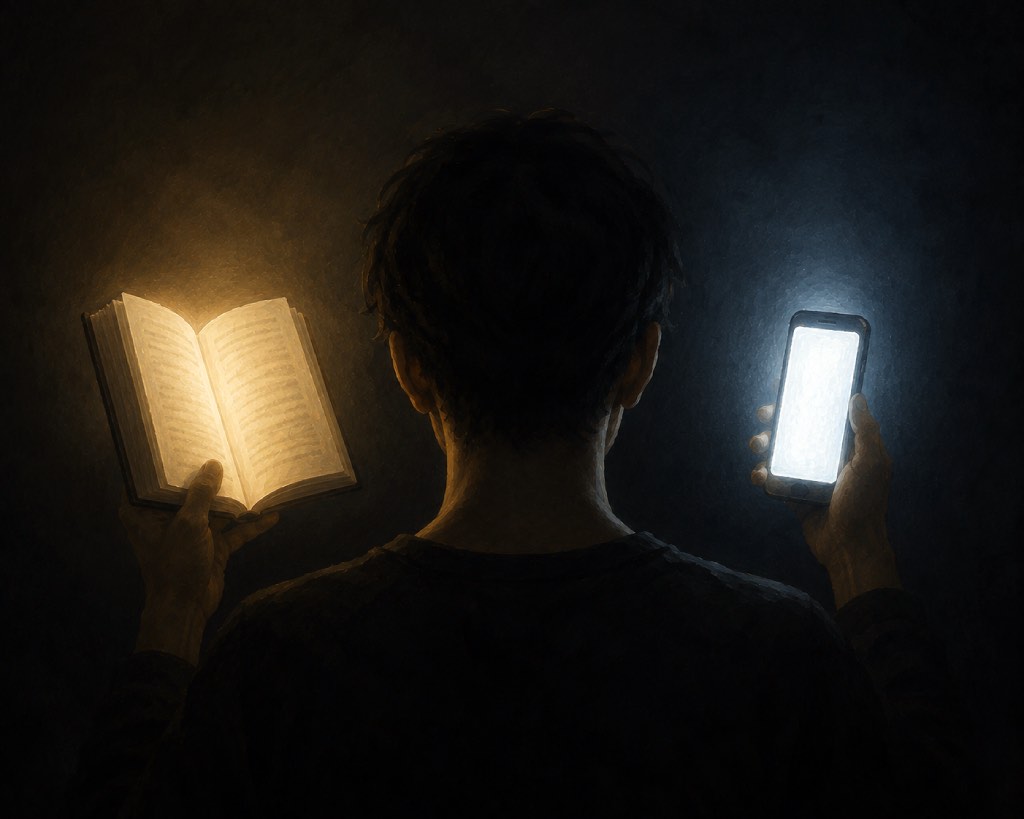
The screen is often considered a threat to the short story—reading on a phone or tablet is different from reading on paper. The screen makes skimming easy and encourages switching between tasks, whereas reading on paper tends to encourage deeper focus. A story that takes twenty minutes to read on paper might take longer on a screen because the screen can sometimes pull attention away.
Yet the screen also offers opportunities. The short story is the ideal form for digital reading—short enough to be read in a single sitting, substantial enough to reward the time. Platforms like Kindle and Apple Books have made short stories more accessible than ever, and online literary magazines have lowered the barriers to publication. The screen is not the enemy of the short story but a new medium for it.
I still prefer reading short stories on paper. But I have also read stories on my phone during commutes, and I have found that the medium changes the experience. The same story reads differently on a screen—more urgent and more compressed. That is not necessarily a loss.
Short Stories as Podcasts: Listening vs. Reading
The rise of audio has created a new way to encounter short stories. Podcasts like The New Yorker: Fiction and Selected Shorts bring stories to listeners in a format that does not require sitting still. The story becomes an auditory experience, and the listener can engage with it while driving, walking, or doing other tasks.
Audio changes the reading experience. A story read aloud has a different rhythm from one read on the page; the voice of the narrator affects how the story is heard. Silence, pacing, and emphasis become part of the experience. Some stories work better in audio, while others lose something in translation. The rise of audio does not replace reading, but it adds a new dimension to the form.
I have always preferred reading short stories on the page to listening to them on audio. When I read, I can control the pace, pause to reflect, and linger on a sentence. Audio moves at its own speed, and I find that I miss the texture of the language when I cannot see it.
The Online Literary Magazine Boom
The internet has democratized literary publishing. Online literary magazines have proliferated, and they have made short stories more accessible than ever. A writer can now reach thousands of readers without a book deal or an agent. The barriers to publication have lowered.
But the boom has also created new problems. The sheer volume of stories available online makes it harder for any single story to stand out. The attention that readers devote to online stories is often less sustained than the attention they give to print. The story that is read on a screen is also more likely to be skimmed or abandoned.
I have read stories in online magazines, and the experience is different from reading a print journal. The screen makes the story feel provisional, as if it were waiting to be replaced by the next thing. That is a problem that publishers have not yet solved.
The Argument That Short Stories Are “Perfect for Our Distracted Age”
The argument that short stories are “perfect for our distracted age” has become a common defense of the form. It suggests that short stories are the ideal reading material for people who do not have time for novels. It treats the short story as a convenience, a quick fix for limited attention.
But the argument misunderstands the form. The short story is not easier to read than the novel. In fact, it is harder. Its compression requires more attention, and the reader must fill in gaps, hold contradictions, and track patterns across a few pages. The short story does not accommodate distraction but demands focus, and to call it “perfect for our distracted age” is to apologize for the form rather than to celebrate it.
I have always disliked the “perfect for our distracted age” argument. It treats the short story as a fast-food version of literature, something to be consumed quickly and forgotten. The short story deserves better than that.
Why the Short Story Matters Now
The short story matters now for the same reasons it has always mattered. It offers something the algorithms and feeds do not: a space where the reader must follow a line of thought to its end, even when the temptation to move on is strong. In an age that rewards speed, the short story moves at its own pace and, where clarity is prized, leaves room for ambiguity. These are not marketable qualities, but they are necessary ones.
The short story is not a convenience. It is not a quick fix for limited attention. It is a form that asks the reader to engage with the world more deeply. That is why it has survived, and that is why it will continue to survive.
What is Microfiction? A Short Guide to Very Short Stories
While this article considers the short story in a digital age of constant distraction, my earlier posts—”Short Story vs. Novella” and “What Is Microfiction?”—offer a useful formal counterpoint. The first post clarifies how word count influences reader expectations and narrative structure, a framework that becomes especially relevant when stories are consumed on screens that reward brevity. The second post examines the extreme end of compression, where stories are distilled to their essence, raising questions about attention and meaning that resonate with this article’s concerns about how we read now.
Further Reading
- Your attention didn’t collapse. It was stolen by Johann Hari, The Guardian
- Digital age brings revival of the short story by Leslie Kaufman, The Seattle Times