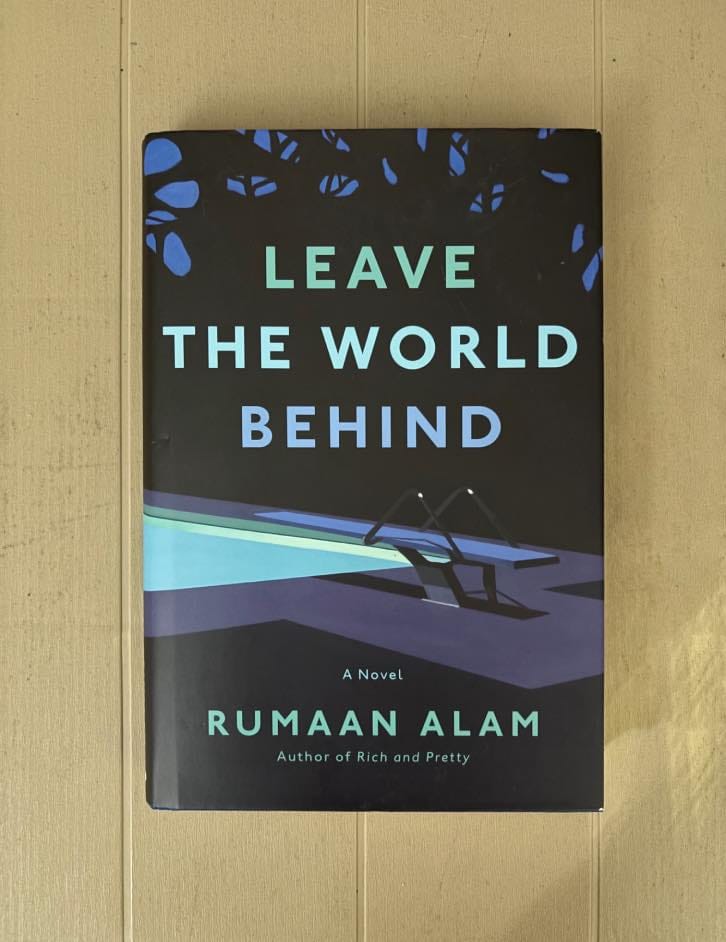
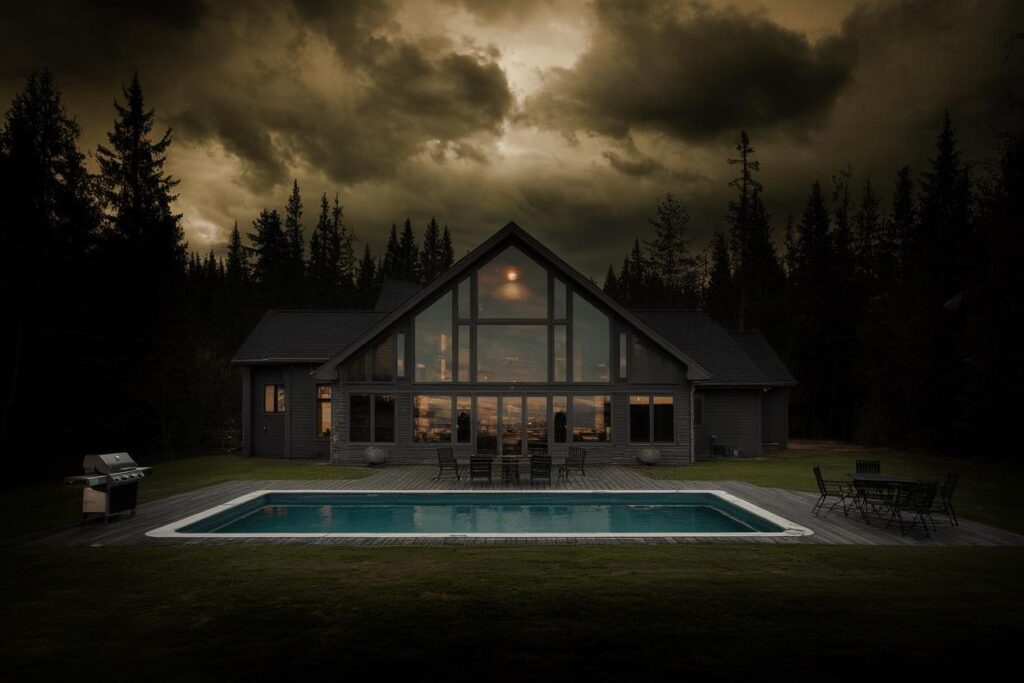
A vacation home stands empty in remote Long Island, awaiting occupants who anticipate a predictable kind of escape. This expectation forms the first layer of a story designed to dismantle every assumption it establishes. Rumaan Alam’s novel, Leave the World Behind (2020), initiates a precise and ruthless operation. It assembles two families within this borrowed space and applies the steady, inexplicable pressure of a distant national crisis. The resulting narrative examines the immediate disintegration of the social and psychological materials from which ordinary life is built.
Amanda and Clay, with their children Archie and Rose, rent this remote Long Island house. Their retreat ends with the late-night arrival of the homeowners, G. H. and Ruth Washington, who bring news of a widespread New York blackout. This unexpected merging of strangers under a shared, undefined threat establishes the novel’s central tension. Unexplained events accumulate—erratic animal behavior, lost communications, distant sounds. The holiday house becomes a closed system where unspoken social and racial tensions become visible. The novel’s distinct power comes from its restraint. The global catastrophe remains offstage, while its full effect registers only through the subtle flaws within the private world of the house.
Themes and Narrative Techniques
Thematic Focus
The novel stages a decisive collision—it brings together a family renting a remote vacation home and the Black homeowners of the property. Their meeting occurs against the backdrop of a developing national emergency. This scenario does not simply depict a disaster; it engineers a specific social experiment. Race and class cease to be abstract concepts. They become active conditions that govern every interaction, every unspoken judgment, every distribution of space and resource within the confined house.
The emergency operates with surgical effect, removing the customary scripts of social interaction. The characters’ polished identities lose their internal logic; the routines and environments that constructed those identities now offer no support. What surfaces, then, are elemental negotiations. These negotiations concern power, suspicion, and the immediate imperative of securing territory, both physical and emotional, for oneself and one’s children. The novel presents parenthood stripped of sentiment, a raw condition of heightened vulnerability, where the duty to protect transforms into a state of continuous perilous alertness.
Narrative Architecture
Alam builds his narrative with a close third-person perspective that moves between characters, focusing on Amanda and G. H. This shifting viewpoint establishes competing versions of reality. One character defines an event—the cause of a blackout, the intent behind a statement—through the lens of personal anxiety or bias. The subsequent narrative shift introduces a contradictory definition grounded in a different set of fears or social assumptions. This technique denies the reader a stable, authoritative version of events, replicating the characters’ own disorientation.
The prose adopts a specific rhythm by favoring short and declarative sentences, a technique that creates a taut, percussive effect. The rhythm mirrors the characters’ sharpened attention and the fragmentation of their reasoning. The narrative structure abandons traditional plot progression; it cultivates unease through accretion, saturating an ordinary setting with a gradual, pervasive sense of dread.
Literary Craft and Influences
Prose and Technique
Alam’s prose operates with a distinct lexical economy, employing a restricted vocabulary to generate its particular power. Slight repetitions gather across the narrative—a recurring phrase, a remembered object, a persistent worry—until they form a chorus of unspoken anxiety. This minimalist technique offers the reader no solace in explanation, focusing attention instead on the smallest behavioral details: the specific angle of a hand resting on a countertop, the exact texture of a shared silence. The novel’s shifting, dueling perspectives document the failure of mutual understanding more than they cultivate empathy. They reveal the precise architecture of isolation as it is maintained within physical closeness.
Literary Context
The novel operates within a tradition of American unease. It shares with Shirley Jackson a preoccupation with the paranoia that underpins ordinary life and with Don DeLillo a focus on the media’s spectral presence in catastrophe. Alam’s primary influence, however, appears to be the thriller genre. He adopts its foundational mechanics—the isolated setting, the escalating threat—and redirects their energy inward. This inward focus repurposes the genre’s architecture, with the aim of getting the reader’s attention fixed on the meticulous documentation of a social fabric coming apart. The resulting suspense arises, then, from the precise observation of social bonds fraying under unseen pressure, moving past concern for the actual source of the disaster.
Symbolic Operation: The Deer
A representative instance of the novel’s symbolic method occurs in Rose’s encounter with a herd of deer. The passage does not treat the animals as allegory but deploys them as a phenomenological instrument. The description proceeds through a graduated series of perceptual adjustments: “a deer,” then “five deer,” then “dozens,” then the imagined perspective of “hundreds, even more than a thousand.”
This progression performs two key functions. First, it formally replicates the mechanism of the larger crisis: a manageable oddity that expands beyond the frame of comprehension. Second, it dramatizes the condition of solitary witness. Rose occupies a position separate from the adults, whose conversation inside the house represents a failing system of knowledge. The deer exist outside that system. They constitute a concrete, silent fact that exceeds available language and social categories. Their symbolic function resides in this objective, overwhelming presence—a natural world proceeding on a scale and logic that renders the human anxieties of the house both transient and small.

Final Assessment
Leave the World Behind constructs a severe diagnostic of its historical context, operating as a meticulous study of the social, racial, and psychological materials from which ordinary life is assembled. Under the specific and sustained pressure of its scenario, their inherent fault lines become starkly visible. The book’s significance is anchored in this diagnostic clarity, which supplies a precise vocabulary for the anxieties defining its era and houses that vocabulary within the persistent, exacting logic of narrative suspense. Alam’s accomplishment is a work defined by the sharp and lingering pertinence of its central inquiry.
Selected Passage with Analysis
She wanted to say “A deer,” but there was no one there to hear her. She looked over her shoulder into the house and saw her parents talking. She wasn’t supposed to go in the pool, but she wasn’t going to go in the pool. She walked down the steps onto the damp grass and the deer just watched her, barely curious. She hadn’t even seen that there was another beside it—no more. There were five deer, there were seven; every time Rose adjusted her eyes to try to understand what she was seeing, she was seeing something new. There were dozens of deer. Had she been up higher, she’d have understood that there were hundreds, even more than a thousand, more than that, even. She wanted to run inside and tell her parents, but she also wanted to just stand there and see it.
Pages 76-77, Leave the World Behind by Rumaan Alam
In this passage, Rumaan Alam explores themes of isolation, perception, and nature’s overwhelming presence. While her parents remain absorbed in their conversation inside the house, Rose experiences a solitary and transformative encounter, emphasizing the divide between the safety of domestic spaces and the unknown that lies beyond.

The imagery in this scene enhances its tension and surreal quality. Alam’s use of sensory details, such as the "damp grass" and the still, watchful deer, immerses the reader in Rose’s point of view. The gradual escalation from a single deer to “dozens,” and finally the suggestion of "hundreds, even more than a thousand," reflects the malleability of perception.

Symbolically, the deer embody both beauty and unease, challenging the characters' fragile sense of control. Rose’s hesitant movement from the house to the wild mirrors a boundary crossing — both literal and psychological — amplifying the tension between innocence, curiosity, and fear.
Further Reading
Rumaan Alam | The True Horror in Leave The World Behind by Fane Productions, YouTube
‘Leave the World Behind’ Ending Explained: Author Rumaan Alam on the Significance of ‘Friends’ and the Accuracy of That Final Theory [spoilers] by Caroline Brew, Variety
How Netflix’s Leave The World Behind Adaptation Differs From the Book [spoilers] by Cady Lang, Time