
My Reading Note
In my early years as a book blogger, How Fiction Works kept appearing in the recommendations of critics I admired. I read it with the enthusiasm of someone discovering a new language for talking about prose. I admired it then, and I still admire much of it. But I have come to see that its clarity comes at a cost. This article is the result of years of testing his method against novels that refuse to submit to it.
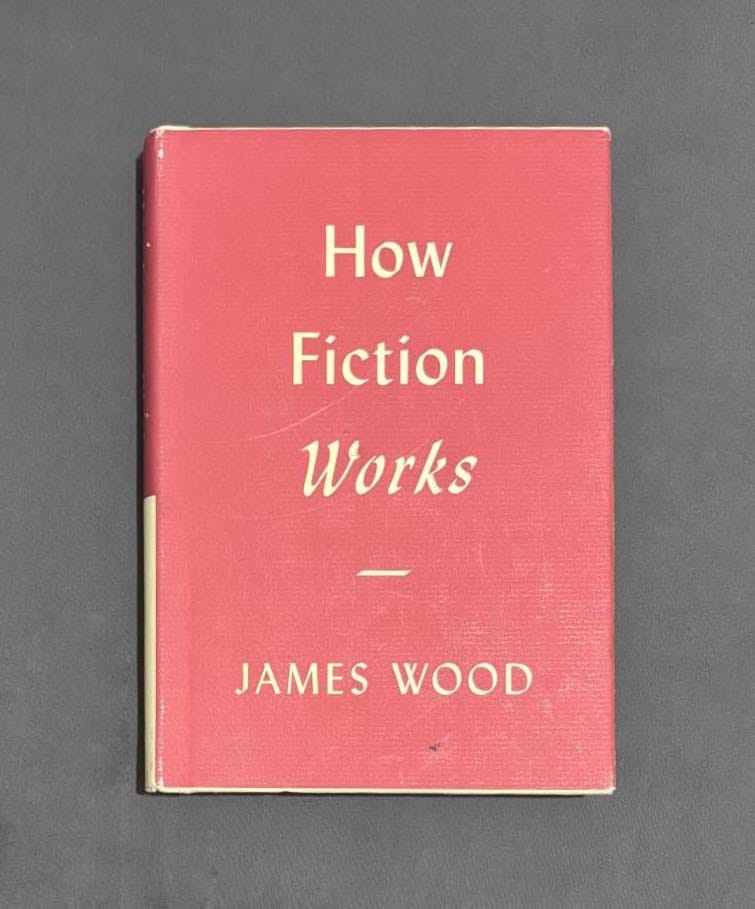
Among contemporary literary critics, James Wood is both the most celebrated and the most contested. His reviews in The New Yorker, his essays collected across eight volumes, and his seminal How Fiction Works (2008) have influenced how a generation of readers approaches the novel. Yet the vast literature on Wood tends to repeat the same biographical arc. What has gone unexamined is the structure of Wood’s method: what it systematically excludes, how his own fiction fares under its own criteria, and how his institutional positions altered the course of contemporary criticism.
This article argues that Wood’s critical method, for all its evident achievements, functions as a lens that sharpens certain traditions while rendering others invisible; that his own novels, judged by his own standards, fall short of the Flaubertian realism he champions; and that his institutional influence has narrowed the terms of literary debate even as it has elevated the practice of close reading. The aim is not to dismiss Wood but to understand what his method makes possible—and what it forecloses.
What Wood’s Method Excludes: A Map of Invisible Traditions
Wood’s critical philosophy is rooted in a specific account of literary realism, one he traces to Gustave Flaubert. Flaubert’s innovations—free indirect style, the effacement of authorial judgment, and the meticulous attention to the detail that reveals character—constitute, in Wood’s telling, one of the fundamental achievements of the modern novel. “There really is a time before Flaubert and a time after him,” Wood writes. “Flaubert decisively established what most readers and writers think of as modern realist narration, and his influence is almost too familiar to be visible.”
What Flaubert introduced, Wood argues, was a new kind of prose: “it favors the telling and a brilliant detail; that it privileges a high degree of visual noticing; that it maintains an unsentimental composure and knows how to withdraw, like a good valet, from superfluous commentary; … and that the author’s fingerprints on all this are, paradoxically, traceable but not visible.” This is not merely a historical claim but a prescriptive one. Wood often treats departures from this model with skepticism or, at best, as interesting aberrations.
I have always been struck by how much Wood’s critical vocabulary—cadence, pitch, and free indirect style—draws from musical language. He began as a chorister at Durham Cathedral and won a music scholarship to Eton. There is something in his method that listens for prose the way a musician listens for pitch. This would explain why he hears “excess” where others hear invention.
What remains invisible in this account are the novelistic traditions that do not submit to Flaubertian scrutiny. A systematic mapping reveals at least five major traditions that Wood’s method struggles to accommodate:
- The Picaresque: From Miguel de Cervantes to Saul Bellow, the picaresque novel often privileges episodic structure, social range, and narrative momentum over the sustained interiority Wood prizes. Wood’s treatment of Bellow is instructive: he praises his sentences but regularly frets over the “excess” and “digression” that are, in this context, structural features of a picaresque-inflected form.
- The Philosophical Novel: Dostoevsky, whom Wood often approaches with skepticism even as he acknowledges his importance, represents a tradition in which ideas contend with characters on equal terms. What Wood hears as “ideological strain” is, from another perspective, precisely the quality that makes Dostoevsky essential: his willingness to let argument deform and enlarge the novel’s form.
- The Gothic and the Fantastic: Wood’s criticism has comparatively little to say about genres that depart from realism altogether, especially given how extensively he has written on the realist tradition. The tradition that runs from Horace Walpole to Shirley Jackson to M. John Harrison follows a different set of assumptions about what fiction can do—assumptions Wood’s method lacks the vocabulary to address.
- The Sentimental Novel: From Samuel Richardson to Charles Dickens to contemporary genre romance, the sentimental tradition foregrounds feeling, moral legibility, and cathartic resolution in ways that often sit uneasily with Wood’s preferred models of psychological ambiguity and tonal restraint. Rather than asking how these works generate and organize emotion for their readers, Wood tends to treat overt sentimentality as an aesthetic flaw, which leaves him largely disinclined to account for what makes such novels work so powerfully for millions of readers.
- The Social Novel: From Elizabeth Gaskell and Dickens to contemporary writers of politically engaged fiction, the social novel foregrounds institutions, class relations, and collective struggle alongside individual psychology. Even when Wood writes about novelists in this tradition, his emphasis tends to fall on the textures of individual consciousness and style, so questions of structure, class, and power often recede into the background of his readings.
This is not to say Wood’s method is wrong but that it is partial. It provides a powerful lens for reading one tradition while rendering others invisible. The problem is not that Wood lacks taste, but that he mistakes it for a universal standard.
Wood’s Fiction as a Test of His Own Principles
Wood has published two novels: The Book Against God (2003) and Upstate (2018). A rigorous test of his critical method would be to ask, “Do these novels achieve the Flaubertian realism he preaches?” The answer highlights a significant gap between Wood’s criticism and his own creative practice.
The Book Against God is a first-person narrative about a doctoral student losing his faith. Formally, it is confined to first-person confession and thus does not employ free indirect style at all. The narrative is confined to a single, unreliable consciousness rendered through first-person confession. By Wood’s own criteria, this is a less sophisticated form than the Flaubertian method he champions—structurally, it is closer to Dostoevsky’s Notes from Underground (1864) than to Madame Bovary (1856). The novel’s intellectual ambition (it is, in effect, a novelized argument about faith) places it squarely in the philosophical tradition Wood’s criticism struggles to accommodate.
The gap between Wood’s criticism and his fiction has always interested me. The Book Against God reads like a novel written against the grain of his own method. I wonder if he felt, in writing it, the limits of what his criticism could accommodate.
Upstate is closer to the Flaubertian model: a limited third-person narrative that moves among the consciousnesses of several family members, rendered largely through free indirect style. Yet the novel’s restraint—its refusal of “hysterical” excess and its commitment to the quiet register Wood prizes—produces a curious effect. The novel is so determined to avoid the faults Wood diagnoses in others that it risks becoming an exercise in negative capability: a demonstration of method rather than a work that stands on its own.
If Wood’s method were correct, his own novels should exemplify the Flaubertian realism he champions. Yet The Book Against God departs from that model entirely, and Upstate reads more like a demonstration of critical principles than a novel driven by its own internal necessity. The gap between Wood’s criticism and his fiction suggests that his method may be better suited to analysis than to creation—and that the novel, left to its own devices, tends toward forms his criticism cannot fully account for.
The Institutionalization of Wood’s Method
Wood’s influence cannot be understood without examining the institutional positions that amplified his voice. He became a leading critic at The Guardian at twenty-seven, moved to The New Republic in 1995, and joined The New Yorker in 2007. He has taught at Harvard since 2003. Each of these institutions left its mark on his method, and he left his mark on them in turn.
The New Yorker Years (2007–present)
Wood’s tenure at The New Yorker has overlapped with a broader shift in American literary culture: the elevation of the “well‑made sentence” as a central marker of literary seriousness. His reviews, with their relentless attention to prose style, have helped codify this emphasis. Many younger critics have adopted his vocabulary—cadence, pitch, and free indirect style—and his habit of extended quotation followed by close parsing. In some venues, this has produced criticism that can parse a sentence beautifully while saying relatively little about structure, genre, history, or ideas.
Harvard and the Training of Critics
Wood has taught a course at Harvard on “The Theory and Practice of Criticism” for around two decades. Many of his students have gone on to work at major literary publications. This is not conspiracy but institutional reproduction: a method taught by a master critic to successive cohorts of aspiring critics. The consequence is a critical culture that prizes the kind of attention Wood models and struggles to recognize other modes of literary achievement.
The How Fiction Works Effect
Published in 2008, How Fiction Works became the most influential book on the craft of fiction since E. M. Forster’s Aspects of the Novel (1927). It is widely assigned in creative writing programs and often cited in reviews as an authority; it has significantly defined how many writers and critics think about literary technique. Yet the book’s influence is also its limitation: it teaches one way of reading—the Flaubertian way—as though it were the only way.
I do not think the institutionalization of Wood’s method was orchestrated. But it remains a problem. A single method, however powerful, cannot account for everything the novel does. The task for critics coming after is not to reject Wood but to expand the range of what counts as literary criticism.
Wood’s institutional influence has been both productive and narrowing. It has elevated the practice of close reading, trained a generation of critics to attend to prose style, and produced a body of criticism that rewards patient attention. But it has also narrowed the range of what counts as literary criticism, marginalizing approaches that prioritize historical context, genre analysis, intellectual history, and formal experimentation that departs from Flaubertian norms.
Synthesis: Wood and the Two Criticisms
The German critic Theodor Adorno, in his essay “The Essay as Form,” argued that criticism must perform two seemingly incompatible functions: it must submit itself to the work’s demands, attending to its particularity, while also bringing to bear the critic’s own concepts and categories. Wood’s method excels at the first function. His close reading is a form of submission, a willingness to be formed by the text. Where it falters is in the second function: the concepts Wood brings to bear—realism, free indirect style, and “serious noticing”—are treated as transparent, as though they simply described the texts rather than actively determining what he sees.
To name these categories as commitments rather than laws is not to diminish Wood’s achievement but to clarify it. His method is a powerful lens, but it’s not a universal standard. What it makes visible is real; what it renders invisible, however, is not an oversight to be corrected but a limit to be acknowledged. The task for the next generation of critics is not to abandon Wood’s method but to supplement it—to learn from his precision while expanding the range of what literary criticism can do.
Literary Theory: A Guide to Critical Frameworks
Reader-Response Theory and the Dynamics of Community Interpretation
Narrative Focalization: The Architecture of Point of View
I selected these three older posts because they provide the conceptual ground for understanding Wood’s method. The guide on “Literary Theory” situates Wood’s approach within structuralist close reading and reader-response criticism. The article about “Reader-Response Theory” supplies the theoretical tradition Wood implicitly draws upon when he judges fiction by its emotional and aesthetic effect. Lastly, the article on “Narrative Focalization” gives readers the technical vocabulary for free indirect style, the Flaubertian technique Wood champions above all others, allowing them to analyze precisely what Wood praises when he attends to the handling of consciousness in fiction.
Editor's Note: This article was originally published on March 21, 2025. It was substantively revised on March 25, 2026 for depth, clarity, and updated research methodology to ensure the highest standard of literary analysis.
Further Reading
A Conversation With James Wood by Isaac Chotiner, Slate
How to read the James Wood way by Louis Bayard, Salon
Critic at Large: James Wood’s return to fiction by Nat Segnit, Harper’s Magazine
What James Wood the Critic Would Make of James Wood the Novelist by Christian Lorentzen, Vulture
The All of the If: “Moby-Dick” is the great dream of mastery over language. by James Wood, The New Republic