My Reading Note
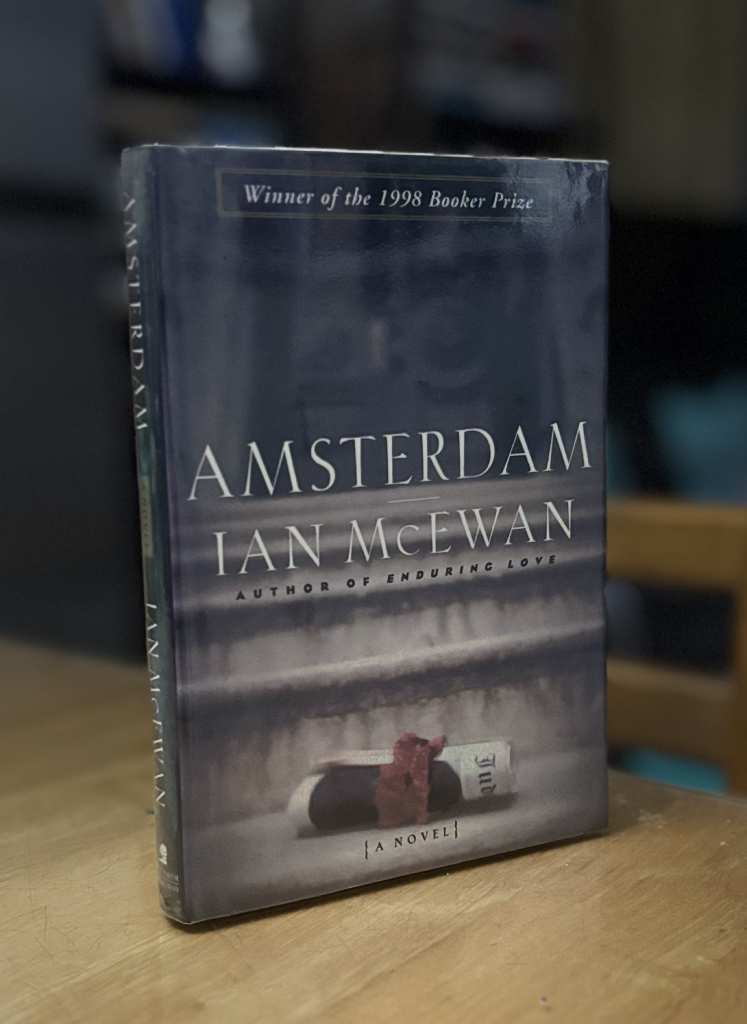
I picked up Amsterdam for two simple reasons: its slender spine promised a swift read, and its Booker Prize win carried a notorious air of scandal. I expected a taut, literary thriller. What I found was a narrative of such cold, surgical precision that it left me intellectually impressed yet emotionally detached.
Amsterdam (1998) by Ian McEwan presents a premise of elegant, cruel symmetry. Two former friends, Clive Linley, a celebrated composer, and Vernon Halliday, a newspaper editor, are bound together by the death of Molly Lane. Molly was a former lover to both men, a connection that created a lasting, competitive intimacy between them. Her death from a rapid illness represents a shared, profound loss. In their shared grief, they make a euthanasia pact. The novel then meticulously traces how this bond of high-minded principle is shredded by separate, squalid crises of ambition.
Clive, chasing a final musical masterpiece, witnesses a potential assault in the Lake District and chooses not to intervene, fearing the disruption to his artistic flow. Vernon, seeking to save his floundering newspaper, acquires compromising photographs of a foreign secretary and plans to publish them. Each man views the other’s moral compromise with hypocritical outrage, setting in motion a mutually assured destruction.
The prose is, as one critic noted, a display of “unobtrusive panache.” McEwan’s control is absolute. The plot is a well-oiled machine where every gear (a stray comment, a missed opportunity, a tactical leak) clicks into place with fatal inevitability. This is not a story of passion but of calculation, and the narrative voice mirrors that quality: cool, observational, and devastatingly precise.
Reading this section felt like observing a master watchmaker. You admire the intricate, flawless assembly of the mechanism, but you are never invited to feel the passage of time it measures.
The Heart of the Controversy: Hollow Men and a “Bonkers” Finale
Here lies the novel’s great divide. For all its technical brilliance, Amsterdam is populated by what one reviewer called “spectral” characters, “men without edges.” Clive and Vernon are not tragic heroes but case studies in male ego and ethical failure. Their dilemmas are intellectual abstractions. The conflict pits the sanctity of art against civic duty and public interest against private ruin. We understand their reasoning, but we are not made to feel the consequence of their choices. Their world is one of dinner parties, professional accolades, and strategic maneuvers, a world so rarefied that its ethical disintegration feels like the shattering of a perfectly cut but empty crystal glass.
This emotional aridity culminates in the novel’s infamous climax in Amsterdam. To avoid spoilers, the sequence of events has been widely described as “completely preposterous” and “highly implausible.” It is a finale of operatic coincidence and dark farce that seems to belong to a different, more melodramatic novel. The critical dispute is fierce: is this a catastrophic failure of tone, or is it the logical, absurdist endpoint for characters whose lives have become purely transactional? The ending does not feel earned by the character; it feels dictated by the plot’s own ruthless mechanism.
The Amsterdam finale is the novel’s most debated gambit. I read it as the punchline of a savagely cynical joke. The problem is, McEwan’s narrative hasn’t been telling a joke but conducting a dissection. The tonal whiplash is severe.
The Booker Problem: Craft Versus Connection
Amsterdam’s victory in 1998 remains one of the Booker’s most contentious moments. To its detractors, it is proof that the prize can reward cold, clever execution over genuine human insight. For its advocates, it is a “dark tour de force,” a timeless and prescient satire of media cynicism, political ambition, and the fragile vanity of the professional class. The truth likely resides in the tension between these poles. The novel is undeniably about something important—the corrosion of private morality by public and artistic vanity—and its satire of late-90s media culture feels unnervingly relevant in any age of scandal and outrage.
Yet, the question persists: does its formidable craft fully compensate for its emotional reserve? Amsterdam is a novel to be admired for its engineering, its lethal efficiency, and its unwavering commitment to its own bleak vision. It is less likely to be a novel that is loved. Its legacy is inextricably tied to the prize that crowned it, ensuring it is remembered not merely as a book, but as a literary event—a controversy that continues to ask us what we ultimately value in fiction.
To contextualize the literary and historical forces surrounding Ian McEwan’s Amsterdam, two key articles from the archive serve as essential prologue. The first, a guide to the three principal types of satire, provides the critical lens necessary to dissect the novel’s particular brand of moral indictment, precisely categorizing its scornful tone. The second article, an examination of the landmark ‘Booker of Bookers’ prize awarded to Midnight’s Children, establishes the high-stakes prestige and public controversy inherent to the Booker Prize itself. Read together, they furnish the reader with the formal framework to analyze McEwan’s method and the cultural backdrop to assess its celebrated yet divisive reception.
Selected Passage with Analysis
He wanted to be away, he was longing to be on a train, hurtling southward, away from the Lakes. He wanted anonymity of the city again, and the confinement of his studio, and—he had been thinking about this scrupulously—surely it was excitement that made him feel this way, not shame.
Page 97, Amsterdam by Ian McEwan
This passage captures Clive Linley immediately after the Lake District incident. He has just made a fateful choice: to ignore a woman’s cries for help in order to preserve a fleeting musical idea for his symphony. The text is his internal flight from the consequences, as he physically flees the scene.

The language reveals a profound act of self-deception. Clive describes an urgent need to escape ("hurtling southward") into the "anonymity" of his studio. He actively reinterprets his visceral unease, insisting it must be "excitement" from his art rather than shame for his moral cowardice. This rationalization is the psychological core of his character.

Thematically, this moment is the novel's crucial hinge. It exemplifies the central satire: how professional vanity and intellectual self-justification corrupt basic ethics. Clive, like his friend Vernon, uses a high-minded principle (artistic genius) as a mask for a selfish, destructive act. This internal hypocrisy makes their eventual mutual betrayal inevitable.
Further Reading
‘Amsterdam’: Dark Tour De Force by Michiko Kakutani, The New York Times
Booker club: Amsterdam by Ian McEwan by Sam Jordison, The Guardian