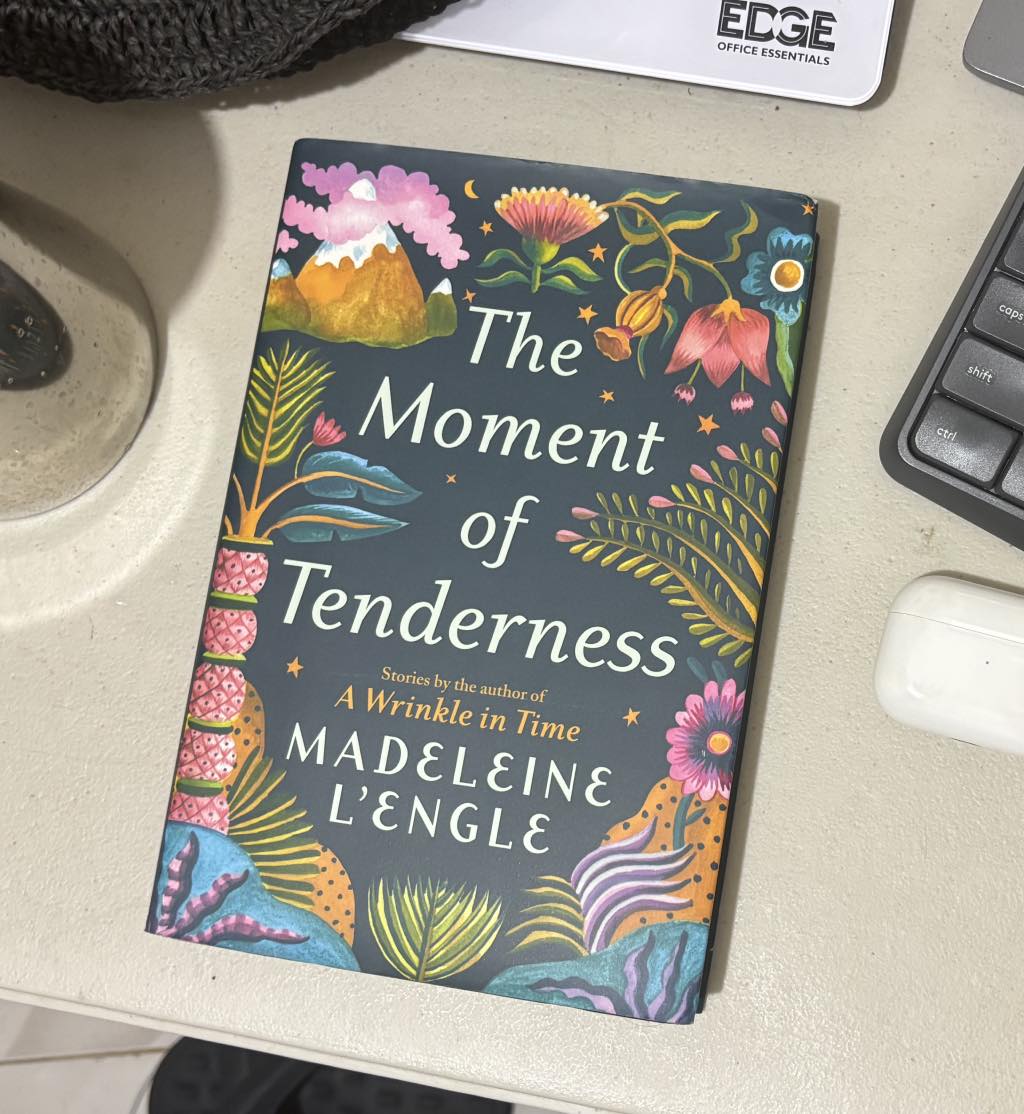
My Reading Note
I bought this collection without knowing what it was. I had read A Wrinkle in Time as a child, and the name Madeleine L’Engle was familiar, so I picked it up. The stories inside were not what I expected. They were rougher, stranger, and more personal than the novel that made her famous. This review is my attempt to understand what these stories reveal about the writer she became.
Madeleine L’Engle’s The Moment of Tenderness (2020) arrived in the world thirteen years after her death and fifty-eight years after A Wrinkle in Time (1962) made her name. The eighteen stories gathered here were written mostly in the 1940s and 1950s, when L’Engle was in her twenties and thirties, acting in New York and writing fiction she could not sell. Her granddaughter, Charlotte Jones Voiklis, found them in boxes stored across three houses, and arranged them in rough chronological order to trace an emotional arc from a lonely childhood in the city to life as a mother in rural Connecticut.
The stories themselves are uneven in ways that reveal how a writer develops rather than how one arrives fully formed. Early pieces such as “The Birthday” read as exercises, sketches of characters in situations that do not yet cohere into narrative. The prose is competent but unremarkable, and do not yet know what they are doing. What redeems these early efforts is the raw material they contain: loneliness, the cruelty of children, the gulf between adults and children, and the persistent search for connection. The themes that would occupy L’Engle for the rest of her career are already present, waiting for a writer skilled enough to do them justice.
What the Collection Is
The collection was not designed for publication. It was assembled from what remained, and it belongs to the years before the name Madeleine L’Engle meant anything to anyone but her. L’Engle studied theater at Smith College, moved to New York to pursue acting, and wrote fiction in the margins of that pursuit. She married the actor Hugh Franklin in 1946, and the couple eventually left the stage for a general store in Goshen, Connecticut. Throughout those years she submitted stories to magazines and collected rejections, and the work gathered here belongs to that interval, with only a few pieces finding their way into print and the rest left unpublished or later reworked into her novels.
The stories range from slight sketches such as “Gilberte Must Play Bach” to longer pieces such as “Madame, Or…,” and they span roughly fifteen years of a writing life that had not yet found its public. L’Engle was not, during this period, a writer with an audience. She was a writer with a habit.
The Arc: From Fragments to Form
The collection’s chronological arrangement determines how the reader experiences it. Early stories such as “The Birthday” do not attempt much, and they do not achieve much. They are studies in character and situation, written by someone still learning what a story requires. The observation is sharp, but the narrative has nowhere to go. A writer is testing her instruments rather than playing a piece.
The later stories show what happens when those instruments are finally mastered. In “The Moment of Tenderness,” placed near the end of the collection, a pregnant wife in a small Vermont town develops an attachment to her doctor, and the story renders her loneliness without ever naming it. She tells him that his words have made “all the difference in the world” to her, “just to know that somebody sees me as a human being.” The sentence is plain, almost bare, and it does more than any of the more elaborate passages in the early stories. L’Engle has learned restraint, and restraint is what the collection has been teaching her all along.
What affects me in this story is the wife’s loneliness. She is not unhappy in any dramatic way. She is simply unseen, and she has accepted it as normal until someone briefly notices her.
The Standout Stories
Four stories in the collection rise above the rest, and each does something the others do not.
“The Moment of Tenderness,” as described in the previous section, belongs among the collection’s strongest pieces. The title story shows what L’Engle could do once she trusted restraint. Of all the stories in the collection, this one shows most clearly what L’Engle could do when she stopped explaining and started trusting the reader. It is the piece that justifies the collection’s existence.
“Summer Camp” is the collection’s most devastating piece about childhood. A child writes an imploring letter to a friend who has drifted away, and then watches that friend mock the letter in front of the other campers. The cruelty is casual, almost offhand, and that is precisely what makes it unbearable. L’Engle understands something most writers of childhood do not: children are not innocent. They are learning power, and they learn it quickly.
“Poor Little Saturday” is one of the collection’s few ventures into the fantastic, and it is the story that most clearly anticipates the writer L’Engle would become. A boy recovering from malaria finds solace in the garden of a woman the locals call a witch, who lives in a derelict plantation house. The story is strange, atmospheric, and genuinely unsettling. One reviewer notes that it “does suggest that L’Engle might have had a career in horror, had she chosen to go that route.”
“The Foreigners” is the second longest story in the collection after “Madame, Or…,” and it tracks the social upheaval in a small New England town after a well-off family arrives and makes a poor impression on the locals. The story engages most directly with L’Engle’s own experience of being an outsider, and it does so without flattering anyone. The newcomers are not sympathetic, the townspeople are not generous, and the narrative offers no reconciliation between them. The result is one of the most uncomfortable pieces in the book, and one of the most revealing.
What the Collection Reveals About L’Engle
For readers who know L’Engle primarily through A Wrinkle in Time, this collection offers something unexpected: a portrait of the artist as a young woman who was not yet sure she was an artist.
The biographical parallels are striking. Many of the stories draw directly on L’Engle’s own life, and “The Foreigners” features a protagonist named Madeleine whose husband is named Hugh. Charlotte Jones Voiklis acknowledges in her introduction that most of the stories are autobiographical, a disclosure that matters when the reader notices how many of them concern marital disappointment and loneliness. These are not disguised memoirs, but they are not far from one either.
This is where the collection becomes more than a curiosity. L’Engle’s published memoirs presented her marriage as content and enduring. “There in the chapel of the church, Hugh and I made promises, promises which for forty years we have, by some grace, been able to keep,” she wrote. Her family, aware of Hugh Franklin’s many affairs, dismissed that account as fiction. The stories gathered here, written decades before the memoir, tell a different story. They are full of marriages that have gone wrong, of women who are isolated, of the distance between the life one has and the life one wanted.
The marriages in these stories are recognizable, and that is what makes them uncomfortable. The husbands are not villains, and the wives are not victims. They are simply two people who have stopped noticing each other, and the stories do not pretend this is unusual.
Should You Read This?
For devoted readers of L’Engle, the collection offers a window into the making of a writer. The themes that would occupy her for decades are already present in these early stories, though they are handled with less control than they would be later. The persistence is visible on every page. It is a book for those who already care about L’Engle, and it may hold less for those who do not.
For readers interested in the development of a writer, the collection has a different value. Apprenticeships are rarely documented at this length. Most writers publish their failures only after they have succeeded, if they publish them at all. L’Engle did not choose to publish these stories. Her granddaughter chose for her, and the result is a record of a writer learning in public.
The general reader will find the collection uneven. The early stories are slight, and the later ones are not uniformly successful. There are moments of casual racism and anti-Semitism that will trouble some readers, and the collection does not address them. Yet even the imperfect stories reveal a writer of brilliant prose and perceptive slices of emotional life.
I would not recommend this collection to someone who has not read L’Engle. It is not an introduction to her work. It is a companion for readers who already care.
The value lies in the sequence. This is not a collection to read for pleasure, though pleasure is available in the best pieces. It is a collection to read for understanding. What does it look like when a writer learns? What does it cost? What gets left behind?
The Short Story as a Way of Seeing: A Reader’s Perspective of the Form
Slice of Life: A Reader’s Guide to the Genre of Ordinary Moments
This review sits alongside two older pieces on the blog. “The Shorty Story as a Way of Seeing” examines what the form asks of readers and why compression is not a limitation but an enabling condition. L’Engle’s stories, written before she understood the form, show what happens when a writer has not yet learned to use compression well. The “Slice of Life” article explores narratives that proceed by accumulation rather than causation, and several stories in this collection, particularly the domestic ones, belong to that tradition. Both posts offer context for what this collection does well and what it does not yet know how to do.
Further Reading
- The Storyteller: Fact, fiction, and the books of Madeleine L’Engle. by Cynthia Zarin, The New Yorker