My Reading Note
Bolaño was the first writer who made me separate a voice from its form—a distinction I realized through reading The Savage Detectives and later on, 2666. The same deadpan, melancholic register appeared in both books, yet their structures bore almost no resemblance to one another: one restless and episodic, the other sprawling and encyclopedic. I had always assumed that a writer’s style encompassed both voice and form together. What follows is a framework I’ve constructed to better understand these differences.
Most readers know the feeling of opening a book and finding a voice they instantly recognize. That recognition has little to do with plot or character but mostly depends on something more fundamental: a quality of cadence or rhythm in the writing, or seeing a sentence structure that belongs to one particular writer. This is one of the pleasures of reading, a form of intimacy that grows stronger each time we return to a familiar author.
This experience, common to any devoted reader, points toward several deeper questions. What do we expect from a writer over the course of a lifetime? Do we want them to deepen a single vision, to build new structures for an old sensibility, or to transform entirely to become a different person on the page? These questions are not about quality. They are about the nature of the relationship we enter when we read and what we ask of the writer across the span of their career.
I have noticed these patterns across decades of reading, though I did not always have words for them. The recognition came slowly, writer by writer, until I realized that the writers I most admired seemed to fall into one of three categories. The framework I offer in this essay is my attempt to define those categories clearly.
Writers relate to their own work in markedly different ways. Some refine a single register across their entire careers. Others shift the structures that contain that register. Still, others abandon their voice altogether. These are not value judgments, only patterns. The sections that follow examine what each of these patterns reveals about the relationship between a writer and their work.
The Framework: Three Orientations of Voice and Form
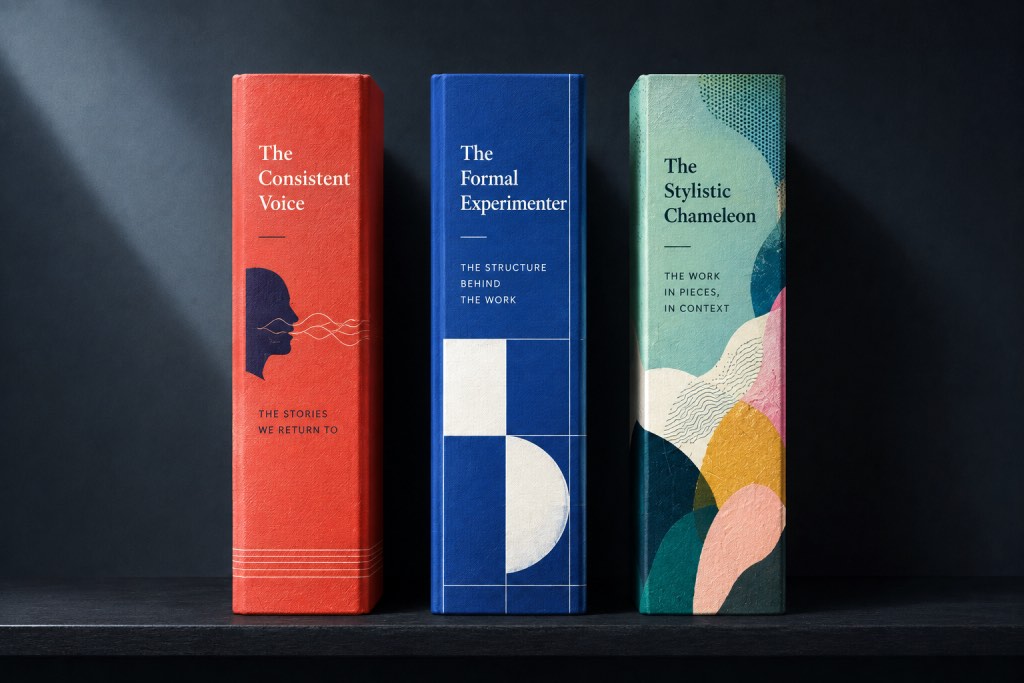
Voice and form are not separate elements that exist independently of one another; their relationship shifts from one writer to the next. Some writers treat their voice as a stable foundation, refining it across decades without ever abandoning its core register. Others keep that register intact but treat structure as a variable, constructing new containers for a familiar sensibility. A third group treats both voice and form as provisional, subject to revision with each new work.
These three orientations—toward stability, experimentation, and transformation—are not rigid categories. They are positions on a spectrum, and a writer may occupy different positions at various stages. A writer who begins by experimenting with form may later keep the voice stable while varying the structure. Another who refines a single register for decades may, late in life, abandon it entirely. These categories are tools for description, not boxes meant to confine.
This distinction emerged from a prior confusion in my own reading. I kept encountering writers who seemed, on the surface, to change radically, yet their prose felt unmistakably the same. The opposite also occurred: writers whose voices seemed to shift entirely, even when their subject matter remained constant.
Orientation 1: The Consistent Voice
The consistent voice is the most familiar of the three orientations. It is what most readers mean when they speak of a writer having a recognizable style. The prose sounds the same from one book to the next. The cadence, rhythm, and preferred sentence structures are common elements that remain stable across decades. The writer refines the writing rather than reinvents it.
What distinguishes the consistent voice is not a lack of ambition but one of a different kind. The writer who adopts this orientation is not repeating but deepening themselves with each new book that covers new territory, introduces new characters, or explores new themes—and yet, the voice that carries these elements remains recognizable as the same. The reader develops a relationship with that voice, not just with the stories it tells.
This orientation offers the reader a particular kind of pleasure: intimacy without unpredictability. There is trust in the encounter. You know what you are getting, and the pleasure lies in the deepening of a familiar voice. The writer who refines a single voice over a lifetime is not avoiding growth. They are choosing a different kind of growth, one that moves inward.
I have sometimes grown impatient with writers who never seem to change their style. But I have also learned that my impatience says more about my own need for novelty than about their work.
Writers of this orientation are often described as having found their voice early and kept it. But that description implies a passivity that does not reflect the work involved. The consistent voice is not a given from the outset; it is consciously maintained. It requires steady attention to craft, a willingness to ignore the pressure of variety and reinvention, and a preference for depth over novelty.
The risk of this orientation, however, is self-parody. When a writer refines for too long, the voice can become a caricature of itself. The prose that once felt alive can begin to feel automatic. The reader may sense that the writer is no longer discovering ideas but merely performing, which can lead to a trap of consistency; the very stability that initially made the voice trustworthy can, over time, render it predictably dull.
I think of certain late-career novels by writers I once admired. The prose remains beautiful, but something has calcified. It makes me wonder whether consistency is a virtue or a trap. The answer, I suspect, is both.
And yet, the consistent voice endures as one of the most common and most beloved orientations in literary fiction. Its practitioners are not lesser artists. They have simply chosen a different relationship to their own work, one that values continuity, depth, and intimacy above the more dramatic virtues of reinvention.
Orientation 2: The Formal Experimenter
The formal experimenter keeps the voice stable but shifts the structures that contain it from one work to another. The prose sounds recognizably the same, yet the architecture (scale, genre, or narrative frame) varies in ways that can make each new work feel like a discovery. This orientation distinguishes itself by a restlessness of form rather than of voice.
The writer working in this mode has found a register that suits them, often early in their career, and has chosen to keep it. But that register is not enough. The formal experimenter treats structure as a variable, constructing new containers for a familiar sensibility. The voice remains constant; the vessel changes.
This orientation offers the reader a different kind of experience: surprise without disorientation. You are in familiar hands, but those hands are building something you have never seen before. The formal experimenter demands structural attention—the reader must be alert to design, not just language. The reward is a body of work that feels unified in tone but varied in form, each book a different experiment within a consistent voice.
I have always been drawn to the Formal Experimenter because I love architecture almost as much as I love language. But I have also learned that not every reader wants to work that hard. That is not a shortcoming, only a different kind of reading.
The formal experimenter is often admired for their ambition, but ambition in this orientation takes on a specific form. It is not the ambition to reinvent the self with each new work but that of testing the limits of a single sensibility against different structures. A writer who keeps the voice stable while shifting the form is not playing it safe. On the contrary, they are asking what a familiar voice can accommodate and how much of a variation it can withstand while keeping it.
Instead of a definitive answer, the formal experimenter treats structure as a series of questions: what can a familiar sensibility accommodate? How much formal variation can a single voice survive? Each new book is an attempt to answer these questions. The formal experimenter demands more from the reader than immersion. Some readers may find themselves admiring the construction while feeling little for the rooms inside it.
Bolaño is the reason I began contemplating any of this. He belongs here. I did not know, at first, that what I admired was the stability of his voice and the restlessness of his forms. I only knew that I could not stop reading him.
Orientation 3: The Stylistic Chameleon
The stylistic chameleon abandons the voice itself. Not just the structures that contain it, but the register, rhythm, and sentence-level texture that once identified the writer. Each new work sounds as though it could have been written by a different person. The voice is not just refined or rehoused but shed entirely.
This orientation is the most radical of the three. While the first orientation deepens a single voice and the second varies the architecture around a stable voice, the stylistic chameleon does neither. The writer working in this mode treats voice as provisional, subject to revision with succeeding projects. The resulting body of work does not form a unified whole but reads as a series of distinct efforts.
What distinguishes this orientation is not a lack of continuity but a different understanding of what continuity means. The chameleon does not abandon coherence but relocates it to other areas: themes or questions that remain across books even when the prose sounds entirely different. The voice may shift, yet the underlying concerns stay constant.
I have always found the stylistic chameleon difficult to love, though I admire the range it requires. What gives me pause is the difficulty of forming a relationship with a writer whose voice I cannot recognize from one work to the next.
Reading the stylistic chameleon offers no familiar voice to anticipate. Each book requires a new adjustment, a fresh recalibration of expectations. The experience is one of vigilance rather than intimacy. The reader must remain alert to the unfamiliar.
This orientation has its admirers, and for good reason. The stylistic chameleon is often praised for their range and ambition and for the difficulty of being pinned down. But range is not the same as depth, and ambition is not the same as achievement. The chameleon risks a kind of shallowness: the voice changes so often that the writer may never fully inhabit any single mode.
I admire the chameleon’s range, but I sometimes wonder whether the constant reinvention is a sign of restlessness or just stubbornness not to commit to any single voice. Is the writer changing because they have exhausted that voice or because they are afraid of what remaining in it might reveal?
And yet the stylistic chameleon complicates any simple notion of what a writer is. The self, in this view, is not something given but something constructed, and it can be reconstructed. The chameleon’s work asks the reader to consider whether continuity is always a virtue, or whether something is gained from choosing not to remain the same.
Writers and Their Orientations
The following table offers a selection of writers who exemplify each of the three orientations. The list is not exhaustive. It is intended to illustrate the framework in practice.
| Orientation | Writers |
|---|---|
| The Consistent Voice | Haruki Murakami — His novels, from A Wild Sheep Chase (1982) to Killing Commendatore (2017), share a flat, affectless first-person voice and a consistent set of preoccupations: jazz, cats, wells, and restless protagonists. The voice almost never varies; the reader knows what to expect. |
| Anne Tyler — Her domestic realism, set almost exclusively in Baltimore, follows the same composed rhythm across decades. Her characters may change, but the register—observant, tender, slightly wry—remains steady. | |
| Gabriel García Márquez — His deadpan delivery of the impossible never wavers. Whether in One Hundred Years of Solitude (1967) or his later short fiction, the voice is unmistakable: magical, measured, and utterly consistent. | |
| The Formal Experimenter | Roberto Bolaño — The voice is unmistakable: deadpan, melancholic, and hypnotic. But the structures vary wildly—The Savage Detectives (1998) is episodic and polyphonic, while 2666 (2004) is sprawling and encyclopedic. The voice stays; the vessel changes. |
| David Mitchell — His formal ambition is the dominant feature of his career. Cloud Atlas (2004) is a nesting doll of nested narratives; Black Swan Green (2006) is a coming-of-age novel; The Bone Clocks (2014) is a supernatural thriller. The voice shifts slightly, but the architectural restlessness is constant. | |
| Milan Kundera — His essayistic, philosophical, and ironic voice remains stable across his novels, but the structures vary. The Unbearable Lightness of Being (1984) is novelistic with philosophical interludes; Immortality (1990) is more fragmentary and openly essayistic. | |
| The Stylistic Chameleon | Vladimir Nabokov — Compare Lolita (1955), baroque and unreliable, with Pale Fire (1962), a puzzle in verse and commentary, and with Speak, Memory (1951), a lyrical memoir. The voice is different in each. Nabokov did not refine a single register; he built a new one for every major work. |
| James Joyce — Dubliners (1914) is restrained and realist. A Portrait of the Artist as a Young Man (1916) is interior and lyrical. Ulysses (1922) is polyphonic and experimental. Finnegans Wake (1939) is something else entirely. Joyce abandoned his voice repeatedly, building a new one each time. | |
| Margaret Atwood — The Handmaid’s Tale (1985) is spare and dystopian. The Blind Assassin (2000) is layered, historical, and metafictional. Alias Grace (1996) is historical and docu-dramatic. Atwood’s voice is not a single register but a collection of registers, each chosen for the demands of the story. |
Synthesis: Voice and Form as Two Axes
The three orientations are not types of writers but positions on a spectrum defined by two variables: the stability of voice and the stability of form. These two axes produce a space in which any writer can be placed, though the placement is less important than what the space reveals.
| Axis | Description |
|---|---|
| Stability of Voice | Does the prose sound the same across the writer’s career? |
| Stability of Form | Does the structure, scale, or genre remain consistent? |
Plotting a writer on these two axes clarifies the distinctions between the orientations. The consistent voice occupies the quadrant where both voice and form remain stable. The formal experimenter occupies the quadrant where voice is stable but form varies. The stylistic chameleon occupies the quadrant where both voice and form vary. A fourth quadrant—where form is stable but voice varies—is theoretically possible but rarely observed in practice.
This synthesis reveals that the orientations are not destinations but tendencies. A writer may move across the spectrum over time, and the movement itself can be as revealing as the position occupied at any given moment. The framework does not capture the movement, but it helps us notice it.
I have often wondered whether the Formal Experimenter and the Stylistic Chameleon are not different modes but different stages of the same career. A writer who experiments with form for long enough may eventually find themselves experimenting with voice—or vice versa. The categories may be less like boxes and more like points on a line, with writers moving along it as they age.
Exceptions and Complications
Not every writer fits neatly into one of the three orientations. Some shift between them over time. Others combine elements of two or more. A few produce a single work that departs radically from their usual mode, then return to it. These complications do not invalidate the framework. They enrich it by revealing its limits.
The Late Transformer
A writer who maintains a consistent voice for most of their career, then undergoes a radical shift late in life, belongs to this category. The shift is not a gradual evolution but a rupture. The writer does not simply deepen or experiment. They abandon something fundamental.
Leo Tolstoy is the exemplary figure here. The author of War and Peace (1869) and Anna Karenina (1877) spent decades refining a voice that was expansive, psychological, and deeply attentive to the textures of social life. His late short fiction, however, reads as though written by a different person. The prose is spare, moralistic, almost fable-like. The concern with interiority gives way to a concern with moral example. Tolstoy did not evolve into this mode. He arrived at it through a crisis of faith and purpose. The late work is not a continuation but a departure.
Henry James offers a similar case, though his transformation was stylistic rather than spiritual. The late novels—The Wings of the Dove (1902), The Ambassadors (1903), The Golden Bowl (1904)—are written in a dense, labyrinthine prose that bears little resemblance to the relatively straightforward style of his earlier works. James did not simply refine his voice. He abandoned it and built a new one. The late style is not a deepening but a reinvention.
The Ambiguous One
Some writers defy easy classification because their work exhibits characteristics of two or more orientations. They do not fit neatly into any single category, and the attempt to place them reveals more about the framework’s limits than about the writer.
Nadine Gordimer is a prime example. Her prose evolved from a lyrical, modernist register in her early work to a sharper, more politically engaged realism in her later work. Yet a moral consistency—a sustained attention to the costs of apartheid and the complexities of human relationships—binds the two periods together. She occupies a space between the consistent voice and the formal experimenter. The voice changes, but the concerns remain constant, and the change itself is a response to historical pressures rather than a purely aesthetic choice.
Chinua Achebe offers another case. His novels—Things Fall Apart (1958), No Longer at Ease (1960), and Arrow of God (1964)—share a measured, dignified, morally serious voice that suggests a consistent voice. Yet his later essays and speeches adopt a different register, more direct, more polemical, and more urgently engaged with the politics of culture. Achebe does not fit neatly into any single orientation. He moves between modes depending on the demands of the form and the occasion.
The One-Off Turning Point
A writer who produces a single work that marks a sharp departure from their earlier mode, and whose later work consolidates that departure, belongs to this category. The work is anomalous only in relation to what came before. In retrospect, it is a turning point.
Fyodor Dostoevsky’s Notes from Underground (1864) is the clearest example. His early works—Poor Folk (1846) and The Double (1846)—are written in a relatively conventional realist mode. Notes from Underground is manic, absurdist, and deeply unreliable, a voice that bears little resemblance to anything he had written before. Yet the major novels that followed—Crime and Punishment (1866) and The Brothers Karamazov (1880)—consolidated that departure into a sustained, psychologically dense style. The anomaly is not the work itself but the break it represents from what came before.
The Sequential Shifter
A writer who moves through orientations in a clear sequence over their career belongs to this category. The shift is not a rupture but a progression. The writer does not abandon their voice abruptly. They outgrow it.
James Joyce is the clearest example. His early work—Dubliners (1914)—is restrained and realist, a version of the consistent voice. A Portrait of the Artist as a Young Man (1916) is more interior and lyrical, a move toward formal experimentation. Ulysses (1922) is polyphonic and experimental, a full embrace of the formal experimenter. Finnegans Wake (1939) abandons voice altogether, placing Joyce finally in the camp of the stylistic chameleon. The sequence is not random. It is a progression, each stage a response to the limitations of the one before.
The Hybrid
This category includes writers who simultaneously combine elements of two orientations—either within a single work or throughout their career. The hybrid does not move between orientations. They occupy two at once.
W. G. Sebald exemplifies this category. His work—The Emigrants (1992), The Rings of Saturn (1995), and Austerlitz (2001)—combines fiction, memoir, travel writing, and historical inquiry in a way that makes placing him in a specific category difficult. The voice is consistent: measured, melancholic, and elegiac, with a distinctive rhythm that carries across all his books. Yet the form is hybrid within each work, not just across them. Sebald does not shift between orientations over time. He compresses multiple orientations into a single book. His work is a genre unto itself.
These complications do not undermine the framework. They remind us that frameworks are tools, not rigid structures. They help us see patterns, but they cannot capture every writer. The exceptions are reminders of what the model cannot contain, not evidence of a flaw.
Closing: A Reader’s Question
What do we want from a writer? The question has no single answer, and the framework offered here does not pretend to supply one. It only asks that the question be asked with greater precision. Do we want the steady companion who never surprises, the architect who builds new structures for an old voice, or the stranger who refuses to be known? Each choice carries its own rewards and its own costs.
These are not questions of quality but of relationship, and they are worth asking because the answers tell us not only what we value in a writer but what we need from literature at any given stage of our lives. The reader who craves intimacy may prefer the consistent voice, while one who values discovery may prefer the formal experimenter. The reader who seeks the shock of the new may prefer the stylistic chameleon. None of these preferences is superior to the others.
The framework is not a verdict but an invitation to examine our own reading habits with greater care. To ask what kind of writer we love is also to ask what we seek from literature at a given time. The answer need not remain the same across a lifetime.
Voice and Style: A Complete Guide to Literary Language
Texture as Element of Prose Style: How Language Feels
Narrative Form vs. Narrative Style
This essay’s framework builds directly on concepts I have explored elsewhere on this blog. For readers who want a deeper foundation, I recommend starting with the “Voice and Style” series, which breaks down the technical elements that combine to create a writer’s recognizable presence. The series on “Texture as Element of Prose Style” examines the felt qualities of language that this essay’s orientations rely upon but do not fully explore. For those interested in the structural side of the framework, “Narrative Form vs. Narrative Style” clarifies the difference between what a writer builds and how they build it, a distinction that underpins the Formal Experimenter orientation. Finally, the “Writer’s Voice” explainer offers a more traditional treatment of voice as a concept, which this essay complicates by introducing the question of how writers relate to that voice over time. Read together, these posts provide the vocabulary and context that make the current essay’s argument possible.