My Reading Note
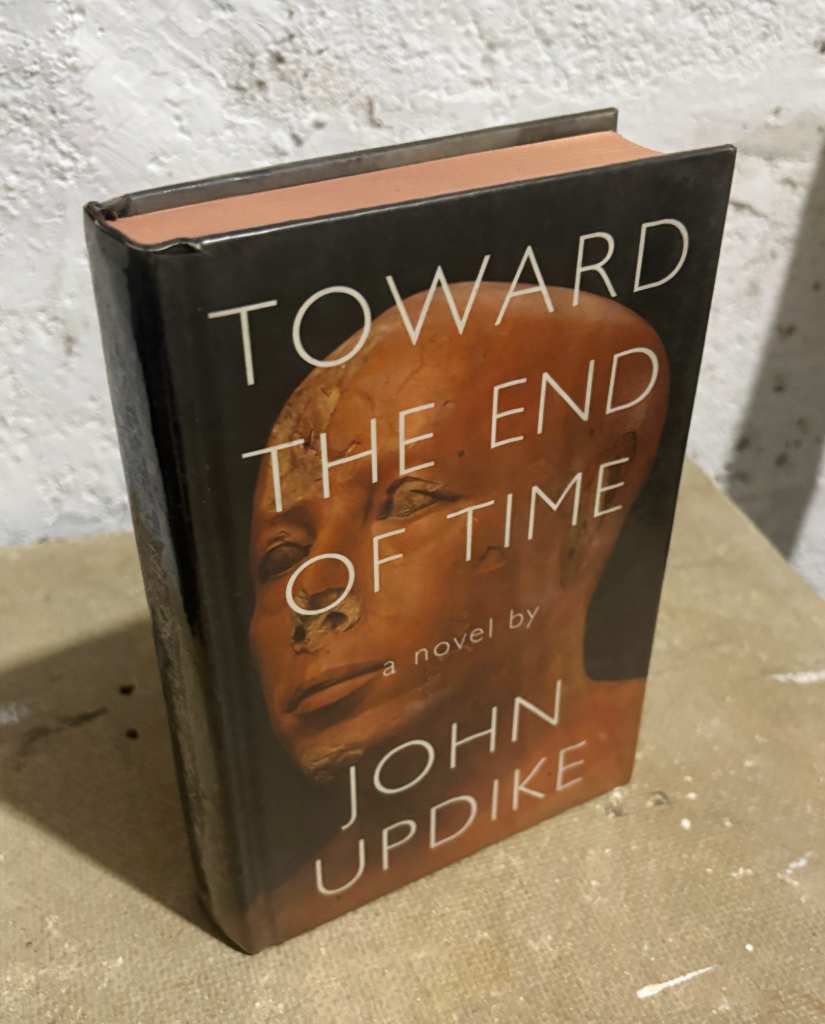
I first read Toward the End of Time in a used bookstore, drawn by the cover and the title. At that time, I knew Updike only as the Rabbit Angstrom writer. What I found was a novel that pushed back at every turn: an unlikeable, boring narrator; a plot wandering into historical fantasies and quantum physics; and an apocalyptic setting that went unmentioned for pages. I put the book down twice before finishing it. When I finally did, the ideas lingered, though I was still uncertain about them. I wrote this review after rereading the book, to fully understand what it is about.
In 1997, John Updike published Toward the End of Time, a novel set in the year 2020 after a brief nuclear war between the United States and China. The protagonist, Ben Turnbull, is a 66-year-old retired investment advisor living on the North Shore of Boston. He writes a journal, tends to his garden, and obsesses over his wife and his mistress. He also fantasizes about a 13-year-old girl. The world around him crumbles, but Ben seems more interested in his own appetites than in the unraveling of civilization.
The critical reception was sharply divided. David Foster Wallace called it “far and away the worst” Updike novel, a “mind-bendingly clunky and self-indulgent” performance that revealed “the Great Male Narcissist” at his most tiresome. Margaret Atwood, writing in The New York Times Book Review, praised the novel as “deplorably good,” a “carpe diem” meditation on pleasure in the face of death. Two respected critics, two diametrically opposed verdicts.
This review argues that both readings capture something true about the novel while missing what it is actually doing. Toward the End of Time is neither a failed novel nor a late-career embarrassment. It is an experiment with a purpose: writing a protagonist whose consciousness has been stripped of meaning and structure. The novel’s apparent flaws—Ben’s dullness, scattered digressions, and tonal instability—are not accidental but the only forms adequate to a man who has outlived his own significance.
The Corrective: Ben’s Dullness as Structure
Wallace’s critique captures Ben’s narcissism but stops there. Ben is indeed self-absorbed, sexually obsessed, and casually misogynistic. He fantasizes about a 13-year-old girl while treating his wife and mistress as instruments of his own pleasure. He seems indifferent to the wider world. Wallace is not wrong about any of these observations.
Wallace’s “Great Male Narcissist” critique is famous for a reason. But he was writing about Updike’s whole career, not reading this novel on its own terms. I find that when you isolate the book from the Rabbit Angstrom shadow, the narcissism looks less like a flaw Updike failed to trim and more like a diagnostic tool.
But Wallace treats Ben’s dullness as a failure of craft, as though Updike intended to write a different kind of protagonist and missed. This assumption needs critical examination. The novel is written as a journal, a narrative form that gives the author a ready explanation for why Ben is the way he is (a journal reflects the mind that writes it). If that mind is self-absorbed, the journal will be self-absorbed. But the real question is not whether Ben is unlikeable but whether Updike either endorses him or exposes him.
The evidence suggests exposure. Ben’s fantasies are not presented as admirable, his obsession with the 13-year-old girl is not romanticized (it is rendered as pathetic), and his indifference to the post-apocalyptic world is not heroic (it is a symptom of his irrelevance). The novel does not ask us to like Ben but to see what happens to a certain kind of American male consciousness when the social structures that gave it meaning have been stripped away. Ben is not a hero but a case study.
The Misreading: Neither Villain Nor Hero
Atwood’s defense is more generous, but it smooths over what the novel leaves unresolved. She reads Toward the End of Time as a “carpe diem” meditation, a late-life celebration of pleasure in the face of death. The novel does contain moments of pleasure: Ben’s gardening, his meals, and his sexual encounters. Atwood is not wrong to notice them.
Atwood’s defense is generous, but it reads the novel as a late-life celebration. I read it as a late-life inventory. The difference is between joy and exhaustion.
But these moments do not add up to a philosophy, because Ben’s pleasures are fleeting and compromised. His sexual encounters are shadowed by impotence and resentment, with his gardening offering a retreat from a world he cannot face. The novel provides no reference point for the concept of carpe diem, as Ben lacks any personal anchor. He is not seizing the day but simply killing time until he dies.
Atwood’s reading captures the surface but not the underlying structure. The novel’s pleasures are real, but they are not redemptive and do not accumulate into meaning. They are simply what Ben does while he waits. As such, the novel is not a celebration of life. It is an inventory of what remains after meaning has gone.
The Structure: Digression as Form
The novel’s most common complaint is its digressiveness. Ben’s journal wanders into historical fantasies (an Egyptian priestess, a Nazi-era German wife) and meditations on quantum physics. These passages seem to belong to a different novel. Critics have called the book meandering, its asides self-indulgent, its structure broken.
The first time I read the Egyptian fantasy, I thought Updike had lost his mind. The second time, I realized Ben had lost his. The difference is crucial.
But these digressions are not random. They are Ben’s failed attempts to find a narrative structure that contains him. The Egyptian fantasy presents a world where death is not the end. The Nazi fantasy, a world where evil has a name. The quantum physics meditations drift to the smallest scale, where one event no longer reliably follows another.
None of these attempts succeed. The fantasies fall apart, and the physics offers no comfort. The novel’s form breaks because Ben’s consciousness breaks, for he cannot sustain a single narrative when no single narrative can hold him. The digressions are not flaws but the only form adequate to a protagonist whose sense of time and self has come apart.
On a first reading, I assumed Updike had lost control of his material. On a second reading, I noticed how each fantasy falls apart at the same structural point: Ben cannot imagine himself into any world where he is not the center.
The Genre: Post-Apocalypse as Diagnosis
Updike’s choice of genre is often cited as a weakness. The post-apocalyptic setting is thinly imagined, wherein the nuclear war is described in a few paragraphs and then largely forgotten. Readers expecting something in line with Cormac McCarthy’s The Road (2006) or Emily St. John Mandel’s Station Eleven (2014) will be disappointed.
But Updike is not building a dystopian world. He is using the genre as a diagnostic tool. The post-apocalyptic setting strips away the social structures that gave meaning to his earlier protagonists. Remove Rabbit Angstrom’s job, his family, his community, and his country—what remains? Ben Turnbull.
The genre allows Updike to isolate his protagonist. There is no society to distract from Ben’s consciousness because society has ended. No future remains, for the future has been erased. The thinness of the worldbuilding serves the novel’s purpose. Updike is not interested in how civilization rebuilds and is mildly interested in what a man does when there is nothing left to do.
Why the Novel Provokes
The novel produces incompatible readings by leaving its own contradictions intact. Ben is both contemptible and pitiable, the novel both bleak and oddly comic, and the form both chaotic and controlled. No single interpretation can absorb all three without flattening one into the other.
Wallace’s reading is not wrong, only incomplete. He saw the contemptible Ben and stopped there. Atwood saw the pleasures and the carpe diem theme and did the same. The novel contains both and more: the failed fantasies, the thin worldbuilding loaded with intention.
The novel does not fit the categories Wallace and Atwood brought to it because it is doing something those categories were not designed to do. It is neither a conventional character study of a narcissist nor a meditation on pleasure in the face of death.
Failure with a Purpose
Toward the End of Time is not a great Updike novel. It is not Rabbit, Run (1960) or The Centaur (1963) or the stories in Pigeon Feathers (1962). But it is a more interesting failure than its critics recognize, and perhaps not a failure at all.
The novel asks a question that most fiction avoids: what happens to a person when the story of his life no longer makes sense? When the social scripts have been canceled, when the future has been foreclosed, and when the only available narrative is the journal of a man who has nothing left to say? The answer, Updike suggests, is not silence. It is the journal itself, with all its dullness and digressions and failed fantasies. That is what remains. That is what the novel gives us.
Postmodern Literature: A Reader’s Guide
If the argument of this review feels unfamiliar, that is because most critical frameworks lack the tools to account for what Updike attempted. My guide to “Postmodern Literature” lays out why the journal form often becomes the only container adequate to a fractured consciousness, a dynamic Updike pushes to its limit. My post on “Genre Blending and Experimental Fiction” examines how hybrid forms challenge reader expectations and why some experiments succeed while others fail. Both help explain why Updike’s novel confounded its first critics and why its digressions serve a structural purpose.
Don DeLillo’s White Noise (1985) is the essential companion to Toward the End of Time. Both novels feature aging male protagonists confronting death in a world stripped of meaning. But where DeLillo’s novel is a satire of consumer culture, Updike’s is a journal of private consciousness. Read them together to see two versions of the same question.
Further Reading
- Toward the End of Time on Wikipedia
- TOWARD THE END OF TIME on Kirkus Reviews
- ‘Toward the End of Time’: An Old Man’s Sour Grapes by Michiko Kakutani, The New York Times
- Toward the End of Time on Publishers Weekly