My Reading Note
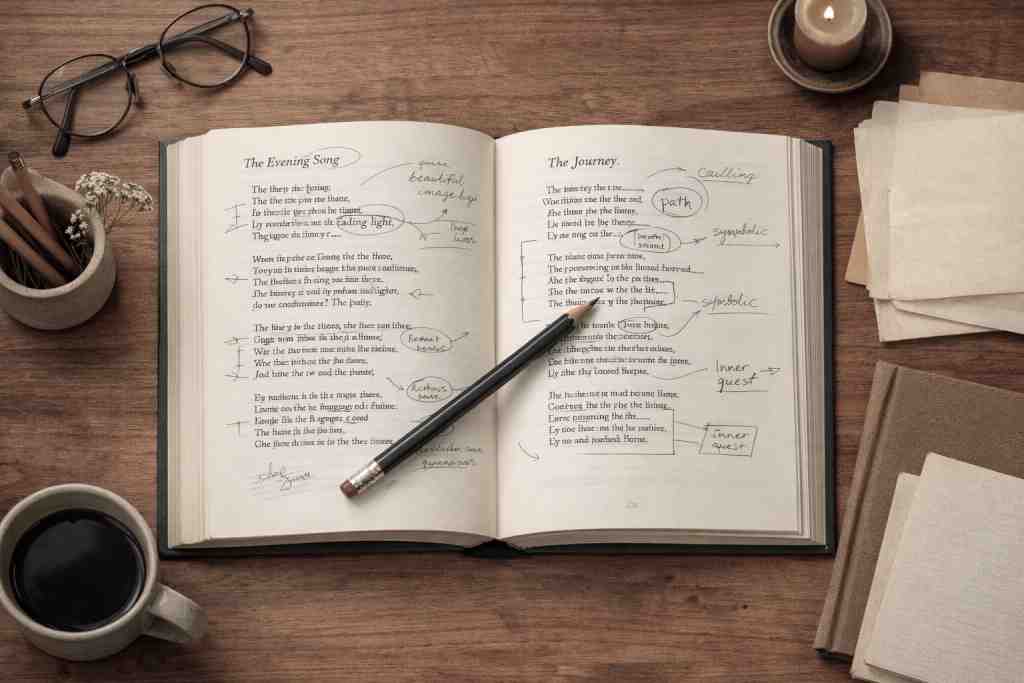
My early poetry annotations were compulsive but directionless. I circled words, marked rhymes, noted metrical shifts, and then sat back, staring at a page full of observations that failed to cohere into a reading. This guide is the bridge I built between those two states. It assumes you already know how to mark a poem. The question is: what do you do with all those marks?
In poetry analysis, close reading is the act of converting annotation into argument. Annotation generates the evidence: patterns of sound, diction, syntax, and structure. Close reading interprets that evidence, advancing a structured claim about how the poem’s formal elements collaborate to produce its meaning. The distinction is crucial. You can fill every margin with precise observations and still not have performed a close reading. The notes become a reading only when they are organized around a thesis.
This guide breaks that process into three stages. First, you will learn to survey your annotations and formulate a working hypothesis. Second, you will select and organize your evidence into a coherent outline. Third, you will build a complete argument using a proven four-part structure. A full demonstration and a troubleshooting guide follow.
STAGE 1: From Marks to Patterns
This section establishes the diagnostic, pattern-finding stage of close reading. It assumes the reader has already annotated the poem and now needs to transition from data collection to analysis.
Your annotated page contains dozens of individual observations. Before you can argue, you must find the dominant pattern. This is the step between collecting evidence and building a case.
Step 1.1: Survey Your Annotations
Read your marginal notes as a separate text. In this step, you are not rereading the poem but reading your own record of attention. When doing this, ask:
- What recurs? Which device appears most frequently?
- What surprises you? Which observation feels most alive or urgent?
- What connects? Draw faint pencil lines between notes that seem to echo each other across stanzas.
Do not judge or select yet. You are taking inventory.
For years, I skipped this step. I finished annotating and immediately began writing, convinced that my first impression must be my thesis. I now force myself to sit with my notes for ten minutes before drafting a single sentence. The thesis is almost never the first thing I noticed. It is the second or third thing, the pattern beneath the surface.
Step 1.2: Ask the Orchestration Question
A single observation proves little. For instance, an alliteration could be accidental, or a metrical variation might be local. But when multiple formal choices align around a single effect, you have found your pattern.
Ask yourself: “How do these different elements work together?”
Then take note of these: the alliteration that clusters at moments of emotional intensity, the enjambment that mirrors the speaker’s loss of control, or the recurrent image of cold that appears alongside every mention of isolation. These are not discrete facts. They are witnesses to the same underlying design.
Step 1.3: Formulate a Working Hypothesis
Write a single sentence that begins with one of the following frames:
- “This poem uses [formal feature] to [effect].”
- “The relationship between [feature A] and [feature B] produces [effect].”
- “The poem’s central tension is enacted through [formal observation].”
This is not your final thesis, however, but your testable claim. You will refine it, complicate it, or abandon it entirely as you move to the next stage. Because you cannot refine something out of nothing. A working hypothesis, however provisional, gives you something to push against.
My working hypotheses are almost always wrong in their first form. They are too simple, too confident, too neat. That is their purpose. A wrong claim is easier to correct than a blank page. The revision is where the real thinking happens.
Step 1.4: Test Your Hypothesis
Next, return to the poem with your working hypothesis in mind. Ask:
- Does the evidence actually support this claim, or have I forced the fit?
- What details does my hypothesis explain well?
- What details does it fail to account for?
A strong hypothesis will illuminate some features and leave others in the shadows, and this is not failure but focus. You are not required to explain everything, only to explain something thoroughly.
STAGE 2: From Hypothesis to Outline
You now have a working hypothesis and have tested it against the poem and confirmed that the evidence supports it. Now you must build the structure that will carry your argument from the first sentence to the last.
This step is the one most readers skip. They have a hypothesis and the evidence, then they begin writing immediately, trusting that the paragraphs will arrange themselves. They never do. What emerges is a collection of observations in search of a thesis. The outline should not be a constraint but a map instead. You draw it before you walk the path.
Step 2.1: Select Your Evidence
Return to your annotated poem, its margins dense with circled words and bracketed stanzas. You cannot use all of it. Selection demands focus, and some evidence must be deferred. For now, choose only what advances your claim. Restricting yourself to a few observations clarifies the argument and gives it direction.
Ask three questions:
- Which pieces of evidence most directly support my hypothesis?
A single, perfectly chosen quotation is worth more than three that merely approximate your point. - Which pieces of evidence are richest?
Some observations reveal deeper meanings beyond their surface. A line with alliteration, assonance, and enjambment can sustain an entire paragraph. A single repeated word may only sustain a sentence. - Which pieces can I set aside?
This is the hardest question. You are not discarding these observations forever. You are recognizing that they belong to a different reading, a different essay, a different day.
Select no more than three to five strong pieces of evidence. If you cannot state your case with five quotations, your hypothesis is too broad.
My early drafts were bloated with evidence. I included every annotation, terrified that omitting something would betray my own diligence. The result was unreadable. I now force myself to begin with a single page and a single constraint: I may only use three quotations. The argument that survives this restriction is the one worth making.
Step 2.2: Order Your Evidence
You now have a short list of quotations. How should they appear?
- Chronological order follows the poem’s own sequence. This is often the clearest choice for a first close reading. You walk the reader through the poem as you walked through it yourself.
- Climactic order saves your strongest evidence for last. This creates momentum and ends on your most persuasive point.
- Comparative order moves between two passages that echo or oppose each other. This is useful when your hypothesis concerns development, contrast, or internal tension.
Choose one. If you cannot decide, choose chronological. It rarely fails.
Step 2.3: Draft Your Thesis Sentence
Your thesis is the controlling idea for your entire close reading. It is not a summary of the poem nor a statement of your topic. It is a single, complete sentence that names the poem’s central formal strategy and the cumulative effect that strategy produces across the whole work.
A strong thesis does three things:
- Identifies a dominant formal feature (or a cluster of related features)
- Proposes what that feature does, creates, or reveals across the poem
- Implies why this matters to an understanding of the work as a whole
Weak thesis: Larkin's "Aubade” is about death and fear.
This statement identifies the poem’s subject matter but does not advance an interpretation. It makes no claim about how the poem generates meaning or why its treatment of death and fear matters. Because it offers a topic rather than an argument, it cannot guide analysis or organize evidence.
Strong thesis: In "Aubade," Larkin's blunt diction and relentlessly heavy rhythm — achieved through stacked monosyllables and metrically weighted polysyllabic words — strip death of consolation and present it as inescapable and isolating.
This statement identifies specific formal strategies and asserts what they accomplish. It connects technique to meaning and establishes a clear interpretive direction. The analysis can now demonstrate how diction and rhythm produce this understanding of death.
Your thesis governs everything that follows. Each paragraph, each claim, each piece of evidence must serve it. If a paragraph does not advance this thesis, it does not belong in your close reading.
Step 2.4: Map Your Paragraph Sequence
Now that you have a thesis by having your evidence selected and ordered, the next step you need to know, before writing a single paragraph, is what each paragraph will do. To do this, create a brief but functional outline:
| Paragraph | Function | Content |
|---|---|---|
| Paragraph 1 | Introduction | Thesis statement; brief orientation to the poem (title, speaker, situation) |
| Paragraph 2 | First Evidence | Quotation; formal observation; warrant connecting evidence to thesis |
| Paragraph 3 | Second Evidence | Quotation; formal observation; warrant connecting evidence to thesis |
| Paragraph 4 | Third Evidence | Quotation; formal observation; warrant connecting evidence to thesis |
| Paragraph 5 | Conclusion | Significance of the reading, both within the poem and beyond it |
This template offers a standard structure. Your argument may require additional paragraphs or fewer, and the organization may evolve during drafting. However, deviation is difficult without an initial map to depart from.
For years, I avoided outlines. They felt like schoolwork, not real thinking. Then I spent an entire afternoon writing a paragraph that should have taken fifteen minutes. I had no idea what the paragraph was supposed to do. I was writing without a destination, hoping to stumble upon one, and that is what drafts are for. An outline provides direction because it keeps you from getting lost inside the draft.
Step 2.5: Write Your Topic Sentences
Before you draft the full paragraphs, write the first sentence of each body paragraph. This is your final check for coherence. If the topic sentences, read consecutively, do not form a logical sequence, your outline is flawed. Revise the order or reconsider your evidence selection.
When the topic sentences alone tell a clear, progressive story, you are ready to write.
SUMMARY: Output of Stage Two
| Element | Status |
|---|---|
| Selected evidence | 3–5 strong quotations |
| Ordered evidence | Chronological, climactic, or comparative |
| Thesis sentence | Complete, disputable, precise |
| Paragraph map | Each paragraph assigned a function |
| Topic sentences | Each body paragraph has a lead sentence |
STAGE 3: Building a Close Reading
A close reading is an argument, and an argument requires structure. You have surveyed your annotations, identified a dominant pattern, and formulated a working hypothesis. You then selected your evidence, ordered it, and mapped your paragraphs. Now you must build the case that transforms that hypothesis into a demonstrated claim.
Every successful close reading, regardless of length, contains four essential movements: claim, evidence, warrant, and significance. You may compress them into a single paragraph or expand them across several pages. But you cannot omit any of them and still have an argument.
1. Claim
A claim is a paragraph-level assertion that advances a single piece of evidence in direct service of your thesis. Where the thesis makes a promise about the whole poem, the claim delivers on that promise, one passage at a time.
A strong claim does three things:
- Focuses on a specific passage or formal feature
- Proposes what that specific feature does in this specific moment
- Connects implicitly or explicitly back to the thesis
Weak claim: The line "Unresting death, a whole day nearer now" shows that the speaker is afraid of dying.
This statement paraphrases the line’s content but does not analyze how the language produces that fear. It names an emotion without examining the formal choices that create it. The reader is told what to feel but not shown how the poem makes them feel it.
Strong claim: The line "Unresting death, a whole day nearer now" compresses ten syllables into seven words, and the polysyllabic "unresting" and "nearer" receive full stress rather than lightening the meter. This trudging, uniform cadence enacts the inescapable step-by-step approach of death and forces the reader's voice to perform the very dread the speaker describes.
This claim focuses on a specific passage, identifies a precise formal feature (monosyllabic rhythm), explains what that feature does in this local moment (creates trudging cadence, enacts approach), and directly supports the thesis that Larkin’s rhythmic choices strip death of consolation and present it as inescapable.
2. Evidence
Present the specific, local details that support your claim. Quotations must be precise and, where possible, brief. You are not demonstrating that you have read the poem. You are demonstrating that you have read it closely.
Evidence paired with the strong claim above: The line reads: "Unresting death, a whole day nearer now." It contains ten syllables across seven words. "Unresting" (three syllables) and "nearer" (two syllables) are metrically heavy, each occupying multiple beats. The remaining five words are monosyllables. No polysyllabic word offers relief or syncopation.
Do not assume the evidence speaks for itself. Your job is to make it speak.
3. Warrant
Explain why this evidence supports your claim. The warrant is the logical bridge between observation and interpretation. It answers the reader’s implicit question: “How does that detail lead you to that conclusion?”
Warrant for the same claim: Because the polysyllabic words receive full stress rather than diminishing it, the voice cannot hurry or lighten its movement. The rhythm trudges: un-REST-ing DEATH, a WHOLE DAY NEAR-er NOW. Each beat lands with approximately equal emphasis, mirroring the incremental, relentless advance of death that the speaker can neither hasten nor escape. The reader does not merely learn about this dread; the reader's own voice performs it.
This is the most demanding section of any close reading and also the most rewarding. It is the point at which attention becomes interpretation, and description becomes analysis.
At first, I thought the evidence was the argument. I would quote a line, add a brief observation, and move on, assuming the connection was self-evident. It never was. The warrant is where you earn your reader’s trust. You are saying: “Look here. See what I see. Now let me show you why it matters.”
4. Significance
State why this claim matters, both within the poem and beyond it. Significance answers the question: “So what?” A strong close reading does not terminate in itself. It illuminates something larger—the poem’s thematic argument, its place in a tradition, its intervention in a cultural conversation, or its reconfiguration of what poetry can do.
Significance for the Larkin example: Larkin transforms mortality from a stated theme into a somatic experience. The poem does not argue that death is inescapable; it compels the reader's voice to enact that inescapability with each trudging beat. This is the distinctive achievement of his late style: the formal enactment of private dread as public, repeatable fact.
A Complete Model in Miniature
Here is the four-part structure condensed into a single paragraph:
In “Aubade,” Larkin uses a relentlessly heavy rhythm to enact the inescapable approach of death. The line “Unresting death, a whole day nearer now” contains ten syllables across seven words; the polysyllabic “unresting” and “nearer” require full stress, and the surrounding monosyllables offer no relief. This uniform cadence cannot be hurried, and the reader’s voice must trudge through it, step by step. Larkin thus transforms the dread of mortality from a stated theme into a performed experience. The poem’s power lies in what it compels the reader to do.
I learned this structure from reading Helen Vendler. Her paragraphs often follow this exact sequence: a bold claim, a granular formal observation, a patient explanation of the connection, and then a devastating statement of stakes. She never says that “this is important.” She makes it impossible to think otherwise.
DEMONSTRATION: A Worked Example
We have traced the method. Now we watch it work.
I have chosen Robert Frost’s “Nothing Gold Can Stay” (1923). It is brief enough to hold in mind, dense enough to reward attention, and familiar enough that no reader will feel lost in the poem. Here is how the three-stage method moves from annotated page to finished argument.
The Poem
Nature’s first green is gold,
Her hardest hue to hold.
Her early leaf’s a flower;
But only so an hour.
Then leaf subsides to leaf.
So Eden sank to grief,
So dawn goes down to day.
Nothing gold can stay.
Stage One: From Marks to Patterns
Annotated observations:
- Rhyme scheme is AABBCCDD: every two lines rhyme and make a tight little pair.
- The poem is very short and compact (eight lines), which makes it feel like a brief, memorable saying about change.
- Each line has three strong beats, so it’s basically in iambic trimeter, with small variations at the start of the first and last lines.
- All the lines are end-stopped (you naturally pause at the end of each line), so nothing really runs over into the next line.
- “Gold” appears in the first and last lines, so the poem begins and ends on that word, highlighting the idea of precious but short-lived beauty.
- The main rhyme words—”gold/hold,” “flower/hour,” “leaf/grief,” “day/stay”—keep pairing something fresh or beautiful with time or loss.
- Lines 1–4 focus on beginnings and early beauty: “first green,” “gold,” “early leaf,” “flower,” and a brief “hour.”
- From line 5 (“Then leaf subsides to leaf”) onward, the poem shifts to falling or fading: “subsides,” “sank,” “grief,” “goes down,” ending with “Nothing gold can stay.”
Orchestration question: What pattern organizes these observations?
The most conspicuous feature is compression: eight lines, short meter, full rhymes, and end-stopped lines. Everything is brief and tightly packed. The poem moves by contraction: nature’s first green is called “gold,” an early leaf looks like a flower but soon becomes “leaf” again, Eden sinks to grief, dawn goes down to day—each change feels like a loss of something rarer and more intense.
Working hypothesis: Frost uses this extreme formal compression to mirror the principle of loss the poem describes. Beauty and innocence appear in small, concentrated flashes, then thin out and disappear.
Stage Two: From Hypothesis to Outline
Selected evidence (three quotations):
- “Nature’s first green is gold, / Her hardest hue to hold.” (lines 1–2)
- “Then leaf subsides to leaf.” (line 5)
- “Nothing gold can stay.” (line 8)
Order: Chronological. Opening, turn, conclusion.
Thesis sentence: In “Nothing Gold Can Stay,” Frost’s extreme formal compression (the short trimeter lines, the end-stopped syntax, the relentless couplets) not only describes loss but also performs it, making the reader feel the very diminishment the poem names.
Paragraph map:
| Paragraph | Function | Content |
|---|---|---|
| 1 | Introduction | Thesis; brief orientation |
| 2 | First evidence | Lines 1–2: paradox, compression as enactment |
| 3 | Second evidence | Line 5: the turn, “subsides,” syntax of diminishment |
| 4 | Third evidence | Line 8: final couplet, impossibility of staying |
| 5 | Conclusion | Significance: form as meaning |
Topic sentences:
- “Nothing Gold Can Stay” is an eight-line poem about how everything beautiful ends.
- The opening couplet announces the poem’s subject and its method simultaneously.
- Line 5 marks the precise moment the poem’s ascent becomes descent.
- The final line offers not consolation but confirmation.
- Frost’s achievement is to have made a poem that does not argue for its thesis but demonstrates it.
Stage Three: Building the Close Reading
Every successful close reading contains four movements: claim, evidence, warrant, significance. Here they are, woven together.
“Nothing Gold Can Stay” is an eight-line poem about how everything beautiful ends. Through extreme formal compression (the short trimeter lines, the end-stopped syntax, the relentless couplets), Frost not only describes loss but also performs it. The opening couplet announces this method immediately: “Nature’s first green is gold, / Her hardest hue to hold.” The paradox is impossible to resolve, and the couplet briefly balances what cannot be held before it snaps shut on “hold.” Line 5 marks the poem’s turn: “Then leaf subsides to leaf.” The verb and the repetition across the caesura enact the very subsidence the line describes, syntax settling into its own diminishment. The final line offers no consolation: “Nothing gold can stay.” It is shorter and more abruptly cut off than the lines before it, a complete sentence and a complete couplet that state its thesis without an argument or exception. Frost has made a poem that compels the reader to feel the line click shut, the couplet close, the poem subside into its own closure. That is its achievement.
TROUBLESHOOTING: Common Errors and Corrections
You have the method. Now here are the places it could break, what the breakdowns look like, and how to fix them.
Error 1: You have many observations but no hypothesis.
Symptoms: Your annotated page is full of circles, underlines, and marginal notes. You see alliteration, enjambment, imagery, rhyme. But when you try to formulate a hypothesis, nothing coheres. Each device points in a different direction.
Cause: You are still treating your observations as separate facts rather than as witnesses to a single design. You have not yet asked the “Orchestration Question.”
Correction: Return to Step 1.2. Draw literal lines between notes that seem to echo each other. Look for the device that appears most frequently, not the one that seems most interesting. Frequency is a reliable signal of intention. A hypothesis built on the dominant pattern may not be the most original reading, but it will be the most defensible one.
Error 2: You believe your thesis is “too obvious.”
Symptoms: You have written a thesis sentence that accurately describes what the poem does. It is clear, precise, and supported by evidence. It also feels like something any reader would notice. You worry it is not “smart” enough.
Cause: You have confused obviousness with irrelevance. The most important things a poem does are often the most visible. Frost’s compression is not hidden but the first thing any reader notices. Your job is to explain why the obvious matters, not to discover a secret.
Correction: Test your thesis by asking: If this is so obvious, why has no one explained it this way? The answer is usually that you have articulated the function of a visible device with unusual precision. That is not a failure but the goal.
I spent years believing that a good close reading must reveal something no one else had ever seen. This belief produced contorted, unconvincing arguments about marginal details. The best close readings do not discover hidden devices. They show why the conspicuous devices matter more than we thought.
Error 3: You cannot explain why your evidence supports your claim.
Symptoms: You quote a line, state your claim, then move to the next paragraph. The connection between evidence and claim is missing, or it is asserted rather than argued.
Cause: You are treating the quotation as self-evident. You assume the reader sees what you see and accepts what you conclude. The reader does not.
Correction: Write the warrant first. Before you draft the paragraph, complete this sentence: “This quotation demonstrates my claim because [explain the connection here].” If you cannot complete the sentence, you have not yet understood the connection yourself. Revise your claim or replace your evidence.
Error 4: Your close reading is just a list of devices.
Symptoms: Each paragraph identifies a different formal feature. For example, paragraph one notes alliteration, paragraph two notes enjambment, and paragraph three notes imagery. No paragraph explains how these features work together or what they collectively achieve.
Cause: You have skipped the Orchestration Question. You are still treating devices as discrete exhibits rather than as collaborators in a single design.
Correction: Delete the paragraph that feels least connected to your thesis. Then ask: Does the remaining evidence now feel more coherent? Often, removing one observation reveals the pattern among the others. If not, return to Step 1.2 and resurvey your annotations.
Error 5: You do not know how to conclude.
Symptoms: Your final paragraph summarizes what you have already said, gestures vaguely at “the human condition,” or trails off without resolution.
Cause: You have not articulated your significance claim. You know what the poem does but not why it matters.
Correction: Return to “Significance” in Stage Three. Complete this sentence: “This reading matters because it reveals that the poem [state what the poem does, subverts, reconfigures, or renders].” Do not reach for universal themes or grand philosophy. Stay inside the poem. Your significance claim might be that the poem subverts its own form, that it reconfigures a convention, or that it renders an experience no other poem has rendered in quite this way. Precision matters more than profundity.
My early conclusions were always about “the human condition.” I wrote this phrase so often it became meaningless. Now I forbid myself from concluding anything I cannot trace directly back to a formal observation. The significance must be earned by the evidence, not imported from elsewhere.
Error 6: Your outline and draft do not match.
Symptoms: You mapped your paragraphs carefully. Then you started writing, and the close reading went somewhere else. Now you have a draft that does not follow the plan, and you are unsure whether to revise the draft or abandon the plan.
Cause: You treated the outline as a constraint rather than a guide. Outlines are not contracts. They are hypotheses about structure. When you discover a better structure during drafting, you are revising your hypothesis. You are thinking.
Correction: Update the outline to match the draft. Then assess the new structure. Does it serve your thesis better than the original plan? If yes, keep it. If not, revise the draft to restore the original logic. The outline is not the draft, but it is the thing that keeps you from getting lost inside it. You cannot deviate from a map you never drew, but you can also draw a new map when you discover better terrain.
A Final Note on Failure
These errors are not signs that you lack ability; they just show that you are doing something difficult. The method does not eliminate failure; it only makes it legible. Knowing precisely where and how your reading has broken down gives revision a concrete starting point.
How to Annotate a Poem: A Practical Starter Guide
Philip Larkin: A Technical Field Guide
These articles from the archive complement this guide and extend its method. The guide “How to Annotate a Poem” teaches the physical practice the three-stage method assumes, while the explainer “Close Reading” provides the historical and critical context. For readers who wish to go deeper, “The Demands of Presence in Reading Poetry” examines why certain poems require this kind of attention. Finally, the “Philip Larkin” guide offers a sustained case study of the entire process, from annotation to argument.
Further Reading
- Ten Poems Students Love to Read Out Loud by Eileen Murphy, Poetry Foundation
- A Close Reading of “I Cannot Live With You” by Poets.org
- Close reading of poetry on Reddit