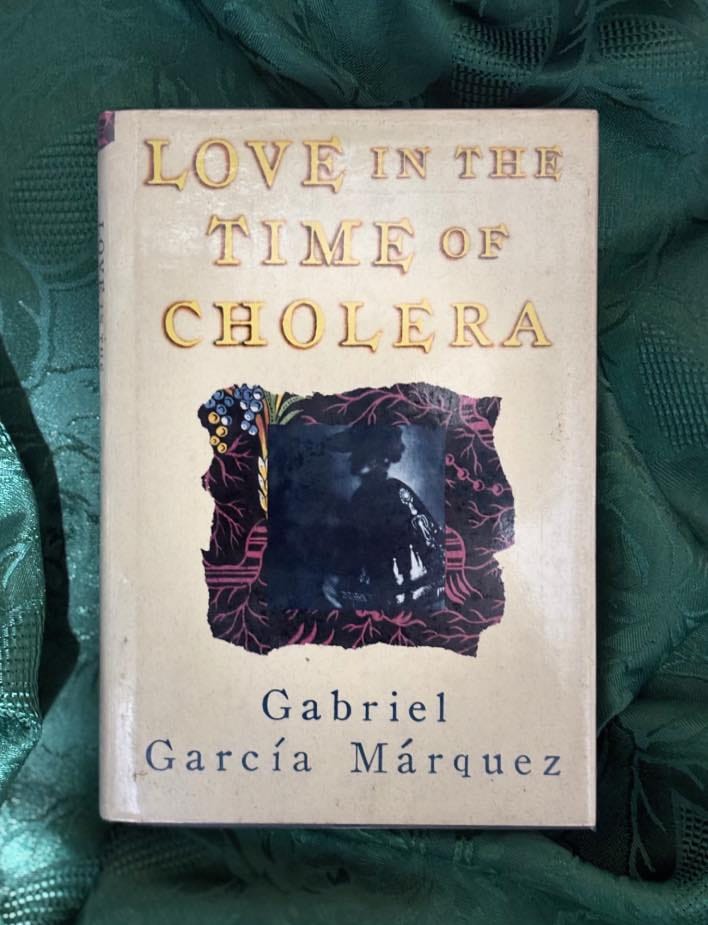
My Reading Note
I first read this novel in my twenties and thought it was the most romantic book I had ever encountered. I read it again in my forties and was not so sure. Florentino no longer seemed like a hopeless romantic but something closer to a case study. That shift in reading made me want to understand what the novel was actually doing, not just what I wanted it to mean.
When Florentino Ariza declares his love to Fermina Daza at her husband’s funeral, he has waited fifty-one years, nine months, and four days. The moment is absurd, touching, and deeply inappropriate all at once. Readers have debated ever since whether his devotion is noble or pathological.
Most readings of Love in the Time of Cholera (1985) treat it as a meditation on the persistence of love. This is true as far as it goes. But the novel is doing something more intricate. Gabriel García Márquez has constructed three love stories, each governed by a different logic, each challenging the others. Florentino’s lifelong obsession, Fermina’s stable marriage to Dr. Juvenal Urbino, and the final voyage they share in old age are separate registers rather than stages of a single love.
This article examines the novel through those three registers. It argues that the book’s real subject is not love alone but the relationship between love, time, and the stories we tell about both. The first section lays out the framework, while the second offers a corrective to readings that romanticize Florentino uncritically. The third section shows how the novel’s nonlinear structure enacts the same logic as the three registers. The fourth acknowledges the framework’s limits, particularly regarding Fermina’s role.
In the intervening years before I read this book again, I spent the time trying to decide whether Florentino was a hero or a fool. Eventually I realized the novel does not ask us to choose, just to watch him move through the world and make up our mind about him.
I. The Three Registers of Love
García Márquez does not offer a single theory of love. He presents three distinct registers, each with its own rules, its own satisfactions, and its own failures. However, the novel does not rank them but places them side by side to let the reader feel the friction between them.
Idealized Love
Florentino Ariza’s love for Fermina Daza begins as a young man’s infatuation and hardens into a lifelong obsession. He loves the idea of her constructed in adolescence, an idea he never revises as she ages into a different person. When she marries Urbino, he does not move on. He waits, and while waiting, he pursues 622 other women, recording each affair in a ledger he keeps for half a century. The novel reports this without judgment, but the mathematics are damning. Florentino claims fidelity to an ideal while practicing serial infidelity.
His love exists in the realm of letters, poetry, and memory. He writes constantly, first to Fermina, later for himself. The beloved in this register is not a person but a recipient, a muse, an absence that can be filled with language. He loves her the way a writer loves a character: completely, but at a distance.
I used to think the 622 affairs disqualified Florentino entirely. Now I think they show how a man can live two lives at once: one in the world and one in his head.
Domestic Love
Fermina’s marriage to Dr. Juvenal Urbino occupies the novel’s middle register. They marry for practical reasons (his status, her beauty, and the expectations of their class) and build a life together over five decades. The marriage has its grievances and its accommodations. They quarrel and reconcile as they grow old together. Urbino is unfaithful once, and Fermina leaves him for two years before returning. Then, the marriage resumes.
This register offers durability rather than grand passion. Urbino says late in life that the secret to a good marriage is recognizing that it is intolerable and that they would still be together even if they ceased to be lovers. This is love as an institution.
Enduring Love
The novel’s final section shifts registers again. After Urbino’s death, Florentino resumes his courtship of Fermina with the patience of a man who has waited fifty years. Over months, she resists, then tolerates, then finally accepts. They take a river voyage together, and the boat becomes a world apart from the judgments of their former lives.
On the river, the registers begin to merge. Florentino’s idealized love meets the actual woman, now in her seventies. Fermina’s domestic practicality meets a passion she thought she had outgrown. The love that emerges is neither the obsession of youth nor the compromise of middle age. It is something else: two people who have survived their own lives choosing to be together at the end. The boat flies a yellow flag signaling cholera so that no one will board, as if they could travel up and down the river indefinitely. This is love as escape rather than achievement, a refusal to let the world have the last word.
II. A Corrective—The Trouble with Florentino
Many readers take Florentino at his word. They see a man whose love survives fifty years, 622 affairs, and the death of his rival, and they call it romantic. The novel encourages this reading on the surface while subtly undermining it beneath.
Florentino keeps a ledger of his encounters. He records each woman’s name, the duration of the affair, and sometimes a few notes. The ledger is a bookkeeper’s method of seduction, a way of counting what cannot be counted. By the time he finally wins Fermina, he has slept with more women than there are weeks in a year. The novel reports this without commentary, but the numbers speak for themselves. Florentino claims to have saved himself for Fermina while saving nothing of the sort.
His affairs are not incidental, however, but structural. They allow him to wait without actually waiting, to fill the years while telling himself he remains faithful to an ideal. The women exist for him as placeholders, substitutes, and proofs that he is still alive. The novel does not condemn this, however. It simply shows it, over and over, until the accumulation becomes its own judgment.
Fermina understands this better than Florentino does. When he declares himself after Urbino’s funeral, she throws him out of the house. Her rage is not just at the timing but at the presumption. He has spent fifty years imagining her while knowing nothing of the person she became. His love is for a ghost, and he has the audacity to bring that ghost to her husband’s wake.
I have argued with friends about Florentino for years. The ones who love him have usually read the novel once. The ones who question him have usually read it twice.
III. Time and the Registers
The novel does not tell its story straight. It opens with Urbino’s death, flashes back to his marriage, then forward to Florentino’s renewed courtship, then back again to the lovers’ youth. The novel’s structure refuses chronology the way the registers refuse the hierarchical category of love.
This nonlinear arrangement does something specific. It places Florentino’s adolescent passion, his decades of waiting, and his final years with Fermina on the same plane. No period is presented as more real or more authentic than any other. The novel cuts between them without apology, as if time were not a line but a surface that could be traversed in any direction.
The effect is to make the reader feel what the registers enact: that love exists simultaneously in all its forms. The young Florentino writing letters is not replaced by the old Florentino on the riverboat. He is the same person, and the novel holds both versions in view at once. The structure itself insists that we not choose between them.
I tried counting the number of pages between Florentino’s first sight of Fermina and their first kiss. The novel made that count feel both impossibly long and surprisingly short.
IV. What the Registers Miss
This framework has limits, and they are worth naming. It treats Florentino and Urbino as embodiments of different love registers, which they are. But Fermina functions differently. She moves between registers rather than inhabiting one. She is the object of Florentino’s idealization, the partner in Urbino’s domesticity, and finally an active participant in the river voyage. Her experience across these registers is not captured by any single category.
A reading centered on Fermina might produce a different framework entirely. It might attend to how she chooses, refuses, accommodates, and finally claims a love on her own terms. The three registers illuminate much, but they also risk reducing her to a position between men. That is a loss, and acknowledging it matters.
The framework also cannot account for readers who experience the novel differently. Some will find Florentino’s persistence noble no matter what. Others will find him irredeemable. The registers do not adjudicate these responses. They only provide a way to see what the novel is doing, not a verdict on what it means.
For years I read the novel from Florentino’s side without realizing it. His waiting, his letters, his obsession. For me that was the story. Then a friend told me she reads it as Fermina’s book. I had never considered that until she pointed out how often the novel turns inward to follow Fermina’s own thoughts and perceptions.
This article argues that reading Love in the Time of Cholera through the three registers of love—idealized, domestic, and enduring—illuminates patterns in the novel that might otherwise remain invisible. It does not claim that García Márquez intended this framework or that it exhausts the novel’s meanings. It only claims that this way of reading produces observations worth considering. A reader who disagrees can test the framework against their own experience of the book and see whether it holds or not.
What Love Claims to Be, and What It Learns to Become: Shakespeare’s ‘Sonnet 116’ vs. ‘Sonnet 138’
These three articles from the archive approach love from directions that illuminate García Márquez’s novel. The roundup of book titles with “love” shows how widely the theme has been treated across literature, providing context for where Love in the Time of Cholera sits within that tradition. The piece on Barthes’s “A Lover’s Discourse” examines the language and psychology of love, which resonates with Florentino’s obsessive inner monologues and the novel’s interest in how love gets talked about. The comparison of Shakespeare’s sonnets explores how love can be both idealized (Sonnet 116) and knowing about its own deceptions (Sonnet 138)—a tension between romantic vision and the reality that runs through the entire novel. Together they offer different lenses for thinking about what García Márquez is doing with love on the page.
Editor's Note: This article was originally published on October 30, 2024. It was substantively revised on February 23, 2026 for depth, clarity, and updated research methodology to ensure the highest standard of literary analysis.
Selected Passage with Analysis
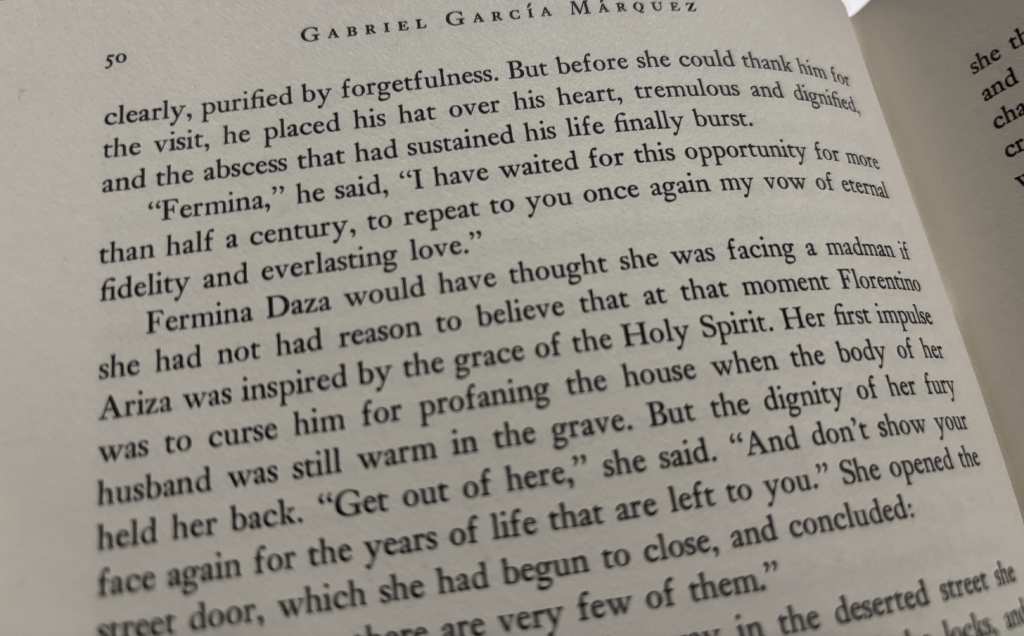
I have waited for this opportunity for more than half a century, to repeat to you once again my vow of eternal fidelity and everlasting love.
Page 50, Love in the Time of Cholera by Gabriel García Márquez
Taken from the book's first chapter, this passage occurs at the funeral of Fermina’s husband, Dr. Juvenal Urbino, who has just died in an accident. As Fermina grieves, Florentino sees an opportunity he has waited decades for, and, despite the highly inappropriate timing, he seizes the moment to profess his love once more. His declaration catches Fermina off-guard and reveals Florentino's unrelenting, almost obsessive, commitment.

García Márquez employs hyperbolic language here, with "eternal" and "everlasting," to underscore Florentino’s devotion to Fermina while subtly questioning whether such sentiments are realistic or sustainable. This line, spoken in the twilight of their lives, also imbues the scene with irony, as the fervor of youthful love confronts the reality of aging.

The setting of a funeral — somber, formal, and emotionally charged — heightens the irony and audacity of Florentino’s vow. García Márquez uses this unconventional context to immediately introduce the novel’s exploration of idealized love versus reality while also underscoring the tension between life, love, and death. Florentino’s words embody the novel’s theme of love’s persistence and the lengths to which one might go to fulfill an unrequited passion.
Further Reading
The Heart’s Eternal Vow by Thomas Pynchon, The New York Times
Unshelved: Less Than in Love With Love in the Time of Cholera by Sienna Brancato, The Georgetown Voice
Love in the Time of Cholera Study Guide by LitCharts
Your Guide to Love in the Time of Cholera by Oprah’s Book Club