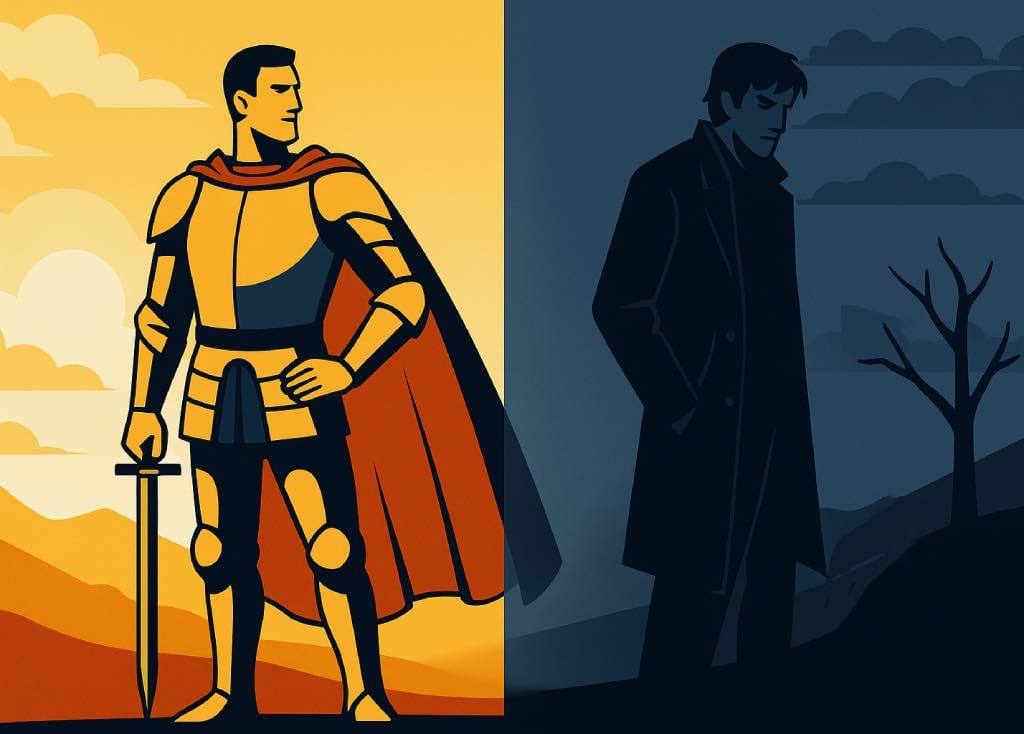
In literature, the distinction between a hero and an antihero is often framed as a matter of moral alignment: one represents noble ideals, the other complicates or rejects them. But this contrast fails to address how these roles actually function within a story.
Heroes and antiheroes are not fixed types; they are conditioned by narrative framing, context, and reader alignment. So, instead of asking what separates a hero from an antihero, a more revealing question might be: what causes a character to be perceived as either? The answer is rarely fixed.
The distinction depends not only on a character’s actions but on how a story frames those actions, and what the reader is led to excuse, admire, or condemn. Rather than setting them up as opposites, it is more revealing to examine how their actions are presented, what the story demands from them, and what expectations they inherit from the worlds they inhabit.
Why the Hero vs. Antihero Divide Falls Short
The binary between hero and antihero oversimplifies the roles they play. The supposed clarity between a virtuous protagonist and a morally compromised one breaks down when we account for how often both traits coexist in the same character.
Traditional definitions reduce heroes to noble actors and antiheroes to flawed rebels. But literature, as in life, rarely supports such rigid sorting. Think of Achilles, Hamlet, or Raskolnikov. Do they fit cleanly on either side? Not quite. They reveal how character morality often operates along a spectrum, fashioned by power, motive, and context.
Characters on a Continuum
Many modern stories treat the hero and antihero labels as flexible roles rather than fixed moral types. A character cast as heroic may act with self-interest, evasiveness, or ethical compromise, while an antihero may display courage, restraint, or sacrifice when it counts. The decisive factor is rarely a checklist of traits. It is the pattern of choices a character makes and the consequences the story attaches to those choices.
Characters who hold a reader’s attention tend to move along a spectrum rather than occupy a single moral position. In that context, the line between hero and antihero depends on the values the story treats as central and the standards it uses to judge action. Ideas such as justice, loyalty, and failure can shift as the narrative progresses, especially in fiction where the governing values remain contested or in flux.
Flaws, Power, and Consequences
What distinguishes a compelling character from a forgettable one often lies not in the presence of flaws but in their consequences. A deeply flawed character with no power might be a source of humor, pity, or tragedy—but not tension. Give that same character influence, and their flaws begin to influence the direction of the story. They become active forces that alter relationships, escalate conflict, and steer outcomes.
This is why antiheroes often dominate morally volatile settings. Captain Ahab in Herman Melville’s Moby Dick (1851), Kurtz in Joseph Conrad’s Heart of Darkness (1899), and Tom Ripley in Patricia Highsmith’s The Talented Mr. Ripley (1955) are not simply flawed. What sets them apart is how their desires and rationalizations, unhindered by morality or opposition, take root in positions of authority or persuasion. Their flaws are not just personality traits but mechanisms through which the story tests its limits.
Flaws alone, therefore, don’t define the antihero; it’s the combination of flaw and leverage. The more power a character holds, the more pressure their flaws exert on the story. The pressure they place on the world around them creates momentum. This momentum occurs because those actions shift the ethical boundaries the story is built on, rather than simply stemming from immoral actions.
The Antihero is Not Simply the Villain
An antihero is not simply a villain in disguise. While both may act out of self-interest or operate outside traditional morality, the antihero remains central to the story’s emotional and ethical structure. They are often agents of conflict, not just sources of it. A villain opposes the protagonist; an antihero often is the protagonist—reluctant, compromised, or resistant to ideals, yet still carrying the momentum of the story’s direction. Their flaws are not just obstacles; they are the very ground on which the story progresses.
Reader Allegiance and Narrative Framing
A character’s label often depends on how closely the story aligns us with their internal world. When we are placed inside their thoughts—such as in Fyodor Dostoevsky’s Crime and Punishment (1866) or Vladimir Nabokov’s Lolita (1955)—we begin to tolerate, even rationalize, choices we might otherwise condemn. This kind of narrative proximity doesn’t require the character to be just or admirable. It simply makes their perspective difficult to dismiss.
The power of narrative framing lies in its ability to control what information is shared, and how. In George R. R. Martin’s A Game of Thrones (1996), for example, the rotating point of view causes shifting loyalties. Characters who initially seem heroic may reveal flaws or compromised motives over time. Others, initially cast as villains, earn complexity. The story avoids a fixed hierarchy of virtue, instead emphasizing how allegiance depends on access to thought and motive.
When the Story Refuses a Clean Moral Map
There are stories where the moral architecture has utterly failed. In these accounts, the antihero becomes a tool of realism, not a figure of rebellion. Winston Smith in George Orwell’s 1984 (1949) and Offred in Margaret Atwood’s The Handmaid’s Tale (1985) act due to the intolerable nature of inaction, not because they are brave in a conventional sense. They do not reject morality; they reject a system that rewards obedience and punishes dignity.
In these settings, idealistic heroes either don’t exist or are rendered ineffective. The antihero’s decisions carry more influence due to their necessity within the constraints of their world and not simply because they are admirable.
Fiction Without Heroes
There are also works in which no character behaves heroically by any traditional measure. William Golding’s Lord of the Flies (1954) and Cormac McCarthy’s Blood Meridian (1985) offer bleak examinations of violence and instinct. The absence of a guiding moral presence leaves the reader without an anchor. These are not stories of redemption or clarity; they are stories about what happens when the mechanisms that support either fall apart.
Reframing the Question: Who holds the moral weight in a story?
The real difference between heroes and antiheroes lies not in their personal traits, but in how a story chooses to organize meaning around them. Heroes carry the burden of consequence; antiheroes test the limits of consequence altogether. In many cases, the same character can be both—depending on what the story demands, and what it chooses to reveal.
In stories featuring morally ambiguous premise, the hero often absorbs the repercussions of action. Conversely, an antihero might shirk that obligation—until a moment of reckoning arrives. The central tension here focuses on agency and accountability, setting it apart from a simple conflict between good and evil.
Rather than seeing heroes and antiheroes as opposites, we might think of them as different answers to the same question: what kind of person does this world make possible? The most revealing stories aren’t those that present tidy moral contrasts but those that force us to wonder what makes one character bear the title of “hero” while another is cast as something else entirely.
Further Reading
The 10 Greatest Heroes of Greek Mythology by N.S. Gill, ThoughtCo
On Writing & The Brain: Is the Antihero Our Hero? by Cullen Traynor, The Writing Cooperative
Why antiheroes are a more realistic version of the heroes we wish we were by Jonathan Heaf, GQ Magazine