Explore This Topic
My Reading Note
When I first started paying attention to diction, I noticed something strange. Words I had read dozens of times without thinking suddenly seemed more noticeable. A character’s slang revealed their background, while the author’s formal vocabulary signaled distance. The words were not just carrying meaning but creating it. This guide explains how to recognize and understand what word choices do in a text.
Diction is the writer’s choice of words, a definition that seems simple but conceals deeper implications because every piece of writing involves thousands of such choices. Each decision carries meaning about the writer, the characters, the subject, and the reader. The problem is that defining diction simply as “word choice” can make the term feel useless, since writers obviously choose words to accomplish everything they do.
Words carry more than their dictionary definitions because they bring connotations, associations, and histories. They belong to registers such as formal or informal, technical or colloquial, dated or contemporary. They place speakers in social contexts, reveal educational backgrounds, and signal attitudes toward subjects and audiences. Paying attention to diction means paying attention to all of these.
Denotation and Connotation
Every word has two kinds of meaning. Denotation is the literal dictionary definition. Connotation is the web of associations, emotions, and subtle meanings a word carries beyond its definition.
| Word | Denotation | Connotation |
|---|---|---|
| House | A building for human habitation | Neutral, functional |
| Home | A building for human habitation | Warmth, safety, belonging, family |
| Residence | A building for human habitation | Formal, official, slightly cold |
| Crib | A building for human habitation | Slang, casual, youthful |
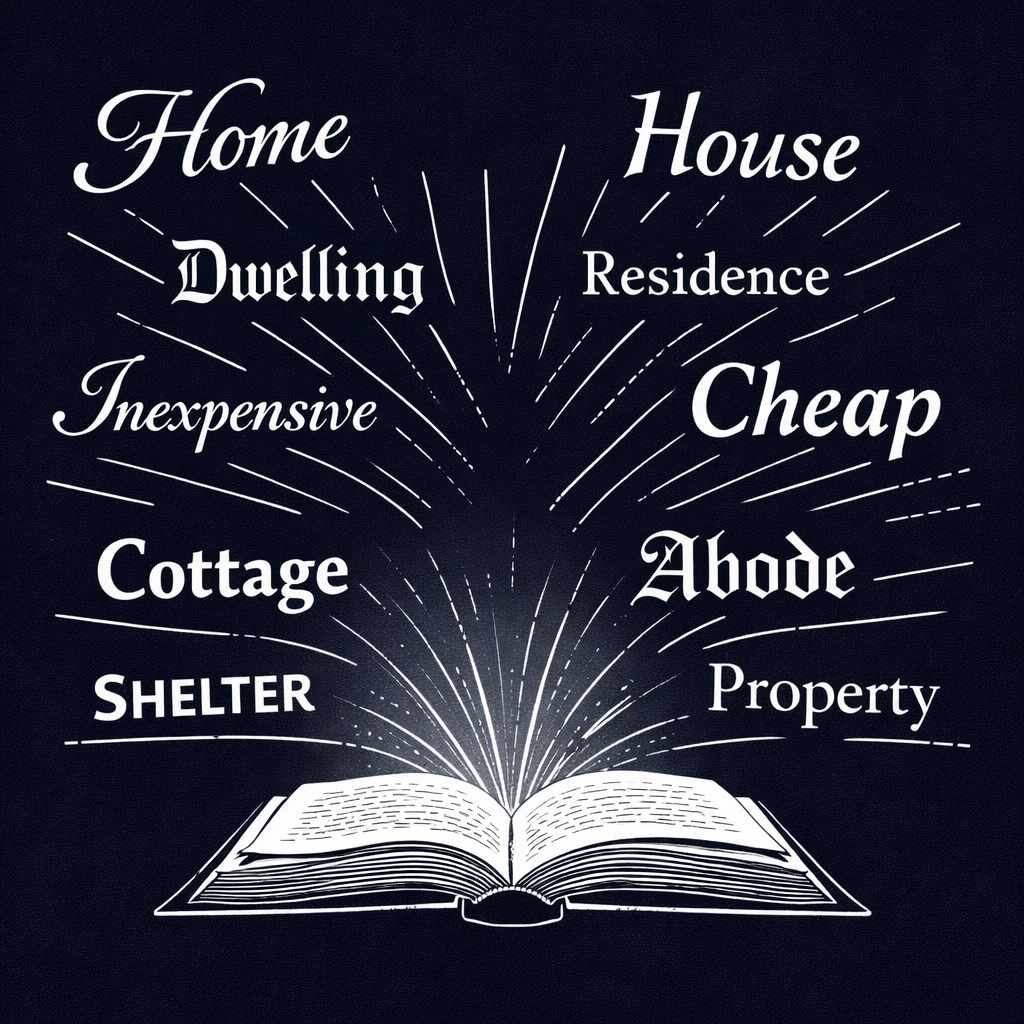
The difference between “house” and “home” is not a difference in what they refer to but in how they make readers feel. Both denote the same thing, but their connotations pull in different directions. Writers choose between them based on the tone they want to create and the response they want to evoke.
Consider the difference between “inexpensive” and “cheap.” Both mean low cost, but “cheap” carries negative connotations of poor quality, while “inexpensive” suggests good value. A writer describing a product as “cheap” signals disapproval; calling it “inexpensive” signals approval. The denotations are nearly identical; the connotations are opposite.
For a more detailed discussion of this distinction, see the separate guide to Connotation vs. Denotation.
Levels of Diction
Diction exists on a spectrum from formal to informal. Most writing falls somewhere in between, but recognizing the extremes helps identify where a particular text lands.
| Level | Characteristics | Examples |
|---|---|---|
| Formal | Complex vocabulary, Latinate words, no contractions, standard grammar | Academic writing, legal documents, ceremonial speeches |
| Neutral | Standard vocabulary, moderate sentence complexity, accessible to most readers | Journalism, textbooks, general fiction |
| Informal | Colloquial expressions, contractions, slang, casual grammar | Dialogue, personal essays, blog posts |
F. Scott Fitzgerald’s narrator Nick Carraway in The Great Gatsby (1925) uses formal, elevated diction. His sentences are complex, vocabulary sophisticated, and tone slightly removed. This diction reflects his education and social position while also creating a sense of distance from the events he describes.
In contrast, Holden Caulfield in J. D. Salinger’s The Catcher in the Rye (1951) uses informal, slang-filled diction. Words like “phony” and casual, repetitive phrases reveal his teenage voice, his rebellion against adult pretension, and his emotional state. The diction does not simply describe Holden but makes him feel real.
When The Catcher in the Rye was first published, some readers objected to Holden’s language. They thought the slang and casual swearing were inappropriate for a novel. But Salinger could have told Holden’s story in proper, formal English, and it would have been a completely different book.
Diction and Character
Word choice reveals character. How a person speaks—the words they use, the constructions they favor, and the level of formality they adopt—tells the reader who they are.
In The Great Gatsby, the difference between Nick’s narration and Gatsby’s speech reveals their distinct positions. Nick describes Gatsby’s love for Daisy through elaborate figurative language: “forever wed his unutterable visions to her perishable breath.” Gatsby himself speaks more plainly: “I can’t describe to you how surprised I was to find out I loved her, old sport.” Gatsby’s simpler diction, his slightly awkward constructions, his attempt to sound sophisticated with “old sport”—all of this reveals a man who has risen from a poor background and never quite mastered the language of the class he aspires to join.
The same principle applies to Tom Buchanan. When Tom warns about the rise of “coloured empires,” his diction undermines his message of white superiority. He stumbles: “the white race will be—will be utterly submerged.” His hesitation, repetition, and reliance on phrases like “it’s all scientific stuff” reveal a man who has absorbed racist ideas without actually understanding them. The diction creates irony: Tom sounds less superior the more he tries to sound authoritative.
Readers sometimes miss why Tom’s stumble matters because they only hear a confident racist making a speech. But Fitzgerald puts those dashes in for a reason. “Will be—will be.” Tom cannot even finish his own sentence. The words fail him because the ideas he has borrowed cannot actually support themselves. His diction reveals what he believes, but it also reveals that he does not really understand those beliefs.
Diction and Tone
Tone is the writer’s attitude toward subject and audience, and diction is one of the primary ways tone is established .
A writer describing a character as “slender,” “thin,” or “skinny” creates different tones. “Slender” suggests elegance and grace. “Thin” is neutral, merely descriptive. “Skinny” carries negative connotations of being too thin, perhaps unhealthily so. The choice among these words defines how readers feel about the character before they know anything else.
In Zora Neale Hurston’s Their Eyes Were Watching God (1937), the narrator describes Janie’s emotional state through carefully chosen diction: “The years took all the fight out of Janie’s face… She was a rut in the road. Plenty of life beneath the surface, but it was kept beaten down by the wheels.” Words like “rut,” “beaten down,” and “wheels” create a tone of despair. The figurative language extends the diction, but the effect begins with individual word choices.
Long after I forgot the plot of the novel, the word “rut” in that Hurston passage continues to surface in my reading. It is such a plain word, a farmer’s word, a word for dirt and wheels and things that get stuck. But in context, it carries years of oppression and life pressing down. That is what diction can do and what that word did to me.
Diction and Context
Words do not exist in isolation but carry the marks of their historical moment, their cultural context, and their generic conventions.
In Ernest Hemingway’s “In Another Country” (1927), the first paragraph repeats the word “fall” in ways that accumulate meaning. The season denotes autumn, but the word also evokes “the Fall” of humanity and the falling of soldiers in war. The context—wounded soldiers in Milan during World War I—activates these connotations. The repetition signals that the word deserves attention and that its meanings multiply across the passage.
The same passage reveals how diction works with syntax to create effects. Short, simple words arranged in repetitive patterns create a childlike or traumatized voice. The narrator’s word choices, combined with the strange rhythms, suggest a mind disturbed by what it has experienced.
A Framework for Analyzing Diction
When examining diction in a text, consider these questions:
- What kind of words are these? Formal or informal? Abstract or concrete? Latinate or Anglo-Saxon? Technical or colloquial?
- What do the words connote? Beyond their dictionary definitions, what associations do they carry? Positive or negative? Warm or cold? Simple or complex?
- Whose words are these? Do they belong to the author, the narrator, or a character? What does the word choice reveal about that speaker’s background, education, attitude, and emotional state?
- How do words contrast? When different characters use different diction, what does the contrast reveal? When the narrator’s diction differs from a character’s, what effect does that create?
- What patterns emerge? Are certain words repeated? Does the diction shift at key moments? Do words from particular semantic fields cluster together?
- What tone do the words create? How do the connotations, level, and patterns of word choice influence the reader’s emotional response?
Common Misconceptions
- Diction is just vocabulary: Diction is not about using big words or showing off a rich vocabulary. It is about choosing the right words for the context, the speaker, and the desired effect.
- Diction is only important in poetry: While poetry concentrates language most intensely, diction matters in all forms of writing. A single word in a novel can reveal character, establish tone, or create irony.
- Diction is a matter of individual choice: While writers choose words, those choices are influenced by context, culture, and convention. A character’s diction reflects their placement in the world, not just the author’s decisions.
- Analyzing diction means hunting for symbols: Not every word carries hidden meaning. Diction analysis is about noticing patterns, contrasts, or effects and not treating every noun as a symbol.
When someone asks me if the green light in Gatsby was “just a light” or “really a symbol,” I always reply that it was a light that becomes a symbol because of how the novel uses it. The same principle applies to diction. Most words are just words. But when a word always repeats and appears in key moments, then it is worth noticing.
Diction is the foundation of literary style. Before sentences can be structured, before tones can be established, and before voices can emerge, words must be chosen. Those choices accumulate into patterns, create effects, and generate meaning.
Learning to attend to diction means learning to read differently. It means noticing not just what words say but what they do: how they position speakers, how they influence readers, and how they carry histories and connotations beneath their surfaces. The words are always there, doing their work. The task is learning to see it.
Ernest Hemingway’s Iceberg Theory and the Art of Minimalist Writing
I picked these two posts because they develop concepts that build directly on the foundation laid in the diction guide. The article on “Tone vs. Mood” explores how word choice contributes to the author’s attitude and the reader’s emotional atmosphere, showing diction in action at the level of the whole text. The piece on “Hemingway’s Iceberg Theory” demonstrates how purposeful word choice and omission can create meaning beneath the surface, offering a practical case study of the principles this guide establishes. Together, they show readers how the micro-level choices explained here appear in finished works.
Further Reading
- Poetic diction on Wikipedia
- What does diction mean in literary terms? on Quora
- Books/authors that uses big words and helps me improve my vocabulary on Reddit