My Reading Note
My first real encounter with an unreliable narrator wasn’t a shock. It was a slow, cold realization that built as I read Ford Madox Ford’s The Good Soldier. The narrator, John Dowell, insists he is telling “the saddest story.” Yet his own telling is filled with gaps, chronological jumps, and emotional revelations that contradict his stated calm.
The most common contract in fiction is one of trust, wherein the reader accepts the narrator’s account as a reliable and credible guide. Some narratives, however, establish a different contract, one that makes more demands on the reader. They present a narrator whose credibility becomes the central question of the text. This presentation transforms the act of reading into an act of investigation.
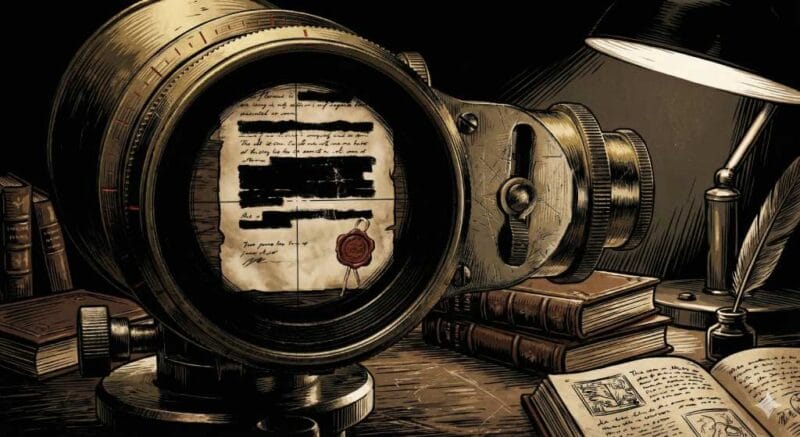
An “unreliable narrator” is a narrative strategy. This strategy breaks the default contract of trust between reader and storyteller by transforming the reader’s role from a passive consumer to an active interpreter. This article examines the formation, the possible forms, and the unique demands of this different contract.
The Architecture of Doubt: How Unreliability Is Constructed
Unreliability is not announced but built, engineered by authors through specific, detectable fissures in the narrative. A primary method is the persistent gap between the narrator’s account and the reality implied by other story elements. These elements include the reactions of other characters, the evidence of events, or the internal logic of the plot. For example, the narrator in Yann Martel’s Life of Pi (2001) presents a fantastical story, yet its plausibility is questioned by the “true” account offered at the novel’s end. This creates an unresolvable gap for the reader to navigate.
I have observed the common misreading to label any narrator with a subjective opinion as “unreliable.” True unreliability hinges on a tangible gap between the story as told and the story as implied. It requires evidence, not just bias.
Unreliability also manifests through the narrator’s voice and diction. Overly defensive language, compulsive justification, or a tone that clashes with the described events can signal a perspective working to convince itself as much as the reader. These verbal cues are the texture of the narrator’s psychology that offers clues to their blind spots or deceptions.
A Spectrum of Distortion: Intentional and Unconscious
The classic division is between the liar and the misguided, but the effect on the reader is more nuanced. The intentionally deceptive narrator (e.g., Tom Ripley in Patricia Highsmith’s novels) engages the reader in a game of cat and mouse. The reader’s role is to outthink the narrator, to spot the slip beneath the charming facade. The unconsciously limited narrator, whose unreliability stems from innocence, trauma, or ideology, creates a different effect: dramatic irony and pathos. The reader perceives the tragedy or truth that the narrator cannot, creating a powerful emotional duality.
In my own reading, I find the most potent unreliable narrators are those who believe their own stories. Their deception is not a performance for the reader, but a necessary fiction for their own consciousness. The reader’s investigation then becomes a kind of psychological excavation.
The Reader’s Labor: From Consumer to Co-Conspirator
This technique shifts the reader’s fundamental task. The reader becomes an active investigator who pieces together clues, weighs accounts, and decides where the truth might reside in the gap between the narrator’s words and the story’s evidence. This engagement asks the reader to practice a skepticism and interpretive skill that mirrors the analysis of testimony outside fiction.
A strictly reliable narrator offers a guided tour, while an unreliable narrator provides a map with several routes missing. This map demands the reader to chart their own course. The satisfaction of this route derives from the intellectual and emotional work of pursuing the truth, rather than from being handed a truth.
Methodological Grounding
This analysis approaches unreliability as a functional component of narrative design. It is examined as a calculated authorial technique for managing information, perspective, and reader engagement, rather than solely as a character trait. The focus is on its operational mechanics within the text.
Observed Patterns in Reader Response
A predictable pattern emerges in engagements with unreliable narration. It begins with an initial period of trust. A moment of dissonance follows, perhaps a contradiction or an odd emphasis. This leads to the formulation of a hypothesis about the narrator. The reader then tests that hypothesis against the rest of the text. This recursive process of belief, doubt, and reinterpretation defines the act of reading a text that uses this narrative technique.
This pattern is a concrete demonstration of reader-response theory. The theory argues that meaning is not a fixed product within a text but an event created by the reader’s interaction with it. The unreliable narrator provides the imperfect, gapped text. The reader provides the active interpretation, testing, and synthesis. The narrative’s final meaning emerges from this dynamic collaboration, not from the narrator’s account alone.
The Unreliable Narrator: A Review of Julian Barnes’s The Sense of an Ending
Reliable Narrator: The Provisional Contract in Fiction
Reading Recommendations: To see this technique’s range, read Ford Madox Ford’s The Good Soldier (1915) for a foundational study in psychological unreliability and Vladimir Nabokov’s Lolita (1955) for its definitive, rhetorical form.
I recommend the two articles from the archive and these two novels. The review on “The Sense of an Ending” shows the mechanism of unreliability in practice, while the explainer on the “reliable narrator” provides the essential theoretical counterpoint. The Good Soldier and Lolita demonstrate the technique’s scope, moving the reader from the analysis of a single novel to a broader understanding of its psychological and persuasive dimensions.
Editor's Note: This article was originally published on June 29, 2022. It was substantively revised on February 14, 2026 for depth, clarity, and updated research methodology to ensure the highest standard of literary analysis.
Further Reading
- Unreliable Narrator, Wikipedia
- How Crime Writers Use Unreliable Narrators to Add Suspense by Emily Martin, Novel Suspects
- Isn’t Every Narrator an Unreliable Narrator? by Christopher Hermelin and Drew Broussard, Literary Hub
- Is There Such a Thing as a Reliable Narrator? by Stacey Megally, Book Riot