My Reading Note
After an exhausting week of interrupted sleep, I tried to pick up where I left off in Thomas Pynchon’s Mason & Dixon and could not parse a single page, yet the next evening I read Banana Yoshimoto’s Kitchen for two hours without any effort. The difference in my reading experience was not a matter of one book being better than the other but of my cognitive energy: Pynchon demands linguistic deciphering and tolerance for syntactic ambiguity across eight hundred pages, while Yoshimoto asks for emotional openness without cognitive strain. Writing this essay forced me to examine why I had kept these two kinds of reading in separate boxes for so long.
The literary world has long ranked books by difficulty. James Joyce sits at the top, Dan Brown at the bottom, and most readers internalize a shame about how far down the ladder they usually stand. This ranking assumes a single axis of complexity on which a book’s position determines its value, with the most demanding works granted the highest status and the most accessible works dismissed as inferior. Yet, this assumption serves a social function more than an aesthetic one. Difficulty often functions as a gatekeeping mechanism. The reader who finishes Joyce’s Ulysses (1922) earns cultural capital, while the reader who finishes a novel that prioritizes accessibility and comfort earns less status or none at all. The implied message is that hard reading is virtuous reading, and easy reading is a guilty pleasure.
This essay challenges that hierarchy. Reading demands different kinds of cognitive labor depending on what a book is trying to do. One novel can demand patience from its readers due to its need for linguistic deciphering or tolerance for ambiguity. Another novel can demand attention to subtext, emotional precision, or the craft of appearing effortless. A third novel may demand minimal cognitive labor (routine comprehension of plain prose and linear narrative) and offer emotional restoration instead of intellectual challenge. The skills required for one are not the same as those required for another, and treating one kind of demand as the only kind that matters distorts how reading actually works.
A Spectrum of Cognitive Demands
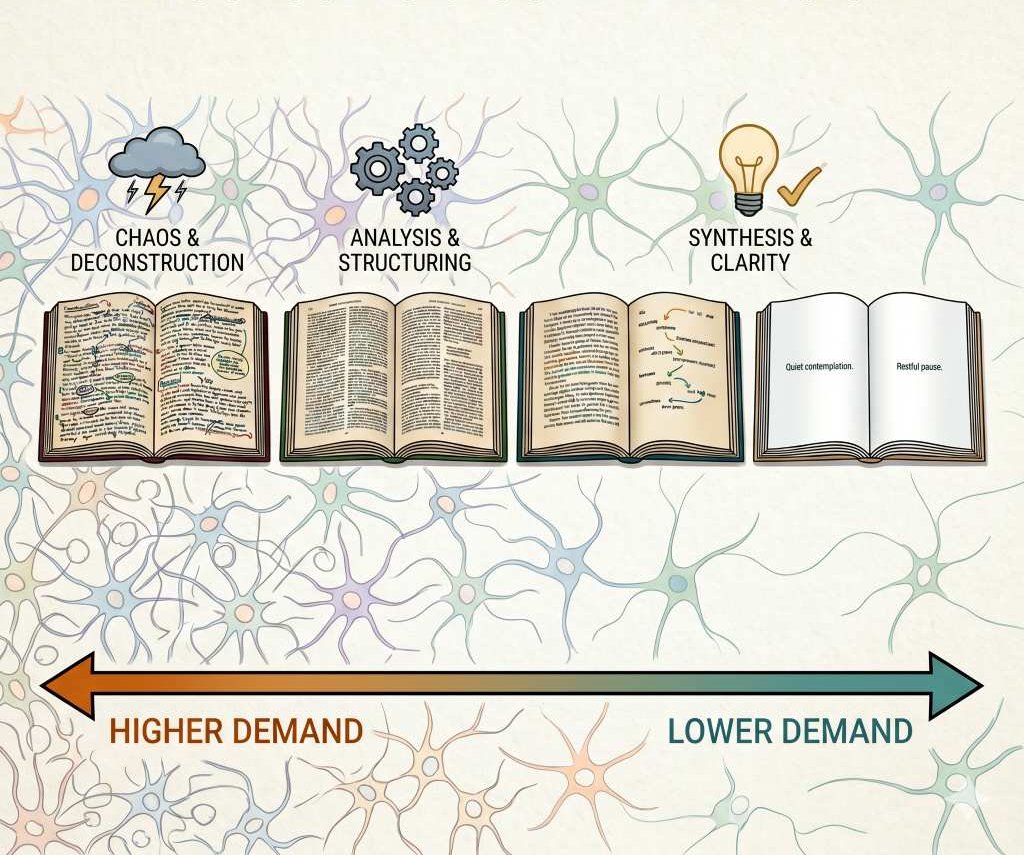
The spectrum can be understood as a continuous gradient with seven anchor points. Each anchor is defined by the primary cognitive demand it places on the reader.
| Point on Spectrum | Primary Demand | Examples |
|---|---|---|
| 1. Stylistically Dense | Deciphering non-standard syntax, perspective shifts, or nonlinear narration | Thomas Pynchon’s Mason & Dixon (1997); Djuna Barnes’s Nightwood (1936) |
| 2. Encyclopedic | Memory and pattern recognition across vast informational fields | Don DeLillo’s Underworld (1997); David Foster Wallace’s Infinite Jest (1996) |
| 3. Philosophical | Following extended debates and unresolved conceptual questions | Iris Murdoch’s The Sea, The Sea (1978); Fyodor Dostoevsky’s The Brothers Karamazov (1880) |
| 4. Gradual Accumulation | Patience for delayed payoff and accumulated emotional resonance | Tove Jansson’s The Summer Book (1972); Anne Tyler’s A Spool of Blue Thread (2015) |
| 5. Thoughtful Page-Turner | Balancing propulsive plot with moral and psychological complexity | Eleanor Catton’s The Luminaries (2013); Tom Perrotta’s Little Children (2004) |
| 6. Transparent Masterpiece | Attending to subtext, rhythm, and the craft that hides itself | Nicholson Baker’s The Mezzanine (1988); Ann Patchett’s Tom Lake (2023) |
| 7. Restorative Read | Minimal cognitive labor for emotional restoration | Alexander McCall Smith’s The No. 1 Ladies’ Detective Agency (1998); Banana Yoshimoto’s Kitchen (1988) |
Each anchor will be examined in turn. However, please note that the framework does not claim to have these seven points exhaust all possibilities, only that they illustrate the range that serves this essay’s purposes.
1. Stylistically Dense: Pynchon’s Mason & Dixon & Barnes’s Nightwood
The stylistically dense novel departs from standard grammar, syntax, or narrative perspective. The reader must decipher sentences that do not yield to immediate comprehension, often because the novel inhabits a consciousness that struggles with language or because the prose adopts an unconventional register.
Pynchon’s Mason & Dixon is written in a pastiche of late-Enlightenment-era English, complete with eighteenth-century typography, capitalized common nouns, and the characteristic use of the ampersand. The prose features what scholars call “aurality, variability, and polysemy”: the reader must hear the rhythm of the sentences, track multiple possible meanings of individual words, and parse syntax that runs counter to modern conventions. The difficulty remains systematic across nearly eight hundred pages rather than appearing in intermittent bursts, and the archaic language serves a purpose beyond style. Pynchon uses the pastiche to argue that the Enlightenment’s faith in measurement, rationality, and progress is both necessary and impossible.
Djuna Barnes’s Nightwood (1936) offers a shorter, more concentrated dose of linguistic density. Where Pynchon sustains his archaic pastiche across the entire novel, Barnes compresses her difficulty into metaphor and grotesque aesthetics, severing the link between subjects and verbs in long, unwieldy sentences. The reader of Nightwood must reconstruct meaning from fragments, but the demand is intermittent rather than systematic. Both novelists require active deciphering at the sentence level, though Pynchon’s demand is uniform and sustained while Barnes’s arrives in concentrated bursts.
The demand: Linguistic deciphering and tolerance for sustained syntactic ambiguity across nearly eight hundred pages (Pynchon), or the ability to reconstruct meaning from fragmented, metaphor-dense sentences (Barnes).
The reward: Access to a meditation on history and knowledge carried by the prose itself, not stated in plain terms (Pynchon), or entry into a consciousness that cannot be rendered in standard English (Barnes).
2. Encyclopedic: DeLillo’s Underworld & Foster Wallace’s Infinite Jest
The encyclopedic novel presents a world of excessive information. It includes lists, digressions, multiple plotlines, and a vast cast of characters. The reader must hold these elements together in memory while discerning patterns that the novel often makes difficult to extract.
DeLillo’s Underworld spans five decades of Cold War history, from a 1951 baseball game to the end of the millennium. The novel moves backward in time, linking nuclear waste, domestic terrorism, pop culture, and the art world through a network of unexpected connections. The reader cannot rely on linear chronology alone but must track associations across more than 800 pages, holding disparate moments in mind simultaneously. The novel argues that the Cold War never ended as a contained historical period; it continues as an ongoing condition that determines the present. The reward for the reader who persists is a transformed understanding of history as a web of causes and echoes rather than a sequence of events.
Foster Wallace’s Infinite Jest offers a complementary model of encyclopedic fiction. Where DeLillo organizes his novel around reverse chronology and historical association, Wallace distributes his encyclopedic ambition across hundreds of footnotes and digressions on film theory, drug rehabilitation, and competitive tennis. The reader must manage attention across more than a thousand pages while navigating the footnote apparatus, a different cognitive demand from DeLillo’s pattern recognition but equally representative of the encyclopedic mode.
The demand: Memory and pattern recognition across a nonlinear chronology of five decades (DeLillo) or across a distributed footnote apparatus (Wallace).
The reward: A model of cultural totality, whether Cold War America or contemporary entertainment and addiction.
3. Philosophical: Murdoch’s The Sea, The Sea & Dostoevsky’s The Brothers Karamazov
The philosophical novel places conceptual debate at its center. Characters argue about love, jealousy, freedom, and the will. The reader must follow these arguments while tracking how they emerge from characters and situations.
Murdoch’s The Sea, The Sea is narrated by Charles Arrowby, a retired theater director who believes he can control his own desires through an act of will. The novel systematically dismantles his self-deception over five hundred pages. The philosophical argument is not stated but dramatized: the reader watches Charles fail to see himself as others see him, and the gap between his self-image and his behavior becomes the novel’s moral engine. The reward is a direct encounter with how self-deception unfolds from the inside, a kind of understanding that no philosophical treatise could provide.
Dostoevsky’s The Brothers Karamazov offers a different model of philosophical fiction. Where Murdoch confines the philosophical argument to a single unreliable narrator, Dostoevsky distributes his debate across multiple characters, each representing a coherent worldview: Ivan’s rationalism, Alyosha’s faith, Dmitri’s passion, and Zosima’s wisdom. The reader must hold these competing positions in tension without any single narrator guiding judgment. Both novels demand that the reader engage with unresolved conceptual questions, though Murdoch isolates the reader inside a single deluded consciousness while Dostoevsky disperses the argument across a family.
The demand: Sustained attention to a narrator who is wrong about himself and the patience to watch him fail without authorial intervention (Murdoch); or the ability to hold multiple competing worldviews in tension while the novel leaves the debate unresolved (Dostoevsky).
The reward: A direct experience of philosophical irony that no treatise could produce (Murdoch); or a direct encounter with the impossibility of resolving the problem of evil and free will (Dostoevsky).
4. Gradual Accumulation: Jansson’s The Summer Book & Tyler’s A Spool of Blue Thread
The gradual accumulation novel challenges the reader through pacing rather than complexity. Events unfold slowly, and emotional payoffs arrive after many pages of steady accretion. The reader must trust that the stillness serves a purpose.
Jansson’s The Summer Book follows an elderly grandmother and her six-year-old granddaughter, Sophia, during a summer on a remote Finnish island where nothing dramatic happens: a storm passes, a cat dies, and a wasp’s nest is removed, yet the accumulation of small observations, small losses, and small affections devastates many readers. The reader who expects conflict and neat closure will find neither, while the reader who accepts the novel’s pace will discover what the novel offers.
Tyler’s A Spool of Blue Thread offers a related model of gradual accumulation. Where Jansson compresses her novel into a single summer on an island, Tyler expands her narrative across generations of a Baltimore family. The prose remains limpid and unfussy, but the accumulation of family dinners, disappointments, and reconciliations across decades does its work slowly. Tyler asks the reader to hold multiple timelines in mind rather than a single season, and the demand for patience remains the same: the reward comes from the gradual recognition of how family patterns repeat and change, instead of plot twists.
The demand: Patience for delayed payoff and tolerance for low-stakes events that accumulate meaning over time, whether compressed into a single summer (Jansson) or expanded across multiple generations (Tyler).
The reward: An emotional experience that gathers so gradually that the reader does not notice its depth until late in the narrative. Jansson delivers this through the contained intensity of a single season, while Tyler achieves it through the slow recognition of recurring family patterns across decades.
5. Thoughtful Page-Turner: Catton’s The Luminaries & Perrotta’s Little Children
The thoughtful page-turner balances a propulsive plot with moral and psychological complexity. The reader wants to turn pages, but the novel also asks the reader to think.
Catton’s The Luminaries is an 800-plus-page historical mystery set in the New Zealand gold rush. The plot is intricate: a series of crimes, a web of suspects, and a structure based on astrology. The reader can race through the novel for the pleasure of solving the puzzle, but the astrological structure is not a mere prop; it is a meditation on determinism and free will. The reader who moves too quickly misses these layers, while they who move too slowly lose the plot’s momentum. The reward is a rare combination of propulsion and depth.
Perrotta’s Little Children offers a more accessible model of the thoughtful page-turner. Where Catton demands that the reader track an astrological schema across 800 pages, Perrotta keeps his structure simple: multiple character perspectives in a suburban town, with tensions building around a local sex offender, a college student making exploitative films, and a group of parents. The prose is clear, the pacing is compulsive, and the themes of hypocrisy, moral ambiguity, and adulthood performance are handled with a deft touch. Perrotta does not demand structural deciphering but asks the reader to hold contradictory character perspectives while turning pages.
The demand: Simultaneous attention to plot mechanics and thematic structure (Catton) or the ability to hold multiple character perspectives in tension without losing narrative momentum (Perrotta).
The reward: A novel that satisfies the desire for story and the desire for meaning in the same gesture (Catton), or a compulsive read that leaves the reader with unresolved moral questions (Perrotta).
6. Transparent Masterpiece: Baker’s The Mezzanine & Patchett’s Tom Lake
The transparent masterpiece uses simple language, direct syntax, and familiar structures. The reader never struggles with a sentence while the craft hides itself. The apparent effortlessness is the result of immense discipline.
Baker’s The Mezzanine describes an office worker’s lunch break. The narrator buys shoelaces, rides an escalator, and thinks about paper towels. The prose is clear and the vocabulary ordinary, with the events being trivial. But behind this facade, the novel is a philosophical inquiry into perception, memory, and the texture of ordinary time. The reader who moves too quickly misses the argument embedded in the details. The difficulty is not in the words but in the attention required to notice what the novel is doing beneath its transparent surface.
Patchett’s Tom Lake offers a warmer, more domestic model of the transparent masterpiece. Where Baker focuses on a single lunch break and the minutiae of office life, Patchett follows a family picking cherries on their orchard during the pandemic, as the mother tells her adult daughters the story of her youthful summer romance with a famous actor. The prose is warm, the pacing gentle, and its emotional register highly accessible. Yet the novel shifts between past and present as the mother’s storytelling dictates, and the accumulation of small observations about marriage, parenthood, and the passage of time produces a cumulative effect that many readers find powerful. Patchett is not as philosophically playful as Baker, but her craft is equally hidden.
The demand: Attention to subtext and the craft that hides itself, whether in the trivial details of a lunch break (Baker) or the gentle shifts of family storytelling (Patchett).
The reward: An experience of the ordinary as extraordinary (Baker) or a recognition of how sustained attention to small moments can produce a powerful effect without dramatic events (Patchett).
7. Restorative Read: McCall Smith’s The No. 1 Ladies’ Detective Agency & Yoshimoto’s Kitchen
The restorative read makes no claim to literary ambition in the traditional sense. It uses familiar patterns (the detective novel or the gentle comedy of manners) to provide comfort, escape, and cognitive rest. The reader does not need to work to absorb the reading, and the feeling of restoration is its own reward.
McCall Smith’s The No. 1 Ladies’ Detective Agency follows Precious Ramotswe, Botswana’s first female detective. The mysteries are low-stakes, the prose is unobtrusive, and the tone is warm. The reader can finish the novel in an evening and feel neither exhausted nor cheated because it does not ask to be reread for hidden meanings; it asks to be simply enjoyed and then set aside. That is a legitimate function of this type of novel. A reading diet composed exclusively of demanding texts leads to cognitive burnout. The restorative read serves as a strategic reset, carrying no guilt despite its ease.
Banana Yoshimoto’s Kitchen offers a literary variant of the restorative read. Where McCall Smith relies on genre conventions (the detective plot and the familiar structure of a series), Yoshimoto writes a slim literary novella about grief, loss, and found family. The prose is smooth and precise; the reading experience is cathartic rather than exhausting. Yoshimoto addresses heavy themes with a light touch, and readers consistently describe her work as a balm. Unlike McCall Smith, Yoshimoto still asks for emotional openness and attention to theme, but the demand is so manageable that the novel functions as restoration for a reader exhausted by denser work.
The demand: Minimal cognitive labor (routine comprehension of plain prose and linear narrative) for emotional restoration (McCall Smith); or light emotional openness without cognitive strain (Yoshimoto).
The reward: Cognitive rest and the preservation of reading momentum (McCall Smith); or catharsis without exhaustion (Yoshimoto).
The Double Take: Two Novels of Obsession
To see the spectrum in action, compare two novels that seem similar but sit far apart: Murdoch’s The Sea, The Sea (philosophical) and a straightforward thriller about obsession, such as Patricia Highsmith’s The Talented Mr. Ripley (1955).
Both novels feature a protagonist consumed by desire for another person while tracking the moral consequences of that desire. But the cognitive demands are radically different. Highsmith’s novel moves quickly—the reader turns the pages to discover what Tom Ripley will do next. The moral complexity is present, but it is carried by the plot. In contrast, Murdoch’s novel moves slowly—the reader must endure Charles Arrowby’s self-justifications for hundreds of pages, recognizing his self-deception without the author’s explicit judgment. The demand here is not propulsion but patience.
The framework outlined above clarifies this difference: Highsmith’s The Talented Mr. Ripley sits near the thoughtful page-turner end of the spectrum, while Murdoch’s The Sea, The Sea sits firmly in the philosophical zone. Both are excellent novels, but they demand different kinds of attention while offering different kinds of reward. Neither is superior to the other; they are different tools for different purposes.
The Unclassifiable Book: Where the Framework Fails
Not every novel fits neatly on the spectrum. Italo Calvino’s If on a winter’s night a traveler (1979) is simultaneously encyclopedic (it contains ten incomplete novels), philosophical (it meditates on reading, interpretation, and desire), stylistically dense (the second-person narration disorients), and playful. The reader cannot locate it at a single point because the novel shifts modes every few pages.
This is not a weakness of the framework but a test of its limits. A good taxonomy accounts for its own exceptions. If on a winter’s night a traveler evades easy placement, it’s because its purpose is to evade easy placement. The novel shows that reading is not a linear process but a series of false starts, digressions, and renewed attempts. A framework that could classify it neatly would miss what the novel is doing. The spectrum works for most novels, but the unclassifiable novel reminds us that no system can contain every exception.
Why Move Across the Spectrum
A healthy reading life is not confined to a single point on the spectrum. It moves across it according to energy, curiosity, and need. The reader who reads only encyclopedic novels may develop extraordinary memory and pattern recognition but may lose the capacity for sustained attention or the pleasure of losing oneself in a restorative read. The reader who reads only restorative works may maintain reading momentum but may never experience the deep resonance of a transparent masterpiece or the moral seriousness of a philosophical novel.
If a reader spent a year only on restorative reads, their ability to read encyclopedic novels would measurably decline. Conversely, a reader who spent a year only on encyclopedic novels might lose the ability to relax into a restorative read without feeling guilty. The spectrum trains different cognitive muscles. Neglecting one set weakens it; exercising a variety strengthens the reader’s overall capacity.
The spectrum of cognitive demand and the concept of the reader’s energy budget are two sides of the same coin. The spectrum describes what a novel demands, while the energy budget describes what the reader has available. A wise reader matches demand to supply. Reading a demanding novel when energy is low produces frustration, not insight. Reading a restorative novel when energy is high may feel like wasted potential. The skill involves learning to read the right book at the right time.
The Practice of Literary Attentiveness: How Deep Reading Alters the Experience of Fiction
Argument by Digression: Essayistic Chapters in Hawthorne, Hugo, and Steinbeck
I selected these three posts as related reading because they address the core concerns of this essay from different angles. “Deep Reading and Literary Attentiveness” examines the cognitive discipline required to engage with complex fiction, a skill that becomes essential at the demanding end of the spectrum. “Can Fiction Be Philosophical” explores how novels carry complex ideas through voice, character, and scene without slipping into abstraction, which directly informs my Philosophical and Thoughtful Page-Turner categories. Finally, “Argument by Digression” analyzes how novelists pause their narratives to argue or meditate, a structural choice that sits at the intersection of Encyclopedic demand and narrative interruption. Readers who finish this essay and turn to those posts will find their arguments deepened and their examples contextualized within the spectrum.
Further Reading
- Why You Should Read Challenging Books by Fleur Morrison, HuffPost
- Reading Hard Books is Good, Actually by Danika Ellis, Book Riot
- i alternate between “easy” and “hard” books, it helps keep me engaged with the habit of reading as a whole. anyone else? on Reddit