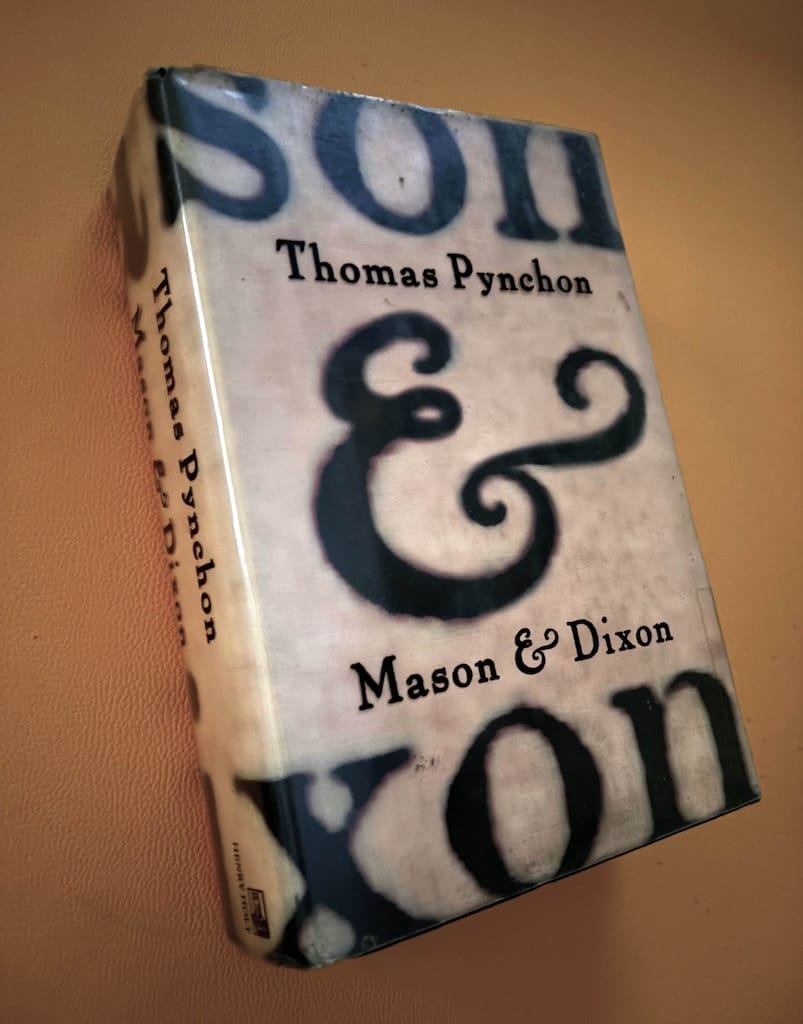
Thomas Pynchon’s Mason & Dixon (1997) is an intricate postmodernist novel that explores the adventures and partnership of English surveyors Charles Mason and Jeremiah Dixon. Set in the 18th century, this narrative traverses their work, including the famed Mason-Dixon Line, which historically divided the North and South in British North America.
Pynchon’s Mason and Dixon novel blends historical facts with imaginative storytelling, offering a rich tapestry of events and personalities that captivate readers. It doesn’t merely recount historical episodes; it delves into complex themes such as friendship and the quest for knowledge.
The book navigates various locations, including the Dutch Cape Colony and Saint Helena, painting a vivid picture of the era’s scientific and sociopolitical climate. Pynchon’s unique writing style mixes 18th-century grammar with contemporary flair, creating a labyrinthine yet rewarding reading experience.
For those intrigued by history, science, and nuanced character development, Mason & Dixon promises an engaging read. Pynchon’s narrative craftsmanship ensures that each chapter offers unexpected turns, making the journey through the lives of these surveyors both educational and entertaining.
Thomas Pynchon
Thomas Pynchon is a notable American author known for his dense and complex novels. Born in 1937, he has become one of the most significant writers in contemporary literature.
In addition to Mason & Dixon, Pynchon’s other notable works include Gravity’s Rainbow (1973) and Inherent Vice (2009). The latter was adapted into a feature film by Paul Thomas Anderson in 2014.
Pynchon’s work often explores themes of history, science, and technology. His unique style often blends reality with fiction, creating multilayered narratives. His novels are celebrated for their intellectual depth and intricate plots, making him a subject of study and admiration in literary circles. His contribution to modern literature is undeniable.
Pynchon is known for his meticulous research. In Mason & Dixon, he replicates 18th-century writing and speech to give the novel an authentic feel. This enhances the reader’s immersion into the historical period.
Pynchon remains a reclusive figure in the literary world. Few photographs of him exist, and he rarely makes public appearances. This has only added to his enigmatic reputation.
Plot Summary

Mason & Dixon combines fantasy and history. It gives a fictionalized account of British surveyors Charles Mason and Jeremiah Dixon; the duo is best known for creating the Mason-Dixon Line, which later became a cultural boundary between the North and South in the United States. The Mason-Dixon Line not only serves as a geographical marker but also symbolizes cultural and philosophical boundaries.
The story is set against the backdrop of the 18th century. The narrative takes readers through the surveyors’ work in the Dutch Cape Colony, Saint Helena, Great Britain, and finally along the boundary line in British North America. The novel doesn’t just summarize their surveying exploits. It also delves into varied aspects of Colonial American history. Topics include women’s roles, Native Americans, and the lives of slaves. Alongside historical elements, Pynchon introduces fantastical themes like alien abduction and hollow Earth theory.
Philosophical discussions and parables are a significant part of the narrative. Themes cover topics like automata, deism, and the afterlife. The complex interplay of historical facts and imaginative fiction makes Mason & Dixon a richly layered book.
Characters and Development
The central characters in the novel are Charles Mason and Jeremiah Dixon, whose complex personalities and interactions drive much of the narrative. The supporting cast adds depth and texture to their journey.
Charles Mason
Charles Mason, one of the primary figures, is a deist with deep spiritual conflicts. His scientific mind often clashes with his inner doubts and uncertainties. He serves as an astronomer, contributing significantly to their joint surveying efforts. Mason is portrayed as somewhat reserved and more inclined toward introspection compared to Dixon. His reluctance to forge close relationships, especially with Dixon initially, highlights his complex emotional state. This makes his character an interesting study of logic intertwined with existential musings.
Jeremiah Dixon
Jeremiah Dixon, juxtaposed against Mason, is an expelled Quaker with distinctive habits and traits. Known for his affable nature, Dixon is an encourager of friendship and camaraderie, standing in stark contrast to Mason’s reserved demeanor. His battle with alcoholism adds another layer of complexity to his character. Despite his personal struggles, Dixon’s surveying expertise and willingness to bond with others position him as a balancing force against Mason’s solitary tendencies. His character embodies a mix of optimism and personal flaw, making his development throughout the novel noteworthy.
Supporting Cast
The supporting cast in the novel enriches the narrative with their varied interactions and contributions. These characters, both real and imagined, provide a broader context to Mason and Dixon’s journey. Historical figures, local inhabitants, and other diverse personalities interact with the protagonists, each leaving an imprint on their travels. The intricate web of relationships and encounters brings a multifaceted perspective to the duo’s mission, providing both challenges and moments of levity. This array of supporting characters ensures that the novel’s world feels lived-in and dynamic, complementing the central narrative with additional depth and color.
Themes and Analysis

Pynchon’s novel engages deeply with themes of scientific inquiry versus superstition and the nuanced dynamics of friendship and collaboration between its protagonists.
Science and Superstition
The clash between empirical science and traditional beliefs is a central theme of the novel. The novel depicts their expeditions to survey the Mason-Dixon line, where their scientific rigor-driven work frequently encounters opposition from superstitious local populations.For instance, Mason and Dixon’s reliance on astronomical observations to draw the boundary contrasts sharply with the folk beliefs prevalent in the colonies. This dichotomy reflects the broader Enlightenment-era tensions between rational thought and mystical traditions. Pynchon’s narrative underscores the challenges faced by the protagonists, caught between advancing scientific knowledge and confronting entrenched superstitions.
Friendship and Collaboration
The friendship and professional collaboration between Mason and Dixon is intricately portrayed. Their relationship represents a microcosm of broader social and scientific collaborations of the time. Despite their personal differences, they work together to achieve a significant historical and scientific feat.
Pynchon’s depiction of their bond delves into the emotional and intellectual complexities of working together under challenging conditions. Their camaraderie is not just a subplot but a vital force driving the narrative forward. Through their interactions, Pynchon explores themes of trust, loyalty, and the shared pursuit of knowledge amidst the backdrop of pre-Revolutionary America.
Literary Significance and Reception
Postmodernist literature recognizes Pynchon’s Mason and Dixon novel as a significant contribution. The book has received significant critical attention since its publication in 1997. Its blends of fantastical elements with historical contexts make the novel a unique reading experience. Critics have noted its complex structure and rich thematic content.
Key Points:
- Historical Context: The novel describes Mason and Dixon’s 18th century surveying and astronomical adventures.
- Fictional Elements: Pynchon incorporates imaginary elements, giving the work a postmodernist vibe.
Reception Highlights
- Mason & Dixon won the New York Times Best Book of the Year in 1997.
- Scholars have compared the novel to other literary classics, highlighting its impactful narrative and character development.
Critical Perspectives
- The interplay between historical facts and fictional storytelling has been a focal point of scholarly reviews.
- Responses from literary critics highlight the novel’s innovative approach to storytelling and its depth in character interactions.
Comparisons
- Many people compare Mason and Dixon’s relationship to other famous literary duos like Don Quixote and Sancho Panza.
- Reviews also mention Vladimir and Estragon, Ishmael and Queequeg as comparable pairs.
Reader Reception
- Mason & Dixon has garnered attention for its imaginative approach to retelling historical events.
- Readers have noted its elaborate prose and the intricate portrayal of its characters.
Pynchon’s Mason and Dixon novel stands out for its blend of history and fiction, making it a considerable work in Thomas Pynchon’s bibliography and postmodern literature.
Selected Passage with Analysis
Opening paragraph, Mason & Dixon by Thomas Pynchon
Snow-Balls have flown their Arcs, starr’d the Sides of Outbuildings, as of Cousins, carried Hats away into the brisk Wind off Delaware,— the Sleds are brought in and their Runners carefully dried and greased, shoes deposited in the back Hall, a stocking’d-foot Descent made upon the great Kitchen, in a purposeful Dither since Morning, punctuated by the ringing Lids of various Boilers and Stewing-Pots, fragrant with Pie-Spices, peel’d Fruits, Suet, heated Sugar,— the Children, having all upon the Fly, among rhythmic slaps of Batter and Spoon, coax’d and stolen what they might, proceed, as upon each afternoon all this snowy Advent, to a comfortable Room at the rear of the House, years since given over to their carefree Assaults.
In this passage, Pynchon’s language and style reflect a rich, layered complexity, reminiscent of 18th-century prose. The long, multi-clausal sentences mimic the rhythm of thought or memory, with punctuation such as em dashes and commas creating pauses that allow the reader to absorb each vivid detail. The random capitalization of certain words, such as “Cousins,” “Runners,” and “Dither,” echoes older typographical conventions of the 18th century, lending particular emphasis to those words, elevating them beyond their ordinary function and creating a heightened sense of importance or whimsy.

His choice of words—“brisk Wind,” “purposeful Dither,” “fragrant with Pie-Spices”—evokes a sensory experience, grounding the reader in the scene while maintaining an ornate and historical tone. The imagery is abundant, with snowballs, hats flying off in the wind, and the bustling kitchen offering a glimpse of domestic life in winter. This evokes warmth, contrasting the cold outdoors. The sleds and snowballs symbolize childhood innocence, while the kitchen imagery—“Pie-Spices, peel’d Fruits, Suet”—suggests tradition and familial comfort.

The narrative tone blends whimsy with a hint of nostalgia, placing the reader within the busy, chaotic household scene. The sentence unfurls like a reel of memory, inviting the reader to join the children in their “carefree Assaults.” The tone is affectionate and reflective, casting a warm, immersive atmosphere that complements the novel's overarching themes of exploration and human connection.
Further Reading
- Pynchon Wiki: Mason & Dixon in masondixon.pynchonwiki.com
- Line, Vortex, and Mound: On First Reading Thomas Pynchon’s Mason and Dixon by Peter Schmidt, peterschmidt.domains.swarthmore.edu
- Narrating Sentiment in Mason & Dixon: A Modernist Novel of Feeling by Creon Upton, University of Canterbury