My Reading Note
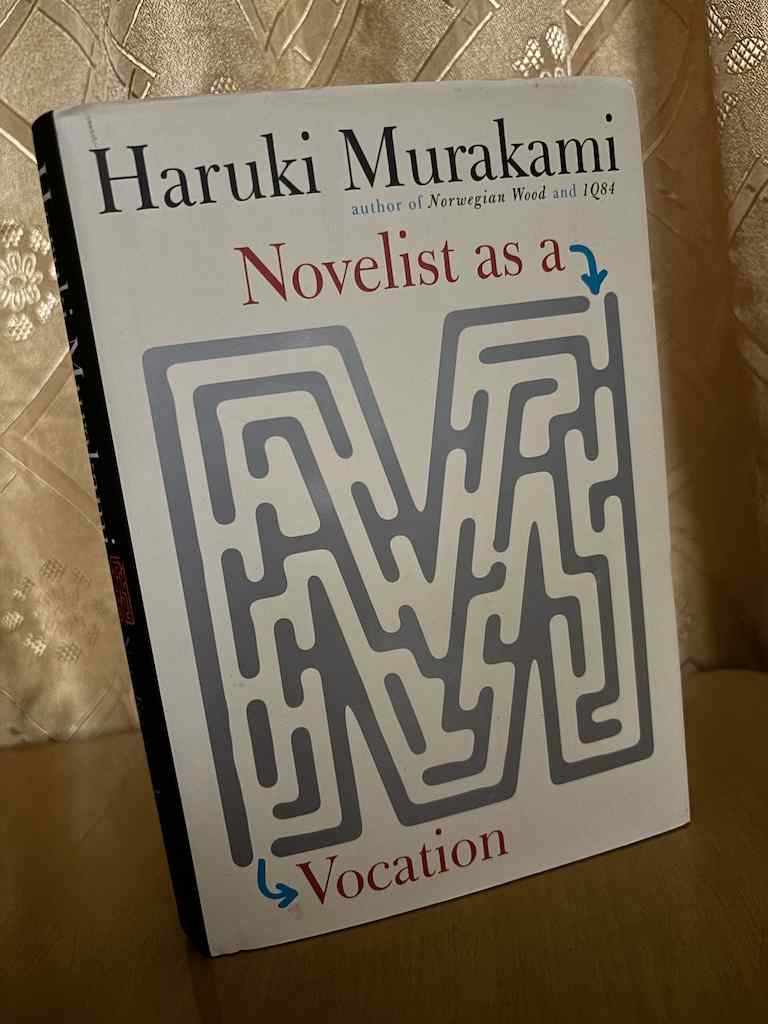
I came to Murakami through his novels, always struck by the gap between the strangeness of his stories and the calmness of his voice. Reading Novelist as a Vocation felt like finally meeting one of his narrators. He insists he is ordinary, an accidental novelist. But the book describes methods that are anything but ordinary. This essay is about that contradiction.
In the spring of 1978, Haruki Murakami was sitting in the stands of Jingu Stadium in Tokyo watching a baseball game when, as he tells it, a life-changing epiphany arrived. The crack of the bat, the scattered applause, and the sudden realization: “I think I can write a novel.” Within six months, he had written Hear the Wind Sing (1979). Within a few years, he was on his way to becoming an international literary phenomenon.
This origin story, recounted in his essay collection Novelist as a Vocation (2015, English translation 2022), has all the hallmarks of a Murakami narrative: the ordinary moment, the inexplicable intrusion, the life tacitly transformed. But the book is structured around a paradox: Murakami repeatedly insists that he is a “regular guy,” the type who gets shown to the worst tables at restaurants, an accidental novelist who simply stumbled into the trade. Yet, the working methods he describes are anything but ordinary: writing his first novel in English to forge a “distinctive rhythm” in his native Japanese, adhering to a factory-like schedule of ten pages per day, and treating the creative process not as a mystical gift but as a form of manual labor, as technical as translation and as physical as running.
The critical reception has been similarly divided. The Guardian praises the book‘s “beautiful essays” and “lessons in simplicity,” highlighting Murakami’s “extraordinary account” of developing his signature style. But The i Paper offers a far harsher verdict, describing the book as “so vanilla, you wonder why he bothered writing it.” The New York Times lands somewhere in between, calling it “assured, candid and often… deeply irritating.”
This review argues that these criticisms miss the point. The apparent banality of Novelist as a Vocation is not a failure of the book but its actual subject. Murakami’s “ordinariness” is not simply a humble pose but a carefully constructed artistic persona—a performance of simplicity that enables the extraordinary imagination to do its work. The book reveals that his vocation is a paradox: a discipline of the mundane that unlocks the fantastical and a commitment to routine that frees the mind to wander into weird, secret places. The man who claims to be ordinary has built an entire literary universe on that claim.
The Persona of the Ordinary Man
Murakami describes his working methods in ways that seem to contradict his ordinary self-portrait. He wrote his first novel in English (a language he did not command fluently) and then translated it back into Japanese. He adheres to a factory schedule: ten pages a day, every day, whether the words come or not. He compares his own creativity unfavorably to writers who draw from a “natural spring.” Those are the lucky ones. He belongs to the other category: those who must “pound the rock with a chisel” to locate the source of creativity. For every new novel, he must dredge out another “unnatural spring” through sheer discipline.
Then there are the “Automatic Dwarves.” He describes his creative process as driving an automatic car for the first time and imagining tiny dwarves inside the gearbox operating each gear. It is an intentionally whimsical metaphor for something most writers describe in loftier terms. But Murakami refuses the loftiness. He chooses dwarves.
I kept circling back to the “Automatic Dwarves” passage while reading this book. The metaphor is so strange and quite silly that I almost laughed out loud. But the more I thought about it, the more it made sense. Murakami is not trying to give us a dignified theory of creativity. He is telling us what it feels like from the inside: you do not know how the gears shift; something down there is doing the work, and you are just driving the car.
The gap between his self-presentation and his actual methods is the book’s central paradox. He insists he is ordinary, yet his practices are meticulously crafted and purposefully chosen. He claims no special talent, yet he has built a career on fiction millions find extraordinary. This is not false modesty but a philosophical position. By demystifying the creative process, by treating it as labor rather than magic, he makes it manageable. If writing is just work, you can do it every day. The dwarves are not mystical creatures but are just workers, like him.
The Discipline of the Unadorned
Murakami’s working methods reveal a philosophy of writing grounded in physical stamina and patient labor. He sets a daily goal of ten manuscript pages and adheres to it “like a bricklayer carefully laying one brick on top of another.” This routine, sustained over decades, produces what he calls “mental toughness” and the ability to endure the loneliness inherent in the novelist’s life. He draws a direct line between this discipline and his long-distance running, an activity he has pursued alongside writing for most of his career. Running, he explains, represents “concretely and succinctly, some of the things I have to do in this life,” even on days when he feels uninspired. For Murakami, the two practices are not separate. Both require showing up, putting in the miles, and trusting that persistence will carry you through the uninspired stretches.
This emphasis on craft extends to his approach to language. Early in his career, Murakami developed a method that remains central to his style. He wrote the opening of his first novel in English, a language he did not command fluently, and then transplanted it back into Japanese. This deliberate limitation forced him to write in a rougher, more direct prose that freed him from the expectations of traditional Japanese literary styles. The voice that emerged was built on rhythm and simplicity rather than ornament, closer in feel to music than to conventional literature.
Once the first draft is complete, Murakami enters a revision process that he approaches with unusual patience. He rewrites each manuscript multiple times, then shows it to his wife for feedback before launching into another round of revisions. He describes this tinkering not as correction but as discovery—a way of finding what the novel wants to become through patient attention to its language. The process continues until the prose feels right, sometimes through ten or more passes.
I have always admired writers who make it look easy, but Murakami makes me admire something else: writers who make it look possible. His daily ten pages, his running, his tinkering—these are not the habits of a genius but of a craftsman who shows up every day. There is something comforting in that. If writing is just work, then work is something you can do.
The Reader Over the Prize
One of the most revealing essays in the collection concerns Murakami’s stance on literary prizes. Early in his career, two of his novels were shortlisted for the Akutagawa Prize, one of Japan’s most prestigious literary awards. Neither won. The news, he noticed, affected others more than it affected him. He found himself wondering why so many people considered the prize important, to the extent that someone later wrote a book on the reasons for his failure to win.
His conclusion is characteristically direct. If receiving an award meant that a war would end or never happen, he suggests, he might feel differently. But in reality, such acknowledgements change nothing. Authors continue working as before, and their work is neither better nor worse for the external endorsement. Prizes, he argues, have more to do with commerce than literature. The Akutagawa winner receives about ten thousand dollars, and the sponsoring publisher receives publicity and a surge in orders. Its purpose may not be strictly commercial, but it would be foolish to pretend the publisher’s bottom line is not involved.
He also questions the judgment of those who confer awards. Truly exceptional writers do not appear often. Giving out a major prize twice annually, year after year, guarantees that some recipients will receive attention and money not because their work deserves it but because the calendar demands it. He has declined invitations to serve on selection committees himself, acknowledging that he is not sure how he would react if someone directed at him the same criticism that such committees inevitably attract.
The writer’s greatest responsibility is to keep providing devoted readers with the best work he can produce. As long as book lovers keep reading, he is content. This stance is not false modesty but a philosophical position grounded in his understanding of what literature is. Prizes are external and temporary, subject to the whims of committees and the pressures of commerce. The relationship between a writer and a reader is something else—private, sustained, and built on trust.
I have thought about this section often since reading it. Murakami is not saying that prizes are meaningless. He is saying they are irrelevant to the actual work. The work exists whether the prize comes or not, because the prize is simply an event and the work is “the thing.” Readers keep the thing alive long after the event is forgotten.
The Performance of Simplicity
The Murakami who emerges from Novelist as a Vocation is not the ordinary man he claims to be, nor is he the baffled accidental novelist who stumbled into fame at a baseball game. He is something more interesting: a writer who has constructed a persona precisely calibrated to make his extraordinary work possible.
The ordinariness is a method, not a confession. By insisting he is a regular guy, by demystifying the creative process into daily pages and patient tinkering, and by replacing the muse with dwarves, Murakami makes the work manageable. If writing is just labor, you can do it every day. If the source of creativity is an “unnatural spring” that must be dredged out through sheer discipline, then you can always dredge another one. The persona protects the work.
The same principle applies to his rejection of prizes. By insisting that the reader matters more than the award and that the work will outlast the event, he aligns himself with the private, sustained relationship that literature requires. Prizes are public, temporary, and subject to forces beyond the writer’s control. The reader is something else entirely—someone who picks up the book alone, reads it alone, and decides alone whether to keep reading. That is the only jury Murakami acknowledges.
The critics who find the book banal or irritating are not wrong about what they see. There are observations that read as painfully simple, statements that seem to state the obvious. But they mistake the surface for the whole. The simplicity is not a failure of thought but a refusal of ornament—a choice to write about the writer’s life in the same unadorned style that Murakami brought back from English and transplanted into Japanese decades ago. The prose performs what it describes.
What the book ultimately offers is not instruction on how to write but testimony on how to live as a writer. The daily routine and the physical discipline, with patient tinkering and turning away from prizes toward readers—these are not just techniques anyone can copy. They are conditions one must accept. Murakami did not become Murakami by following rules. He became Murakami by finding a way to keep working year after year, novel after novel, until the work became inseparable from the life.
My key takeaway from this book is that Murakami did not give me any new rules to follow. He just made the act of writing feel possible. I finished this book and immediately wanted to write something. That may be the most useful thing a book about writing can do to its readers.
Voice and Style: A Complete Guide to Literary Language
Bird by Bird by Anne Lamott: The Lamottian Framework
I picked these three posts from the archive because they offer complementary ways of understanding the Murakami review. The article on “Blind Willow, Sleeping Woman” introduces Murakami’s fiction directly, showing the voice and style that Novelist as a Vocation explains. The guide to “Voice and Style” provides the technical vocabulary for analyzing what makes Murakami’s prose distinctive—the unadorned sentences, the calm tone, the strange imagery. The piece on “Bird by Bird” offers a contrasting framework: where Lamott gives permission through vulnerability and messy first drafts, Murakami gives permission through discipline and patient tinkering. Together, they map the territory this review explores.
Selected Passage with Analysis
What this story shows is that, no matter what you have written, it can be made better. We may feel that what we have turned out is excellent, even perfect, but the fact remains there is always room for improvement. That’s why I strive to set aside my pride and self-regard when rewriting, and cool the passions generated by the creative process. I have to be careful not to cool them too much, though, since that would make rewriting impossible.
Page 102, Novelist as a Vocation by Haruki Murakami
In this passage from the chapter "Making Time Your Ally: On Writing a Novel," Murakami recounts a specific incident from the writing of Dance Dance Dance. He lost a portion of his manuscript on a corrupted floppy disk and rewrote the missing chapter from scratch. Later, he recovered the original version and compared the two. The rewritten version was better. This experience taught him something essential about the writing process: detachment enables improvement.

The passage's temperature metaphor emerges directly from this incident. Murakami describes needing to "cool the passions generated by the creative process" before revision can begin. When he rewrote the lost chapter, he was not simply recreating what had been there. He was writing with a different relationship to the material—less possessive, less attached, and more open to possibilities the original version had not considered. The time between loss and recovery forced a cooling that made better work possible. But he adds the crucial qualification: cooling too much would make rewriting impossible. Complete detachment kills the work as surely as excessive attachment.

This incident explains why time, properly used, becomes the writer's ally. Murakami means time not as a passive waiting period but as an active interval during which the writer's relationship to the work transforms. The lost chapter was not recovered but remade. The remaking was possible only because the passions had cooled to the precise temperature at which judgment could function without extinguishing care. The work improved through a different kind of attention, one made possible by distance, loss, and the patient labor of starting over.
Further Reading
- Haruki Murakami: How I write my novels on penguin.co.uk
- Where to start with: Haruki Murakami by Katie Goh, The Guardian
- The Cult of Haruki Murakami by Jonathan Russell Clark, Esquire
- Haruki Murakami and the Art of the Day by Kevin Hartnett, The Millions
- Why is Haruki Murakami so appealing? on Quora