Language in literature does more than convey information. Its power arises from the arrangement of sound, structure, and imagery to control emphasis, pacing, and continuity. With this control, writers guide attention and manage transitions across sentences and scenes. The result is a text that operates as an integrated, resonant whole rather than a sequence of statements.
For readers, attentiveness to these techniques redirects engagement toward construction. Observing how effects arise from language choices clarifies the relationship between expression and outcome. This awareness exposes the craft decisions that distinguish writing built for accumulation from writing organized through control and intention.
What is a Literary Device?
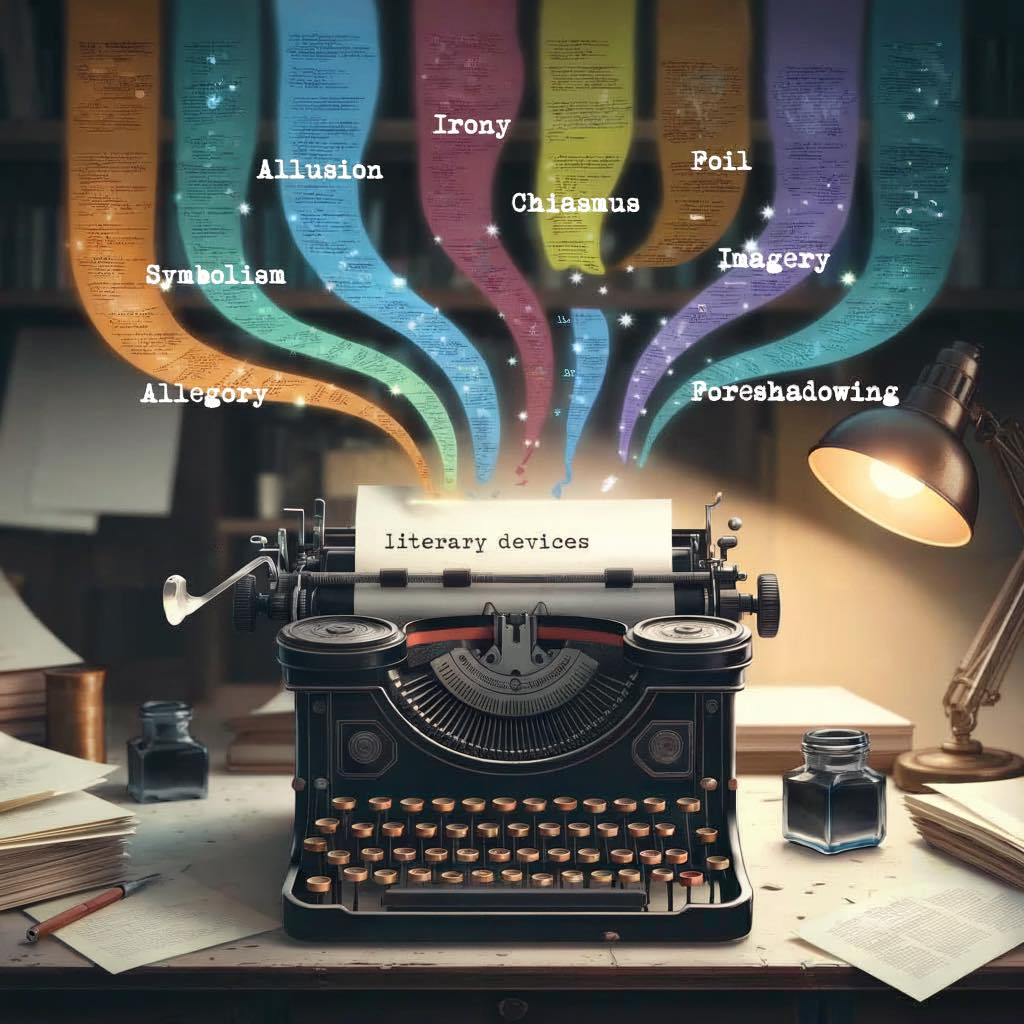
A literary device is a technique that governs how language functions within a text. Such devices operate through comparison, repetition, contrast, pattern, and symbolic reference. They determine how ideas emerge and relate across sentences, scenes, and larger structures. Their purpose lies in organization and emphasis. They guide the progression of thought over the complete scope of a work.
Literary devices do not serve decorative ends. They regulate attention, establish relationships between elements, and determine how transitions occur without reliance on explanation.
The Role of Literary Devices in Writing

Literary devices coordinate language and structure so that expression and idea operate as a single system. Choices in syntax, imagery, sound, and pattern influence pacing, emphasis, and continuity. These choices ensure a text remains whole and does not dissolve into disconnected units.
These techniques also regulate tonal movement. Variations in phrasing, repetition, or imagery redirect focus and signal transition with economy. Through recurring patterns and controlled deviation, devices maintain internal alignment across paragraphs and scenes.
Sound-based techniques extend this control into rhythm and cadence. Repetition, alliteration, and sentence length govern how language registers over time. Structural experimentation further expands narrative range by adjusting sequence, perspective, or form. This grants the writing an evolution that does not sacrifice clarity.
Types of Literary Devices

While it is impossible to cover every literary device in a single discussion, the following list aims to highlight the most essential and widely used tools. These devices have endured over time. They appear consistently in both classic and modern works and are invaluable for writers seeking to refine their craft and readers seeking to engage more deeply with the text.
Metaphor and Simile
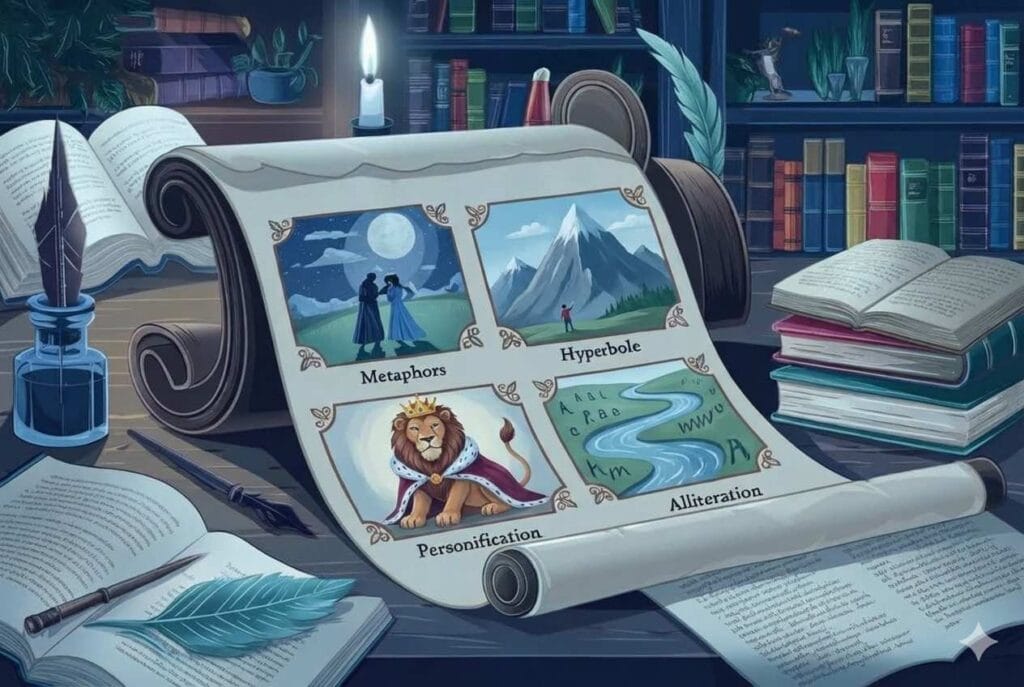
- Metaphor: Creates implicit comparisons by stating one thing is another, distilling abstract or complex ideas into vivid, relatable imagery. Example: “Hope is the thing with feathers” (Emily Dickinson).
- Simile: Explicitly compares two things using “like” or “as.” Example: “Her smile was as bright as the morning sun.”
Symbolism and Motif
- Symbolism: Embeds deeper meaning into objects, characters, or settings. Example: The green light in F. Scott Fitzgerald’s The Great Gatsby (1925).
- Motif: A recurring element that reinforces themes. Example: The use of doubles in Dostoevsky’s The Double (1846).
Personification and Anthropomorphism
- Personification: Attributes human characteristics to inanimate objects. Example: “The leaves danced in the wind.”
- Anthropomorphism: Assigns human traits or emotions to animals or objects as characters. Example: The pigs in George Orwell’s Animal Farm (1945).
Juxtaposition and Contrast
- Juxtaposition: Places contrasting ideas side by side for emphasis. Example: “It was the best of times, it was the worst of times” (Charles Dickens, A Tale of Two Cities, 1859).
- Contrast: Highlights differences between two elements to sharpen meaning or tension.
Allegory and Ekphrasis
- Allegory: Uses narrative or characters to represent larger moral, political, or philosophical ideas. Example: Pilgrim’s Progress by John Bunyan (1678).
- Ekphrasis: Vividly describes art within literature. Example: John Keats’ “Ode on a Grecian Urn” (1819).
Imagery and Sensory Details
- Imagery: Evokes sensory experiences through detailed descriptions. Example: “The crimson petals of the rose drooped in the fading light.”
- Sensory Detail: Engages multiple senses to immerse readers.
Irony
- Dramatic Irony: The audience knows something the characters do not. Example: Oedipus Rex by Sophocles (429 BCE).
- Situational Irony: When outcomes defy expectations. Example: A fire station burns down.
- Verbal Irony: A statement where the intended meaning contrasts with the literal meaning. Example: Saying “What a pleasant day” during a storm.
Paradox and Oxymoron
- Paradox: Contradictory statements that reveal deeper truths. Example: “Less is more.”
- Oxymoron: Combines contradictory terms. Example: “Deafening silence.”
Allusion
- Definition: A reference to an external work, event, or figure that imports its context to enrich the primary text. Example: T. S. Eliot’s The Waste Land (1922) references mythology, religion, and literature.
Hyperbole and Understatement
- Hyperbole: Exaggerates for emphasis. Example: “I’ve told you a million times.”
- Understatement: Deliberately minimizes significance. Example: “It’s just a scratch” (for a large wound).
Foreshadowing
- Definition: Provides hints or clues about future events. Example: The recurring dreams in Gabriel García Márquez’s Chronicle of a Death Foretold (1981).
Flashback and Flashforward
- Flashback: Depicts past events to provide context or background. Example: The fragmented narrative in William Faulkner’s The Sound and the Fury (1929).
- Flashforward: Depicts future events to create anticipation or tension.
Frame Story
- Definition: A narrative that contains another story within it. Example: Mary Shelley’s Frankenstein (1818).
Tone and Mood
- Tone: Reflects the author’s attitude toward the subject. Example: Sarcastic tone in Jonathan Swift’s A Modest Proposal (1729).
- Mood: Evokes an emotional response in the audience. Example: The haunting atmosphere of Edgar Allan Poe’s “The Fall of the House of Usher” (1839).
Alliteration, Assonance, and Consonance
- Alliteration: Repetition of initial consonant sounds. Example: “She sells seashells by the seashore.”
- Assonance: Repetition of vowel sounds. Example: “The rain in Spain falls mainly in the plain.”
- Consonance: Repetition of consonant sounds. Example: “The lumpy, bumpy road.”
Anaphora and Epistrophe
- Anaphora: Repetition of words or phrases at the beginning of successive clauses. Example: Martin Luther King Jr.’s “I Have a Dream” speech.
- Epistrophe: Repetition of words at the end of successive clauses. Example: “…government of the people, by the people, for the people” (Abraham Lincoln).
Chiasmus and Antithesis
- Chiasmus: Reversal of grammatical structures for emphasis. Example: “Ask not what your country can do for you—ask what you can do for your country” (John F. Kennedy).
- Antithesis: Contrasting ideas presented in parallel structure. Example: “To err is human; to forgive, divine” (Alexander Pope).
Apostrophe
- Definition: Directly addressing an absent or imaginary person, or an abstraction. Example: “O Death, where is thy sting?”
Foil
- Definition: A character who contrasts with another to highlight qualities. Example: Dr. Jekyll and Mr. Hyde in Robert Louis Stevenson’s Strange Case of Dr Jekyll and Mr Hyde (1886).
Euphemism and Dysphemism
- Euphemism: A polite expression replacing harsh ones. Example: “Passed away” instead of “died.”
- Dysphemism: A harsh expression replacing mild ones. Example: “Kicked the bucket.”
Synecdoche and Metonymy
- Synecdoche: Uses a part to represent the whole. Example: “All hands on deck.”
- Metonymy: Substitutes a related term for the thing itself. Example: “The crown” for monarchy.
Archetype
- Definition: A universal symbol or character type. Example: The hero’s journey in Joseph Campbell’s The Hero with a Thousand Faces (1949).
Polysyndeton and Asyndeton
- Polysyndeton: Repetition of conjunctions for emphasis. Example: “We have ships and men and money and stores.”
- Asyndeton: Omission of conjunctions. Example: “I came, I saw, I conquered.”
Enjambment and Caesura
- Enjambment: Continuation of a sentence without pause beyond a line of poetry. Example: William Carlos Williams’ “The Red Wheelbarrow” (1923).
- Caesura: A pause within a line of poetry. Example: “To be, or not to be, that is the question” (William Shakespeare).
Stream of Consciousness
- Definition: A narrative style that mimics the flow of thoughts. Example: James Joyce’s Ulysses (1922).
Examples of Literary Devices
Classic Literature
William Shakespeare’s Macbeth (1606) employs a range of devices to explore ambition, power, and guilt. Symbolism is particularly prominent, as the recurring motif of blood signifies the irreversible nature of violence and the magnitude of moral consequence. Lines such as “Out, damned spot!” reflect Lady Macbeth’s psychological unraveling and her inability to escape guilt. Additionally, dramatic irony is used effectively, as the audience is aware of Macbeth’s treachery while other characters remain oblivious, heightening the tension.
Moreover, the oxymoron that juxtaposes opposing words also stands as one of the most prominent literary devices in the classics. Shakespeare frequently used this device to highlight the inherent contradictions of human nature. Phrases such as “loving hate” and “sweet sorrow” (Romeo and Juliet, 1597) reflect the paradoxical nature of our experiences. This device constructs a portrayal that is intricate and dynamic. It mirrors the complex, often contradictory, fabric of existence.
Dante Alighieri’s Divine Comedy (1320), meanwhile, stands as one of the most profound examples of allegory in literature. The entire narrative functions as a representation of the human soul’s journey toward salvation. Virgil, who guides Dante through Hell and Purgatory, symbolizes human reason, while Beatrice represents divine love. Imagery saturates the text, from the gruesome depictions of sinners in Inferno to the celestial beauty of Paradiso, making the moral and theological messages both vivid and enduring.
Yet another intriguing narrative device is the frame story, an overarching narrative that contains another story inside it. Geoffrey Chaucer’s The Canterbury Tales (1392) uses this device to perfection. Every single story is placed within the broader narrative of the pilgrimage, allowing for powerful storytelling that reflects the complexities of culture, faith, and loss.
Furthermore, Herman Melville’s Moby Dick (1851) is replete with symbolism and metaphor. The white whale itself serves as a multifaceted symbol, representing obsession, the sublime, and the unknowable forces of nature. The Pequod, Ahab’s doomed ship, becomes a microcosm of society, with its diverse crew representing humanity’s varied backgrounds and perspectives. Additionally, Melville’s use of allusion—drawing from the Bible, mythology, and Shakespeare—enriches the narrative’s depth.
In Charlotte Brontë’s Jane Eyre (1847), gothic imagery heightens the novel’s emotional and psychological intensity. The fire at Thornfield Hall symbolizes both destruction and purification, mirroring the tumultuous relationship between Jane and Rochester. The recurring motif of the “red room” embodies fear, repression, and Jane’s struggles against external pressures and personal limitations.
Modern Literature
Modern literature further evolves the use of literary devices, but in a modern way. George Orwell’s Nineteen Eighty-Four (1949) uses literary devices to critique totalitarianism and the manipulation of truth. The concept of Newspeak symbolizes the erosion of free thought through the control of language. Irony is pervasive, especially in the Party’s slogans such as “War is Peace” and “Freedom is Slavery,” which reflect the paradoxical nature of authoritarian propaganda. Symbolism is also key, with the glass paperweight representing Winston’s fragile hopes for individuality and connection.
Furthermore, García Márquez’s One Hundred Years of Solitude (1967) exemplifies magical realism, which blends fantastical occurrences with a grounded, historical setting. The rain of yellow flowers upon José Arcadio Buendía’s death symbolizes the merging of the natural and the supernatural, reflecting the novel’s cyclical view of time. Repetition of names within the Buendía family serves as a motif, emphasizing the themes of fate and generational struggle.
Animal symbolism, as seen in George Orwell’s Animal Farm (1945), generates commentary on historical events. Characters embody real political figures. The pigs personify major leaders of the Soviet Union, such as Stalin and Trotsky. They deliver a potent critique of corruption and power. Through allegory, this device offers readers a more complex interaction with the story. It provides a sharper comprehension of the political forces at play.
Toni Morrison’s Beloved (1987), another modern classic, employs symbolism and imagery to address the haunting legacy of slavery. The character Beloved is both a literal ghost and a symbol of the collective trauma borne by enslaved people. Morrison’s use of a nonlinear narrative structure echoes the dislocated nature of memory and identity under such conditions. Metaphors like the “chokecherry tree” scar on Sethe’s back evoke the scars of slavery, both physical and psychological.
In Margaret Atwood’s The Handmaid’s Tale (1985), color symbolism plays a significant role. The red garments of the handmaids signify fertility, sacrifice, and subjugation, while the blue of the Wives’ attire represents coldness and privilege. Atwood also uses irony to critique societal hierarchies; the Commanders, supposedly paragons of morality, are complicit in systematic exploitation. Biblical allusions, such as references to “Rachel and Leah,” highlight the perversion of religious texts to justify oppression.
Kazuo Ishiguro’s Never Let Me Go (2005) employs understatement and subtle imagery to reveal the devastating truths of its dystopian setting. The children’s fascination with creating art symbolizes their longing for individuality and validation in a world that views them as expendable. The setting of Hailsham, idyllic on the surface, contrasts sharply with the grim realities of the characters’ existence, exemplifying the use of juxtaposition to heighten emotional impact.
Using Literary Devices Effectively
To effectively use literary devices in writing, the art lies in subtlety and balance. Overuse of literary devices risks diluting their impact, while skillful integration enhances narrative strength. Devices like metaphor and irony should be seamlessly woven into the text to deeply complement its themes and tone.
Consider the pacing of a story. Alliteration or repetition can generate rhythm. Abrupt changes in diction or syntax intensify tension. Writers must also remain conscious of their audience. They should select devices that connect without alienating through excessive intricacy.
Strategies for Writers
Writers should approach literary devices as tools to elevate their narratives, not as mere embellishments. The goal is to integrate these elements so naturally into the text that they become inseparable from the story.
Recognizing the overlap between literary and rhetorical devices expands the writer’s options for crafting expressive and engaging prose. For instance, the strategic use of litotes can add a touch of understated wit or irony that subtly influences the reader’s perception without being overly dramatic. Euphemisms, idioms, and other everyday language patterns can add relatability to a story when used with care and when clichés or unnecessary ornamentation are avoided.
Sound-based devices such as onomatopoeia offer another layer of immersion, vividly representing auditory elements within the text. When used skillfully, these words enhance the sensory aspects of the writing, anchoring the reader in its scenes. Similarly, paradoxes (through the juxtaposition of contradictory ideas) provoke contemplation and reveal intricate relationships within the narrative. Writers who integrate these devices with precision construct stories that leave a profound impact and linger in the reader’s mind.
Enhancing Storytelling Through Literary Devices
Literary devices have evolved alongside language itself, adapting to cultural and linguistic shifts while preserving their essential role in storytelling. Emerging techniques like neologisms, which are newly coined words, demonstrate how writers consistently push the limits of expression, infusing their work with creativity and novelty. These innovations demonstrate that the application of literary devices is a dynamic process, driven by the demands of each unique narrative.
The ability to distill intricate imagery or concepts into concise, impactful language enhances the narrative’s resonance. A single line—rich with simile, symbolism, or descriptive language—can conjure an entire world on the page. By employing literary devices, writers can construct their works subject to a lifetime of analysis and interpretation, which encourages readers to explore deeper into the text.
Further Reading
- An A to Z Guide to Literary Devices and Tools by Kelly Jensen, Book Riot
- Why a Party is a Perfect Literary Device by Elizabeth Day, Literary Hub
- Most people can’t tell these 4 literary devices apart: your guide to paradox, oxymoron, antithesis & contrast by The Hyperbolit School
- Absolute favorite literary device? on Reddit