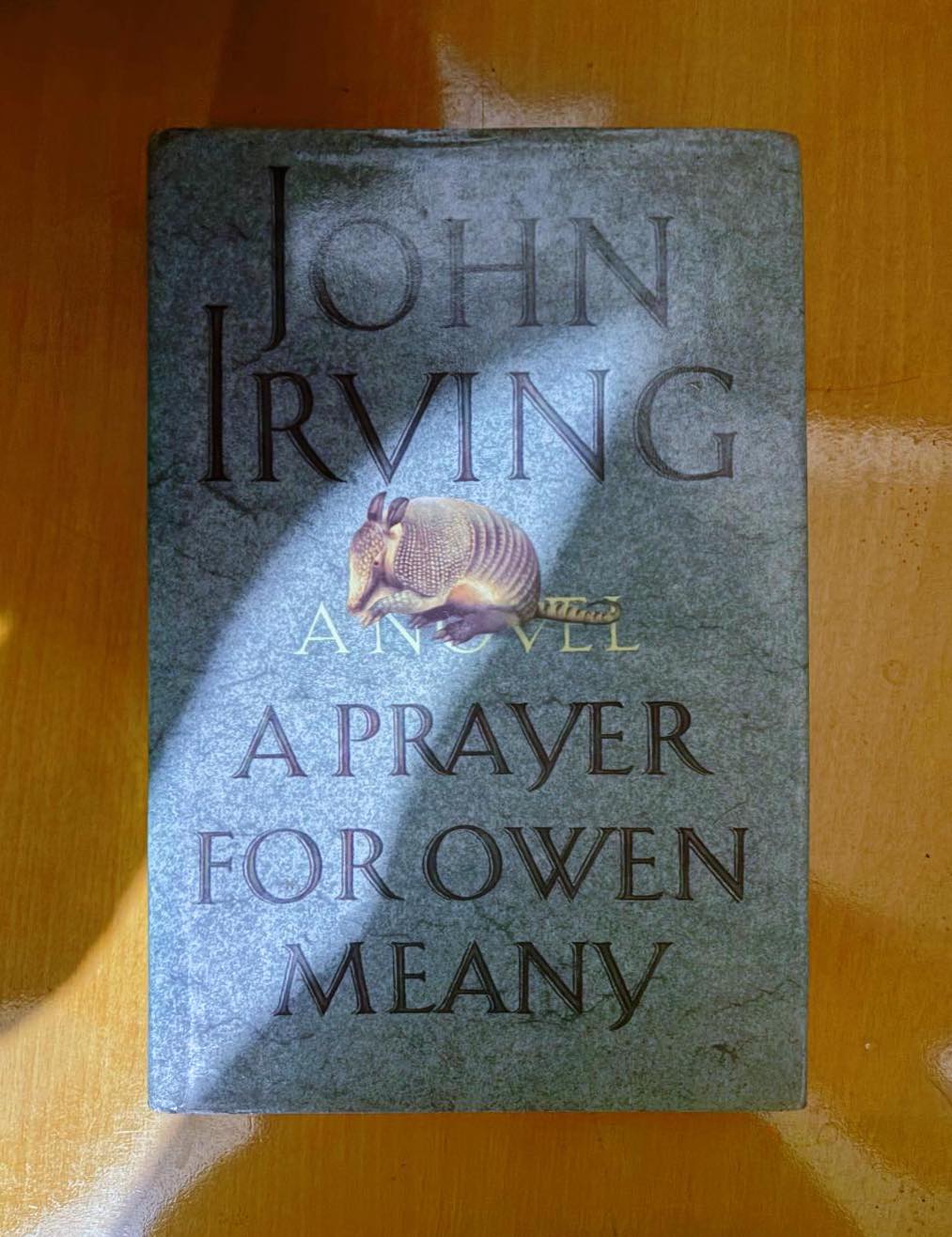
John Irving’s A Prayer for Owen Meany (1989) examines faith, destiny, and the complex filaments of human connection within a vividly rendered New England town. The narrative traces the linked lives of Johnny Wheelwright and his extraordinary friend, Owen Meany. They confront challenges that test their convictions and define their paths. The story maintains a focus on individual experience while extending its inquiry to the broader, enduring puzzles of human existence.
The book examines faith and doubt through the opposing perspectives of Owen, a devout believer, and Johnny, a determined skeptic. The narrative probes the interplay of reason and revelation and challenges readers to confront the tensions between belief and skepticism. Through vividly drawn characters and a resonant setting, Irving poses enduring questions: What defines faith? Can it thrive alongside reason? How do we bridge the divide between the rational and the unexplainable?
Key Themes
Faith and Destiny
Faith and destiny are central themes of the book. Irving explores the tension between belief and skepticism and illustrates how individuals grapple with these forces in a world often marked by uncertainty. Owen Meany’s unshakeable conviction in his purpose serves as a profound counterpoint to the narrator’s (Johnny) struggle with doubt. The recurring imagery of missing body parts, particularly arms, symbolizes the helplessness of people against destiny’s injustices, while Owen’s unwavering belief in divine intervention challenges the boundaries of faith.
Friendship and Sacrifice
The bond between Johnny and Owen, which portrays loyalty and sacrifice with poignancy, forms the heart of the book. Their connection develops from the chaos of childhood into a powerful alliance marked by purpose and trust. Owen’s ultimate act of selflessness encapsulates the depth of their friendship and demonstrates how shared purpose can transcend individual desires. It is a testament to how authentic relationships can transcend self-serving motivations for a collective purpose.
Identity and Belonging
The book probes questions of identity and belonging, with Owen’s physical peculiarities marking him as an outsider even as his sense of purpose anchors his self-identity, while Johnny’s reflections on historical events, such as the Kennedy assassination and the Iran-Contra affair, highlight the interplay between personal identity and broader cultural undercurrents. This examination of identity and belonging is deeply interwoven with the characters’ attempts to reconcile their personal histories with the shifting pressures of history and culture.
Religion’s Influence
Religion is the author’s most important lens through which to view his characters and the world they live in. Irving takes us to his fictional small town of Garp, New Hampshire, which he uses as a backdrop to satirize and critique religious institutions while depicting the characters’ genuine spiritual struggles. Owen’s steadfast faith drives the narrative forward, which challenges the reader to reconsider the role of belief in forging destiny and identity.
Character Analysis: Owen Meany
Owen as a Symbolic Figure
Owen Meany functions as a symbolic presence within the narrative. Irving’s construction of Owen—through his singular voice, small stature, and unshakable conviction—pushes him past the limits of conventional characterization. His physical and vocal particularities isolate him; yet, his profound moral clarity constitutes his defining feature. Owen’s influence persists, a mark of his narrative significance and Irving’s skill in creating figures of lasting consequence.
Owen’s Unique Traits
Unlike the rest of us, Owen Meany has an unshakable faith and, because of that, an unshakable belief in miracles. His memorable physicality and voice establish his immediate presence, yet his defining quality is this foundational moral certainty. Beneath a whimsical and childlike demeanor lies a perspective anchored in innocence and purity, which stands in direct opposition to a world often governed by cynicism. His reflective nature engages deeply with life’s most substantial inquiries, providing the reader with a potent instrument for examining belief.
Owen’s Influence on Others
Owen exerts a profound influence on those around him, especially his closest friend Johnny. This influence directs the emotional trajectory of the book. Through their friendship, Owen fundamentally alters Johnny’s conception of faith and destiny. His bonds with family and friends, combined with his absolute faith, drive the story forward and provide the perfect foil to more cynical, worldly characters.
The inadvertent act by Owen that causes Johnny’s mother’s death becomes a pivotal moment in the book, profoundly affecting all involved. This tragic event not only haunts the characters but also reveals Owen’s multifaceted nature, which highlights the tension between his role as both a catalyst for pain and a symbol of purpose and conviction.
Narrative Craftsmanship
Structure and Pacing
Irving’s narrative moves fluidly between Johnny’s present reflections and his past memories. This dual structure illuminates the enduring impact of Owen Meany on Johnny’s life. The strategic application of foreshadowing generates anticipation while withholding crucial revelations. This technique heightens engagement with the story’s progression. Transitions between timelines occur smoothly, which preserves narrative clarity and sustains forward momentum.
The pacing balances introspective passages with moments of tension and action, which keeps the reader engaged. Irving’s measured pacing mirrors the gradual unraveling of the characters’ destinies and offers a contemplative counterbalance against dramatic events. This rhythmic structure intensifies the book’s emotional texture, ensuring significant moments leave a lasting impact.
Symbolism and Imagery
Symbolism is a cornerstone of the book that weaves deeper meaning into the narrative. The armadillo, for instance, becomes a recurring motif which reflects the complexities of friendship and sacrifice. Other symbols, like Owen’s marble statue and recurring imagery of missing limbs, highlight themes of fate and human vulnerability. These elements create a rich symbolic framework that deepens the story’s exploration of its central ideas.
Irving’s imagery brings the book’s setting and characters to life. Descriptions of New England’s small-town charm stand in contrast to the story’s substantial existential themes. Ordinary moments gain profound significance through Irving’s vivid descriptions and transform the everyday into a canvas for exploring belief, loss, and purpose. This interplay of symbols and imagery enriches the reading experience and rewards those who pay close attention to the book’s nuance and subtleties.
Tone and Mood
The tone and mood of the book mirror the intricate texture of the characters’ lives. Irving’s poetic prose captures a distinct melancholy, particularly within Johnny’s narration. At the same time, moments of whimsy and optimism counterbalance the narrative, preventing it from descending into uniform solemnity. This tonal interplay adds dimension and vitality to the portrayal of the characters’ shifting circumstances.
The mood is equally varied, with an undercurrent of tension that permeates even the lighter scenes. Whether evoking the tranquility of a New England town or the chaos of pivotal events, Irving masterfully crafts an atmosphere that aligns with the story’s emotional beats. The result is a narrative that feels immersive and true to life.
Narrative Voice
One of the most striking aspects of the book is its narrative voice. The first-person perspective of Johnny lends intimacy to the story when recounting his own life and his relationship with Owen Meany. Johnny’s narration, colored by nostalgia and a touch of humor, draws readers into his personal journey. This voice provides a lens through which the book’s events and themes are explored by offering both immediacy and retrospection.
Johnny’s limited perspective adds complexity and nuance as his understanding of events and characters evolves over time. This subjective lens encourages the reader to piece together the broader picture, which deepens engagement with the narrative. The interplay between Johnny’s childhood memories and adult reflections adds richness to the storytelling and to his character arc, making his voice a cornerstone of the book’s emotional impact.
Humor and Absurdity
While the book grapples with weighty themes, Irving’s humor adds balance that offers levity without undermining the story’s gravitas. Absurd situations and witty exchanges reveal the idiosyncrasies of small-town life and the quirks of its characters. This humor makes the narrative more accessible by creating moments of genuine warmth within the overarching tension.
The absurdity frequently fulfills a dual function. It illuminates the paradoxes of human existence while mitigating the effect of darker narrative turns. Irving’s ability to blend humor with poignancy demonstrates his nuanced comprehension of life’s intricacies. This synthesis renders the lighter moments essential components of the book’s overall tone.
Film Adaptation: Simon Birch
The film adaptation, Simon Birch (1998), is a significant departure from Irving’s book. When director Mark Steven Johnson approached Irving with the intention of creating an adaptation, Irving agreed under the condition that he could review the shooting script and decide whether the film could use the book’s title and character names. After reading the script, Irving felt that Johnson’s story was a compelling one but ultimately too different from the book. To avoid misleading the book’s readers, Irving chose to withhold his title and characters from the film, resulting in the creation of Simon Birch as a distinct entity.
Simon Birch preserves certain thematic parallels, namely its engagement with faith and destiny. However, it streamlines the novel’s complexities; it reconfigures the protagonist into a more conventional character and modifies central plot points. Key symbolic motifs from the book, such as the recurring imagery of missing limbs, are largely absent. This omission narrows the film’s capacity to explore themes of vulnerability and free will.
While the film diverges substantially from the novel, it has earned a loyal following. Viewers have come to appreciate the film’s gentler tone, a stark contrast to the book’s darker, contemplative atmosphere. This contrast highlights the different strengths of the two mediums: the novel’s aptitude for intricate psychological exploration versus the film’s focus in visual and emotional immediacy. Ultimately, Simon Birch functions as a distinct reinterpretation, one that illustrates both the possibilities and the necessary compromises of adapting complex literature for the screen
Selected Passage with Analysis
I am doomed to remember a boy with a wrecked voice—not because of his voice, or because he was the smallest person I ever knew, or even because he was the instrument of my mother’s death, but because he is the reason I believe in God; I am a Christian because of Owen Meany.
Opening Sentence, A Prayer for Owen Meany by John Irving
Owen Meany’s description as a boy with a "wrecked voice" and "the smallest person" demonstrates his physical fragility, setting him apart as an extraordinary figure. His damaged voice is emblematic of his otherworldly nature, while his diminutive stature contrasts with the profound impact he has on those around him. These traits make Owen seem almost ethereal, heightening his symbolic role as both a flawed human and a divine instrument. His physical peculiarities are not merely descriptive but integral to his characterization, reinforcing the idea that even the most unlikely individuals can wield immense spiritual significance.

The juxtaposition of Owen as the "instrument of my mother’s death" and the narrator’s faith illuminates the duality of their bond. Owen is a source of both grief and spiritual awakening, embodying the tension between tragedy and redemption. This complexity mirrors the narrator's internal struggle, suggesting that profound faith often emerges from personal anguish. Owen’s role as the cause of the narrator’s loss and the catalyst for his belief in God reflects a nuanced view of faith — one born from adversity rather than blind acceptance.

The word "doomed" injects a sense of inevitability and weight into the narrator's reflection, emphasizing the indelible mark Owen left on his life. The emotional resonance conveys both reverence and sorrow, underscoring the narrator’s transformation through his relationship with Owen. This emotional depth encapsulates the paradox of faith: a bittersweet yet profound journey shaped by both suffering and awe.
Further Reading
- In Garp’s footsteps [spoilers] by Stephen Games, The Guardian
- A Prayer for Owen Meany Study Guide by LitCharts
- 13 Facts About A Prayer for Owen Meany by Erin McCarthy, Mental Floss
- A Prayer for Owen Meany: Attack of the Semi-Colons [possible spoilers] on Reddit