Every story is told through a lens. That lens—the story’s perspective or point of view—fundamentally governs the reader’s experience, determining what they know, when they know it, and how they connect with the characters. Moving beyond simple categories of first or third person, a complete understanding of narration presents it as a powerful and multifaceted tool. We can break down this tool into three essential dimensions: the grammatical voice, the scope of knowledge, and their relationship to the truth.
Dimension 1: The Grammatical Voice
This is the most recognizable layer of narration, defined by the pronouns used.
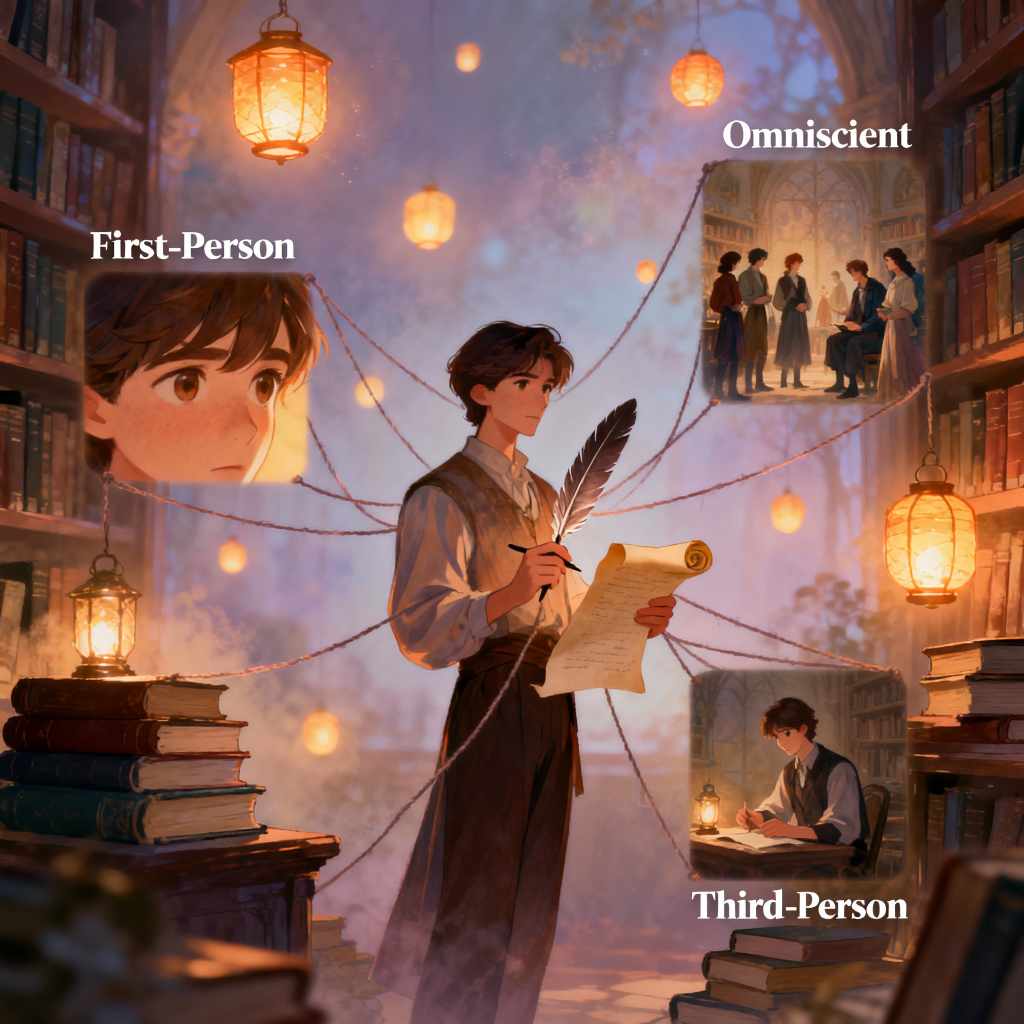
- First-Person Narration (The “I” Voice): The narrator is a character within the story, giving a direct, subjective account. Its power lies in its immediacy and intimacy, which grants the reader deep access to a single character’s thoughts and feelings. However, it is inherently limited; the reader can only know what the narrator knows, sees, and experiences. This limitation is its greatest strength for building character voice, but it restricts the narrative’s scope. A classic example is Holden Caulfield in The Catcher in the Rye (1951), whose distinct personality colors every event.
- Second-Person Narration (The “You” Voice): A rare but potent technique, the narrator implicates the reader directly by making them the protagonist. It can create an intense, immersive experience or a sense of accusatory detachment. Because of its unusual nature, it is often reserved for experimental literature, “choose your own adventure” stories, or specific stylistic effects, as seen in Jay McInerney’s Bright Lights, Big City (1984).
- Third-Person Narration (The “He/She/They” Voice): An external narrator tells the story. This is the most flexible mode, encompassing a spectrum of knowledge and distance, which leads us directly to the second dimension.
This dimension—encompassing first-, second-, and third-person perspectives—is explored in full depth in our definitive guide, Points of View: A Comprehensive Guide.
Dimension 2: The Scope of Knowledge
Within third-person narration, the narrator’s omniscience—or lack thereof—defines the narrative’s scope.
- Third-Person Omniscient (The God’s-Eye View): Here, the narrator is all-knowing. They can access the thoughts of any character, move freely through time and space, and even offer their own commentary. This style finds its classic expression in 19th-century authors like George Eliot and Leo Tolstoy, whose narrators often comment on the story’s events with authority and deep insight. This mode creates a grand, panoramic view of the story world but can create distance from individual characters.
- Third-Person Limited (The Over-the-Shoulder View): The modern successor to omniscience, this mode anchors the perspective to a single character at a time. The narrator is external, but the reader only sees, hears, and knows what the focal character experiences. It combines the objectivity of third-person grammar with the focused subjectivity of first-person. Much of contemporary fiction, from J. K. Rowling’s Harry Potter series to George R. R. Martin’s A Song of Ice and Fire (1996) (which uses multiple limited third-person viewpoints), relies on this versatile mode.
- Third-Person Objective (The Camera Lens): The most detached form, this narrator reports only observable actions and dialogue, never venturing into any character’s internal thoughts. The reader is left to infer motives and feelings, much like an audience watching a play. This creates a sense of realism and impartiality but can feel cold or withholding. Ernest Hemingway was a master of this style.
Dimension 3: Relationship to the Truth
This dimension cuts across the others, questioning the narrator’s trustworthiness and their role in the story’s construction.
- The Reliable vs. Unreliable Narrator: A reliable narrator provides an account the reader is meant to accept as truthful within the story’s context. An unreliable narrator, however, presents a distorted version of events. This distortion can be deliberate (a liar), involuntary (mental illness, naivete), or a result of a limited perspective. The gap between the narrator’s account and the reader’s inference creates rich irony and depth, as seen in the charming deceptions of Nick Carraway from The Great Gatsby (1925).
- The Intradiegetic vs. Extradiegetic Narrator: This technical distinction clarifies the narrator’s position. An intradiegetic narrator is a character within the story, telling a tale to other characters (e.g., Scheherazade in One Thousand and One Nights). An extradiegetic narrator exists outside the story’s world, addressing the reader directly—this is the standard narrative voice of most novels.
- The Self-Conscious Narrator: A subtler variant, this narrator is acutely aware that they are crafting a story for an audience. They may comment on the narrative process, question their own memory, or directly address the reader about the challenges of telling the tale. This metafictional technique, perfected in Laurence Sterne’s Tristram Shandy (1759–1767), breaks the illusion to explore the very nature of storytelling.
The Advanced Tools
Beyond these categories, two advanced techniques blend the dimensions to create unique effects.
- Free Indirect Discourse (FID): This is the secret engine of modern third-person narration. FID seamlessly blends the narrator’s voice with a character’s inner voice. It drops the “he thought” tag and slips directly into the character’s consciousness, often retaining their grammar and emotional tone. For example: “He looked at the letter. So, she was leaving him. It was unbelievable.” Here, the first sentence is pure narration. The second sentence, “So, she was leaving him,” is the clearest example of FID: it is the character’s raw thought, but it has been grammatically folded into the narrator’s third-person voice. The final sentence lives in the ambiguous space FID often creates, belonging both to the character’s shock and the narrator’s description. This fusion creates profound intimacy without abandoning the flexibility of third person.
- Stream of Consciousness: Often confused with first-person, this technique is a mode of representing thought, not a narrative voice itself. It attempts to mimic the raw, chaotic, and associative flow of a character’s pre-linguistic mind, often abandoning conventional grammar and logic. While it can be used in first person (as in parts of Faulkner’s The Sound and the Fury, 1929), it can also be rendered through third-person FID.
No single narrative type is inherently superior. The choice is a strategic one, a symphony of grammatical voice, knowledge, and reliability. A tight third-person limited builds suspense in a thriller; an unreliable first-person creates mystery in a psychological novel; an omniscient voice lends epic scale to a saga. By understanding the complete typology of narration, a writer moves beyond simply telling a story to mastering how it is experienced, choosing the perfect lens to bring their world into focus for the reader.
Further Reading
Narration: Who’s Telling Your Story? by Khepri Hazel, Medium
What Does Your Inner Narrator Sound and Look Like? by Gia R., Book Riot
Who is “the narrator” in the novel, and what are the major types of narration? on Quora
What type of Narration do you prefer? on Reddit