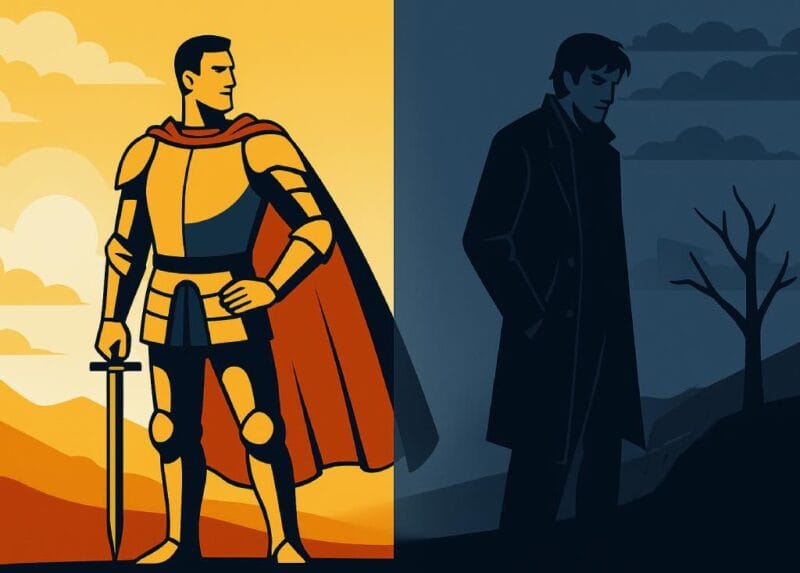
The most compelling tragedies are built on a deep, logical bond between character and fate. The Tragic Hero archetype is the embodiment of that bond. This archetype functions as the human mechanism that makes a plot’s structural descent feel resonant and inevitable.
For the writer, this archetype solves the specific narrative challenge of constructing a protagonist whose own nature guarantees their undoing. This guide examines the Tragic Hero as a functional instrument, defining its three core components that bind character to fate and transform the plot into meaningful tragedy.
The Core Mechanism: A Tripartite Engine
The Tragic Hero operates as a tripartite engine of three distinct components: the Flaw, the Turn, and the Insight. Each component serves a specific function in binding character to consequence.
- The Flaw as Fuel (Hamartia): The tragic flaw is the protagonist’s primary catalyst for action. It is more than a personality trait; it is an active, decision-making filter. Hubris, ambition, or jealousy, for example, dictates the character’s key choices that propel the narrative forward. This flaw ensures the protagonist is not just a passive victim of circumstance but also an active agent in constructing their own misfortune.
- The Turn as Structure (Peripeteia): The reversal of fortune is the direct plot-level consequence of decisions made through the flawed filter. It is the moment where the character’s trajectory shifts from ascent to descent, often aligning with the structural climax of the narrative. This turn is not a random accident but the logical outcome of the flaw in motion, marrying character mechanics to plot mechanics.
- The Insight as Payoff (Anagnorisis): The moment of recognition provides the tragedy’s thematic and emotional justification. The protagonist gains a clearer, often devastating, sense of their role in their own downfall. This insight elevates the narrative from simple misfortune to meaningful tragedy and offers the audience a moment of clarity and catharsis that validates the preceding struggle.
The Functional Archetype: From Ancient to Modern
This three-part engine remains functionally consistent, proving the archetype’s utility beyond classical forms.
Classic Execution: Oedipus
In Sophocles’ Oedipus Rex, the mechanism is explicit. Oedipus’s hamartia (a combination of pride and relentless determination) fuels his investigation. The peripeteia is the revelation that he himself is the murderer he seeks. The anagnorisis is his brutal self-blinding, the physical manifestation of his new, tragic knowledge. Each component drives the next with mechanical inevitability.
Modern Application: Michael Corleone
In The Godfather (1969), Michael’s flaw is a corrosive blend of familial loyalty and cold rationality. His turn (peripeteia) is the cumulative point where his calculated actions to protect his family irrevocably transform him into its most monstrous leader. His final anagnorisis is the silent, empty victory—the moment that conveys the total cost of his choices and the loss of his own soul. This engine, consistent in its precision, functions identically within the sprawling context of a modern epic.
Integration with Narrative Structure
The Tragic Hero archetype finds its natural structural counterpart in Freytag’s Pyramid. The hero’s flaw instigates the rising action; the reversal (peripeteia) defines the climax; the insight (anagnorisis) and its aftermath establish the emotional and logical necessity of the falling action and catastrophe. Attempting a tragic structure without this specific character mechanism often results in a plot where misfortune feels arbitrary or unearned. The Tragic Hero provides the necessary human cause for the structural effect.
Building with Purpose
The Tragic Hero is a purposeful instrument for writers. Its value lies not in replicating a classical checklist but in leveraging its cause-and-effect mechanism to construct a plot where downfall is inevitable, meaningful, and deeply tied to character. By defining the flaw as fuel, the turn as structure, and the insight as payoff, a writer engineers a narrative where every tragic beat feels both surprising and necessary.
To apply this character mechanism, a writer requires the correct structural blueprint. This tragic archetype is engineered to function within the specific five-act framework of Freytag’s Pyramid, which meticulously charts the protagonist’s rise and fall. For narratives driven by transformation, momentum, or strategic plotting, explore other models in our central guide: Choosing a Narrative Structure: A Writer’s Blueprint.
Further Reading
A Tragic Hero: Morally Virtuous or Deliberately Vicious? by No Sweat Shakespeare
Drama in a Tragic Key by The Metropolitan Opera
Who are the most famous tragic heroes in literature? on Quora
Why Tragedy? on Reddit