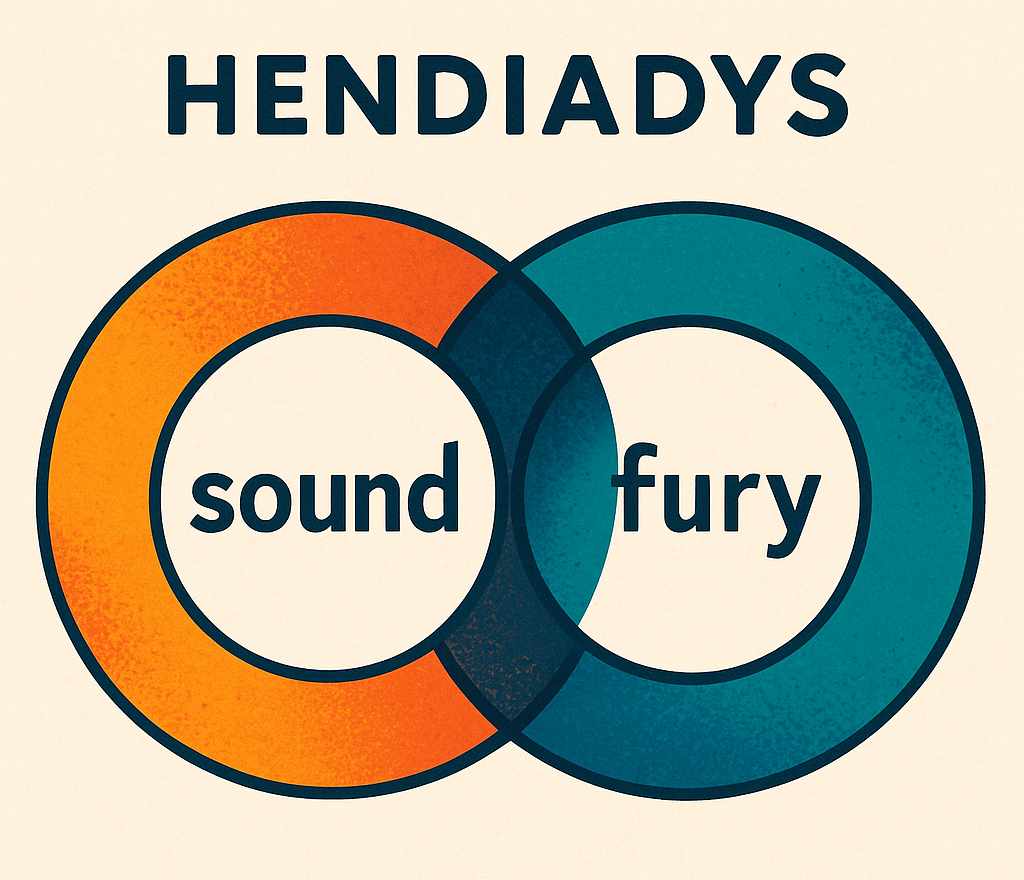
Hendiadys is a rhetorical and literary device in which a single idea is expressed through two nouns joined by a conjunction, most often “and.” Instead of using an adjective to modify a noun, the writer separates the thought into two parallel words. For instance, saying “sound and fury” communicates intensity more vividly than “furious sound.” The term comes from the Greek phrase hen dia dyoin, meaning “one through two.”
Writers employ hendiadys to create emphasis, slow down rhythm, or amplify tone. By breaking a single concept into two, the expression gains a kind of spaciousness, heightening its poetic or dramatic effect.
Hendiadys in Literature
Shakespeare and the English Stage
No writer exploited hendiadys more famously than William Shakespeare. His plays contain hundreds of instances, making the device a signature feature of Elizabethan drama. In Hamlet (1603), Claudius speaks of “the book and volume of my brain,” a phrase where “book” and “volume” are redundant yet powerful together. The doubling slows the cadence of speech and invests the thought with grandeur.
Another striking example appears in Macbeth (1606): “sound and fury.” Both nouns describe a single storm of chaos, but their pairing intensifies the overwhelming force of Macbeth’s despair. Shakespeare’s frequent use of hendiadys suggests he valued its ability to enrich language, even when it strained conventional syntax.
Classical and Biblical Sources
Hendiadys predates Shakespeare. Latin poets such as Virgil and Ovid often employed it to elevate diction. In Virgil’s Aeneid (19 BCE), the phrase “pateris libamus et auro” is translated as “we pour libations from bowls and gold,” where “bowls and gold” essentially form one idea—lavish vessels.
The Bible also contains examples. The phrase “bond and free” in the New Testament does not signify two groups but expresses the entirety of humanity. Hendiadys here serves both stylistic and theological functions, stressing inclusivity through paired terms.
Why Writers Use Hendiadys
- Amplification and rhythm: By splitting one idea into two nouns, hendiadys stretches thought and creates a rhythmic pause. A phrase like “grace and favor” lingers longer in the ear than “gracious favor,” which gives the language a ceremonial solemnity. This elongation was especially useful in oral cultures, where cadence conditioned memory and effect.
- Expressive redundancy: Hendiadys often involves redundancy, but that very surplus carries expressive power. Doubling words can amplify emotional charge, reinforcing the feeling that ordinary grammar would thin out. When Queen Gertrude speaks of “heat and flame,” she urges Hamlet for patience upon his passionate disturbance or anger.
- Texture in poetry and prose: Writers of poetry and fiction employ hendiadys to enrich texture. By refusing to compress thought into a single modifier, the phrase encourages contemplation of both elements separately and together. The dual form avoid closure, keeping the language open and resonant.
Related Rhetorical Figures
- Merism: Expressing a whole through two extremes, such as “high and low” or “young and old.”
- Pleonasm: Redundancy in words, sometimes overlapping with hendiadys when used for emphasis.
- Polysyndeton: Repetition of conjunctions, which, like hendiadys, alters rhythm and pace.
These figures share with hendiadys a concern for amplification and rhythm, showing how rhetorical devices often blur into one another.
Hendiadys and Its Significance in Reading
Encountering hendiadys in literature slows the act of reading. The phrase interrupts the ordinary flow and motivates the eye and ear to linger. Instead of gliding past “furious sound,” one must hold “sound and fury” in suspension and consider how the two words press against each other. This delay draws attention to the structure of language and shows that style can carry as much potency as content.
Hendiadys also reflects how reading engages with rhythm. Doubling creates cadence that echoes in memory, often making these expressions among the most quoted lines from a work. The device therefore functions not just as ornament but as a means of securing permanence in literary consciousness.
Further Reading
Hendiadys on Wikipedia
A challenge to hendiadys in the law by Samuel Bray, Reason Magazine