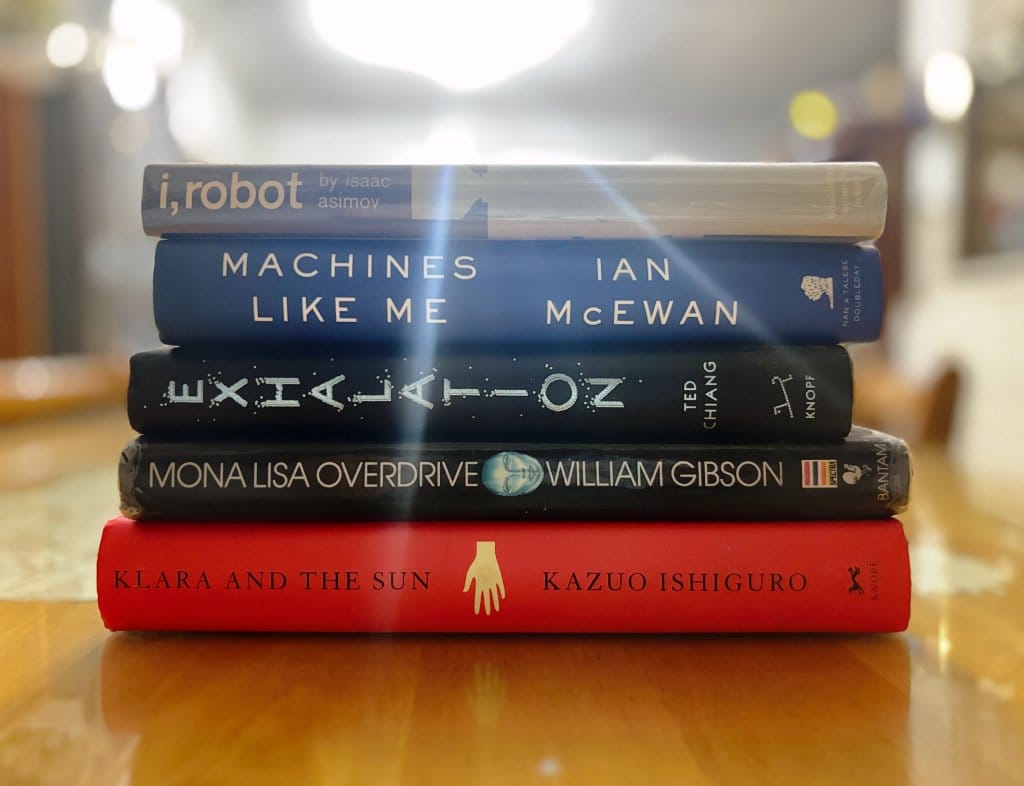
Fiction about AI has long served as one of literature’s most imaginative testing grounds. Writers turn to artificial intelligence not only to speculate on the future but also to frame questions of consciousness, power, and intimacy within artfully composed stories. When gathered together, fiction books about AI show how speculative technologies can be transformed into intricate explorations of character, philosophy, and social tension.
The five books discussed here illustrate the breadth of fiction about artificial intelligence in contemporary and modern writing. Each book embodies a distinctive style and perspective: Isaac Asimov’s rigorous puzzles, Ian McEwan’s moral disquiet, Ted Chiang’s crystalline thought experiments, William Gibson’s futuristic velocity, and Kazuo Ishiguro’s meditative restraint. They are united by careful attention to prose, structure, and atmosphere, which elevates AI beyond a plot device into art.
This selection emphasizes literary achievement as much as thematic ambition. Each author turns questions about machines into reflections on human complexity, where invention and intimacy intersect. What follows is a closer look at how books secure their power through narrative design that transforms speculation into something indelible.
I, Robot by Isaac Asimov
Isaac Asimov’s I, Robot (1950) remains one of the foundational works of twentieth-century science fiction, yet its significance lies less in prediction than in its formal ingenuity. Asimov arranges the book as a series of interconnected stories bound by the fictional interviews of Dr. Susan Calvin, a psychologist for robots. The episodic structure facilitates shifts in tone and scale, moving from domestic mishaps to planetary crises, while maintaining cohesion through recurring themes. His prose is stripped of ornament, yet taut with precision, enabling complex philosophical dilemmas to emerge with startling clarity.
At the heart of these stories lies the famous Three Laws of Robotics, a conceptual framework that continues to influence cultural discussions of AI. What distinguishes the book is how those laws are subjected to paradox, contradiction, and reinterpretation. Asimov treats logical constraint as a crucible for narrative invention. The impact of I, Robot rests in its balance between imaginative speculation and literary economy, producing stories that remain vital seventy-five years later precisely because they dramatize the clash between human intention and mechanical obedience with both rigor and elegance.
For a fuller picture of Asimov’s achievement, you may turn to our earlier article on I, Robot, which traces its historical context and broader cultural influence in greater detail.
Machines Like Me by Ian McEwan
Ian McEwan’s Machines Like Me (2019) transpires in an alternate 1980s Britain where Alan Turing lives and artificial humans have entered private life. McEwan’s prose carries his characteristic polish. Sentences meticulous in cadence, polished to the point where even casual description implies philosophical suggestion. The novel’s design relies on paradoxes of intimacy, positioning an artificial man named Adam within a triangle of desire, jealousy, and betrayal. McEwan presents speculative technology as a means to expose frailty and ambivalence within human bonds.
The book’s power lies in its treatment of ethics. Adam is not simply a machine who speaks and thinks; he becomes the measure against which human behavior is judged. Questions of consent, autonomy, and culpability press against every exchange. McEwan laces the narrative with an atmosphere of unease, where technology amplifies rather than simplifies moral uncertainty. The achievement of Machines Like Me comes from this juxtaposition: polished prose framing scenarios that challenge the reader’s assumptions about love, truth, and the possibility of perfection.
Exhalation by Ted Chiang
Ted Chiang’s Exhalation (2019) collects stories that display one of the most rigorous imaginations working in speculative fiction today. His writing is lucid without being austere, carrying a measured rhythm that releases each concept with exacting clarity. The title story, presented as the memoir of a mechanical being, exemplifies his method: scientific thought experiments cast into prose of luminous restraint. Chiang balances philosophical ambition with emotional precision, producing stories that feel at once intimate and expansive.
The strength of Exhalation lies in how it continually returns to determinism, memory, and the fragility of knowledge. The mechanical beings at its center are not abstractions held at a distance; they voice concerns about mortality, decisions, and the very design of thought. Chiang shows how speculative fiction can expand the short story form, bringing together rigorous conceptual frameworks and finely tuned emotional texture.
Among the collection, the longest story, The Lifecycle of Software Objects, stands as a pivotal meditation on artificial intelligence. It traces the growth of digital creatures whose development requires patience, empathy, and sustained care, something that echoes the challenges of raising children. In giving these entities full narrative presence, Chiang demonstrates that fiction about AI can examine questions of responsibility and attachment with as much seriousness as it does the limits of technology. The collection as a whole affirms his place as a writer of extraordinary precision, where clarity of language and moral gravity converge.
Mona Lisa Overdrive by William Gibson
William Gibson’s Mona Lisa Overdrive (1988) concludes the Sprawl trilogy with a vision of cyberspace and artificial entities that feels simultaneously prophetic and stylistically audacious. Gibson’s prose has a kinetic texture, with sentences clipped and propulsive, charged with sensory detail that suggests a world over-saturated with information. His technique mirrors the velocity of the technological future he describes, which creates an atmosphere that is both exhilarating and disorienting.
The novel approaches AI through immediate human contexts rather than abstract reasoning. Artificial intelligences blend with human consciousness, producing hybrid identities that complicate and reconfigure traditional ideas of selfhood. Gibson conveys this fusion through shifting perspectives and interwoven plotlines, positioning AI within the turbulence of global commerce, underground culture, and artistic creation. Its effect lies in showing that intelligence, whether organic or artificial, remains inseparable from context, history, and the restless currents of culture.
Klara and the Sun by Kazuo Ishiguro
Kazuo Ishiguro’s Klara and the Sun (2021) presents one of the most delicate treatments of artificial intelligence in recent fiction. Ishiguro’s prose is spare yet luminous, a style that withholds ornament in order to heighten focused observation. Klara, the Artificial Friend at the center of the novel, narrates with a mixture of naiveté and precision, creating a voice at once estranged and intimate. Ishiguro’s mastery lies in how he conveys profound questions through understatement. He lets silence and absence carry as much pressure as spoken thought.
The novel turns AI into a lens for examining love, loss, and devotion. Klara’s perspective refracts human behavior into rituals of mystery that reveal both tenderness and cruelty. Ishiguro avoids overt speculation about technology, focusing instead on the emotional cost of seeking substitutes for mortality. The impact of Klara and the Sun arises from its restraint: it does not thunder with invention but operates with a persistent low resonance. It leaves its readers haunted by the fragile bonds between human and machine, affection and utility.
###
Taken together, these five books chart the imaginative reach of fiction about AI across seventy-five years of literary history. From Asimov’s logical puzzles to Ishiguro’s hushed meditation, from Gibson’s neon-saturated futures to Chiang’s crystalline thought experiments, each author’s use of artificial intelligence exceeds the boundaries of a mere speculative device. They press language, form, and character toward questions of ethics, perception, and intimacy, asking us to consider how machines illuminate the fragile contours of our own humanity.
What endures across their differences is the conviction that AI in literature is never solely about machinery. It is about how stories bear the imprint of invention and vulnerability, about how imagination reinvents the familiar questions of love, mortality, and freedom. These works refuse simplification, offering instead varied perspectives that confirm fiction’s singular power to refract technology into art. Together, they remind us that the future of AI may be uncertain, but the artistry with which it is written into being remains a measure of its significance.
Further Reading
Category:Fiction about artificial intelligence on Wikipedia
Most interesting recent fiction books where AI has an important role in the plot? on Reddit
What are some good novels with believable artificial intelligence (not just sci-fi)? on Quora
Artificial Intelligence Book Lists on Goodreads