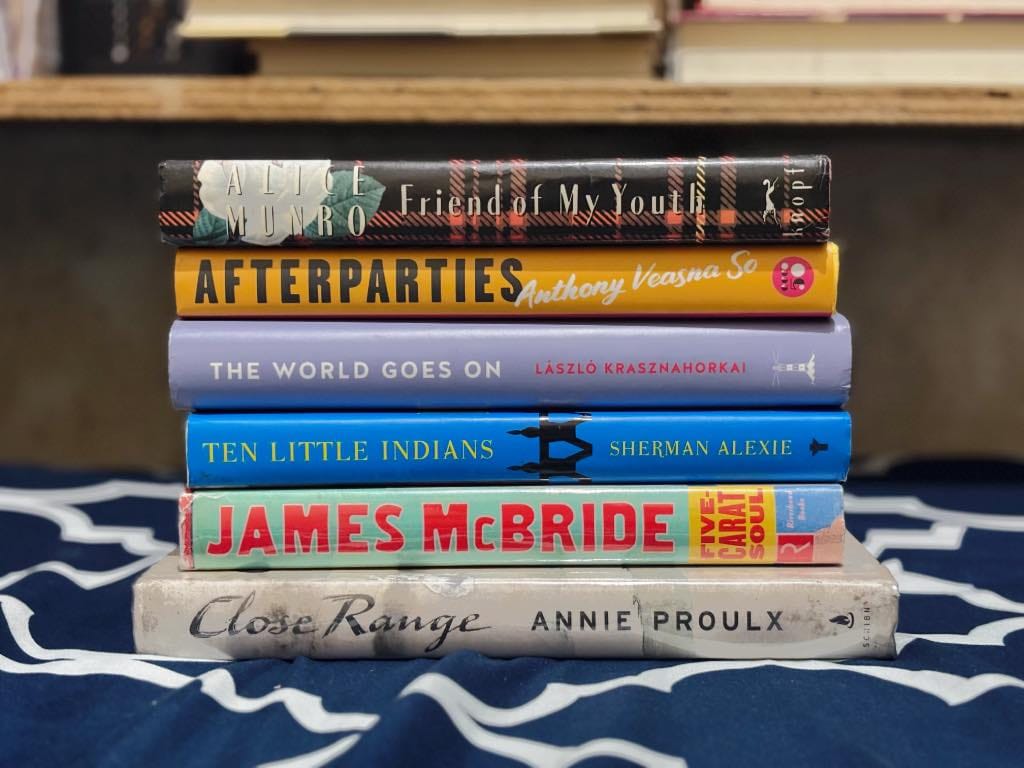
A well-made short story carries a singular presence that cannot be replicated. Unlike novels that build momentum through scale, short fiction draws its strength from compression. Instead of relying on breadth, it offers precision in snapshots of lives in flux, distilled emotion, or sudden insight. This curated collection features six books that showcase the immense range of short fiction, from intimate interiority to philosophical vastness, from stylistic experimentation to culturally rooted realism. Each one brings its own kind of precision, offering not only finely drawn stories but also new modes of telling.
Taken together, these volumes span a wide range of tone and texture. Alice Munro examines memory and misrecognition with devastating restraint, while László Krasznahorkai pursues recursive meditation. Anthony Veasna So brings sharp intelligence and a generational voice formed at the intersection of heritage and contemporary strain. Sherman Alexie writes against invisibility through biting humor. James McBride’s stories avoid thematic neatness and move instead through improvisation and historical subversion. Annie Proulx depicts lives worn down by terrain and time, sparing no one the hard facts of place. These collections show how short fiction can remain exacting while embracing multiplicity, with each story operating as a self-contained world that still speaks to shared conditions of life.
Friend of My Youth by Alice Munro
Alice Munro has long been revered as one of the greatest practitioners of the short story, and Friend of My Youth (1990) stands as one of her most poignant, expertly constructed works. In this collection, Munro explores the fissures and echoes that form across relationships over time—between mothers and daughters, lovers and strangers, youth and age. What distinguishes these stories is not only their emotional precision but also their temporal complexity. Munro layers memory with present reflection, and the result is a sense of life that feels utterly real: nonlinear, elusive, and intimate.
What makes Friend of My Youth stand out is Munro’s masterful command of omission and restraint. She lets silence speak volumes. Her stories often turn on a minor detail such as a gesture, a glance, or a buried letter, which opens inward onto regret, confusion, and recognition. Unlike more overtly dramatic story collections, Munro trusts the reader to dwell in ambiguity. These stories linger through emotional clarity that emerges gradually, sometimes only in retrospect, rather than through abrupt narrative turns.
Afterparties by Anthony Veasna So
Published posthumously in 2021, Afterparties is a blazing debut that introduced a bold new voice to American fiction. Anthony Veasna So, the queer son of Cambodian immigrants, filled these stories with restless energy, dark humor, and unflinching tenderness. Set in California’s Central Valley, the collection captures the tension between inherited trauma and modern identity. So’s characters straddle two worlds: that of their refugee parents, shadowed by genocide, and the contemporary pressures of queer identity, assimilation, and class conflict.
What sets Afterparties apart is its tonal dexterity. So moves seamlessly between absurdist humor and moments of aching vulnerability. He writes about young Cambodian Americans with specificity and irreverence, sidestepping clichés and instead giving us complex characters who struggle, lie, connect, and yearn. Stories like “Superking Son Scores Again” or “Three Women of Chuck’s Donuts” don’t moralize or explain—they just are, vivid and pulsing. The result is a collection that feels urgent, alive, and deeply human.
The World Goes On by László Krasznahorkai
The World Goes On (Megy a világ, 2013; translated from Hungarian, 2017) is less a short story collection in the traditional sense and more a sequence of philosophical meditations masquerading as narratives. Hungarian writer László Krasznahorkai, best known for his labyrinthine sentences and apocalyptic tone, offers a challenging yet transcendent reading experience. These stories often feature solitary figures confronting the absurdity of existence, spiraling into lengthy internal monologues that defy tidy resolution.
What makes The World Goes On unforgettable is its stylistic audacity. Krasznahorkai’s prose circumvents the bite-sized neatness usually associated with short fiction; instead, each piece probes the void beneath surface reality. It’s a collection that demands slow reading and rereading, offering no easy catharsis but ample reward for those willing to wrestle with its depth. In a genre often praised for economy, he chooses to stretch language to its breaking point. Where most short stories end with a flicker of insight, these conclude in vertigo, pushing readers into deeper existential terrain.
Ten Little Indians by Sherman Alexie
Sherman Alexie’s Ten Little Indians (2003) navigates the contradictions of contemporary Native American life with biting wit and piercing empathy. Most stories follow Spokane characters navigating contemporary life in and around Seattle, often occupying social and professional spaces that expose their difference. Alexie’s storytelling has always been marked by tonal range, but here it sharpens into a pattern of elegy embedded within satire.
His protagonists are often ambivalent about heritage, aware of being both seen and misread. In “What You Pawn I Will Redeem,” a homeless man embarks on a quest to buy back a pawned heirloom—his grandmother’s regalia—but what unfolds is a wry commentary on transactional ethics, community failure, and dignity. The voice throughout the collection walks a tightrope between anger and playfulness, managing to critique with the same force that it entertains. Alexie does not flatten his characters into symbols; he writes them as people with sharp contradictions and unfinished desires.
Five-Carat Soul by James McBride
James McBride’s Five-Carat Soul (2017) works like a series of improvisations across time, genre, and voice. No two stories inhabit the same terrain. A boy’s love for toy trains becomes an allegory for innocence and neglect; a surreal fable imagines a talking lion in a failed zoo; historical fiction reimagines Abraham Lincoln’s moral calculus. The diversity in tone and structure makes the collection difficult to categorize, but that’s its strength.
What holds these disparate stories together is McBride’s signature ability to write dialogue that sounds both spontaneous and loaded with implication. His characters speak with the rhythms of speech rarely transcribed with such musicality. Beneath the surface humor lies a restlessness with historical reduction and easy moralism. Whether satirizing myth or exposing the wounds beneath nostalgia, McBride treats fiction as a medium not only for storytelling but also for social revision. And while the stories vary wildly in tone and setting, they share a consistent humanity: a belief in redemption, resilience, and the enduring complexity of the soul.
Close Range: Wyoming Stories by Annie Proulx
Published in 1999, Annie Proulx’s Close Range is a fierce, unsentimental portrait of the American West. The collection’s best-known story, “Brokeback Mountain,” became a landmark in queer storytelling, but every entry in this book bears Proulx’s unmistakable style: blunt, lyrical, and devastating. She writes of men and women scarred by labor, loneliness, and a landscape that devours sentiment, all the while stripping rural life of romanticism, focusing instead on the harshness of land and labor, and the emotional isolation it breeds.
What makes the collection endure is not only its uncompromising tone but also the lyric charge of Proulx’s descriptions. She can describe a falling barn or a man’s weathered face with exacting detail that avoids romantic gloss while still evoking awe. These are not stories of triumph but of endurance—grim fates met with grim humor. Yet within the brutality lies profound tenderness, particularly in moments when characters glimpse something greater than survival: love, memory, or simply beauty in desolation. Close Range redefines regional fiction as something elemental and mythic.
###
Together, these six books of short stories testify to the vitality and versatility of the short story form. They span continents and centuries, genres and moods, but each proves that great stories don’t need hundreds of pages to leave a mark. Every book pursues clarity through careful structure and sustained attention, avoiding easy simplification. Whether through formal experimentation, cultural specificity, or tonal range, they expand what the short story can hold and what it can demand of those who read slowly, patiently, and with focused attention.
Further Reading
The world at an angle: reasons to love short stories by Daisy Johnson, The Guardian
Less Matters More: Joanna Walsh on the Expansive Possibilities of the Short Story by Joanna Walsh, Literary Hub
Why Short Stories Matter Now More Than Ever by Steven Petite, HuffPost
Short story writers, why do you write short stories? on Reddit