My Reading Note
Forty-seven tabs remained open in my browser because each held a promise to a future self: I will return to this article, finish this argument, follow this footnote. Oftentimes, that future self never arrived. The tabs stayed open for weeks and months until I closed the browser eventually. I sat down to write this piece upon realizing that hypertext reading can be constructive, but only with awareness of its mechanisms.
The reader opens a hypertext document, reads a paragraph, and catches sight of a link. They click, and a new page opens. They read a few sentences, then another link catches their eye. Another click follows. An hour passes, and the reader closes the browser without being able to say what they have read. They are not sure they have read anything at all.
This experience arises from the structure of the medium itself, for the hypertext page is designed to branch, and each path asks the reader to decide. The reader who follows learns to think in diverging paths, while the reader who ignores learns to suppress the invitation. Neither response is natural, yet both are trained.
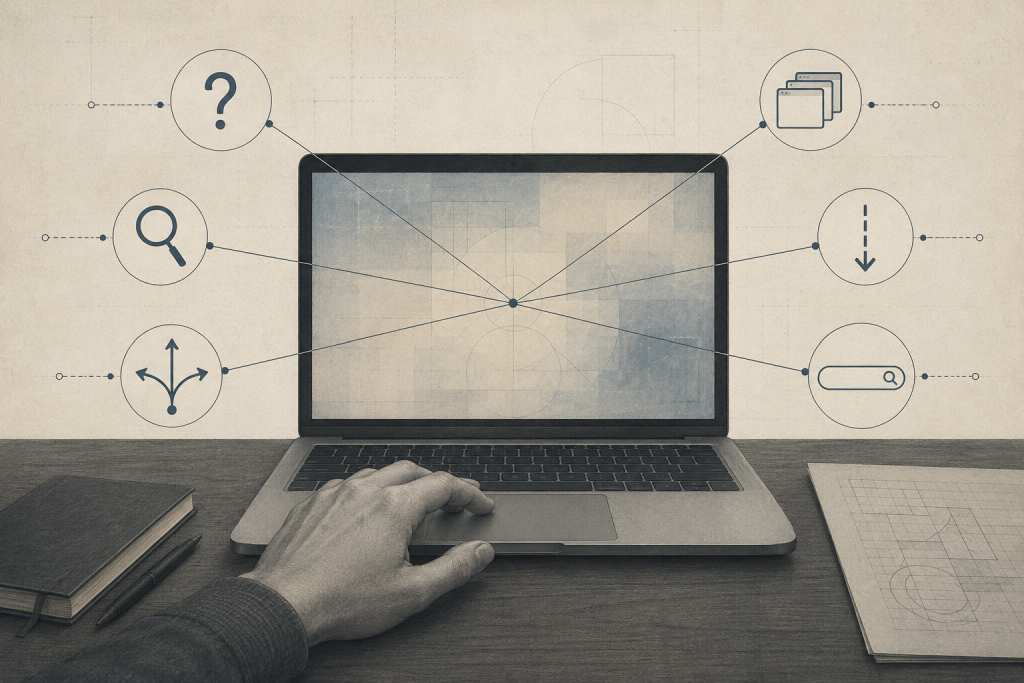
This article introduces six mechanisms of hypertext reading and six principles for reading hypertext documents constructively.
Part One: Six Mechanisms and Their Cognitive Effects
Each mechanism is a small machine within the larger system of hypertext reading. Each produces a specific cognitive effect. The pairing is explicit and tight.
Mechanism 1: The Decision Point
Every link asks the reader to choose: click or continue. This choice appears at every link, so the reader cannot simply read but must decide every time a link is offered. The reader evaluates the link’s promise—more detailed, supplemental, or adjacent information—and decides whether to leave the current page.
Cognitive effect: Decision fatigue. The reader makes hundreds of small decisions per session, and each decision consumes attention. The reader becomes exhausted by choosing rather than by reading, and comprehension suffers from depletion rather than from difficulty. The fatigue accumulates across the session, so the reader closes the browser with little to show for the time spent.
I spent an hour clicking through Wikipedia and closed the browser with a headache, having read perhaps three full paragraphs. The rest of the hour was spent deciding whether each new link was worth following. The headache came from those decisions, not from the text itself.
Mechanism 2: The Promise of Depth
The link promises more: a definition, a related argument, or a deeper dive. The current page becomes insufficient. The reader must leave to obtain what the link promises. The promise matters more than the destination; the act of promising trains the reader to distrust the sufficiency of the present page.
Cognitive effect: The illusion of depth. The reader clicks expecting depth. But each click leads to another page, that contains its own links, which lead to further pages. The reader never reaches the bottom—depth is promised but often not delivered. The reader finishes the session feeling that they have learned less than they should have. The gap between promise and results produces a persistent sense of insufficiency.
Mechanism 3: The Branch as Alternative Path
Each link represents an alternative path. The reader could follow this link or that link or neither. The presence of alternatives makes the chosen path feel contingent, provisional, and incomplete. The reader never fully commits to the path they are on because another one remains available.
Cognitive effect: Divided attention. The reader’s attention is distributed across the original page, the new tab, the back button, and the search bar, so no single element receives sustained focus. The text is absorbed in disconnected units, and these units fail to form a coherent whole. The mind holds multiple possible paths at once, and the effort of maintaining them drains attention from the path the reader actually follows.
I sat down to read a Wikipedia entry on a topic I already knew and did not look up until forty minutes had passed. The problem was not the entry’s length but the number of links I felt compelled to evaluate. Each blue word was a small question: Should I leave or stay? By the end, I had read the entry but could not remember what it said, for my attention had been spent on deciding whether to click each link.
Mechanism 4: The Tab as Suspended Intention
The new page opens in a tab, and the original page remains open behind it. The reader does not have to choose between pages, for they may keep both, and the tab thus preserves the original context alongside the new. The reader does not have to commit.
Cognitive effect: The anxiety of open loops. The reader accumulates more tabs than they can close, and each open tab produces a low-grade anxiety, a sense of unfinished business that follows the reader away from the screen. The mind cannot rest because the tabs remain open, and the reader carries the burden of all the half-read articles still waiting.
The first time I noticed the anxiety of open loops, I had forty-seven tabs open. I could not close any of them because each tab contained a promise I made to my future self. When I closed the browser instead, I felt a sense of relief. Even with promises broken, I didn’t mind.
Mechanism 5: The Scroll as a Weak Boundary
The scroll bar provides a visual cue of the reader’s position within the document: a bar that moves downward as the reader scrolls. This cue is available, but it is not passive. The reader must look away from the text to consult it, and the act interrupts the flow of reading. The printed page provides no such interruption, for the reader can feel the remaining pages in their hands. The scroll’s cue is therefore weaker: it is always there, but it always asks to be looked at.
Cognitive effect: Interrupted orientation. The reader who wants to know how much remains must break from the text to consult the scroll bar, and each break pulls attention away from the text. The reader who ignores the scroll bar cannot tell how much text is left. The scroll thus requires a choice between interruption and disorientation, and neither option preserves the flow of reading.
Mechanism 6: The Search Bar as Prosthetic Recall
The reader can search for any word or phrase without needing to remember where something is located, for the search bar will find it. This convenience reduces the cost of forgetting, so the reader must only know how to retrieve information, not retain it.
Cognitive effect: The atrophy of memory. The reader outsources memory to the machine, and the mind no longer maintains the location of information. Retention can weaken as automatic retrieval takes over, so the reader can find any fact but cannot summon one without assistance. The search bar becomes a prosthesis, which weakens the faculty it replaces.
Part Two: Reading Hypertext Constructively
The mechanisms outlined above are not defects of hypertext material. They are features of the medium. The question is whether the reader can learn to read with awareness of what the medium does to attention. The six principles below offer a constructive practice wherein each counteracts a specific mechanism and its cognitive effect.
Principle 1: Recognize the Decision Point
Counteracts: Decision fatigue.
Before clicking, ask: Do I need this information to understand what I am reading right now? If the answer is no, do not click. If the answer is maybe, do not click. Click only when the answer is an unequivocal yes.
Example: You are reading an article about narrative structure. A link offers a definition of “free indirect discourse.” You already know what free indirect discourse is. Do not click. The link promises depth, but the depth is not needed. The click would be a decision that consumes your attention without returning value.
Application: For one whole session, click no links. Read the page as if it were printed. Notice how much attention returns to the text when there are no decisions to make.
I used to click every link that looked interesting, assuming that more information was always better. The result was never depth but a long chain of half-read pages and a vague sense of having wasted time. I have since learned to ask, before clicking, whether I need the link to understand what I am reading now.
Principle 2: Limit the Branches
Counteracts: The illusion of depth.
Open one link at a time, and return to the original page before opening another. A single branch can be explored and closed, but multiple branches become a maze. The goal is not to avoid links but to prevent a chain of them from carrying you away from where you started.
Example: You are reading a Wikipedia entry on the French Revolution when you see links to Robespierre, the Reign of Terror, and the Committee of Public Safety. Choose one and open it, read it, then close it. Return to the original page. Then, if you still have attention, choose another one.
Application. For one session, allow yourself only one branch away from the original page at a time. If you open a link, you must return to the original before opening another. Notice how much more often you reach the end of the original article.
Principle 3: Accept the Branch You Did Not Take
Counteracts: Divided attention.
You cannot follow every link, for the path you actually read is sufficient. The branches you skip are not signs of poor attention but simply the cost of hypertext reading.
Example. You are reading an article about climate change. There are links to related topics: carbon capture, renewable energy, and policy history. You cannot read them all. Choose one, read it, then accept that the others will remain unread, for those unread links are not a measure of your inadequacy but the consequence of a necessary choice.
Application. At the end of a reading session, list the links you did not click. Acknowledge that they offered paths you chose not to follow, then close the page.
I used to feel a small panic whenever I finished an article and saw the links I had ignored. Those unclicked links felt like evidence of incompleteness, as if I had failed to do the full reading. I have since learned that the panic was a symptom of a false belief: that reading everything is possible. The links I skipped were not obligations but choices, and every choice leaves other paths unexplored.
Principle 4: Close Tabs Without Finishing Them
Counteracts: The anxiety of open loops.
Do not keep tabs as reminders. A tab left open is a promise you intend to keep, but most promises to a future self go unfulfilled. Close tabs even when you have not finished reading them. The relief of closure outweighs the loss of the unread material.
Example: You have fifteen tabs open from a previous session, and you do not even remember why you opened most of them. Close them all. You’ll feel a sense of relief instead of loss because, in some way, it is refocusing your attention.
Application: Before opening a new tab, look at your existing tabs. Close any tab that you have not looked at in the last hour. If you cannot close it, ask: What would I lose by closing it? The answer is usually nothing.
I once kept a tab open for six months because it held a review of a novel I intended to read. The novel came and went from my shelves, but the tab remained, and when I finally closed it, I felt nothing but relief. The novel is still unread, for the only thing that had kept the tab open was an intention I never acted on.
Principle 5: Set a Stopping Point
Counteracts: Interrupted orientation.
Decide how much you will read before you begin, then stop when you reach that limit regardless of whether the page has ended. Read a fixed number of screens, set a timer for fifteen minutes, or commit to reading until a natural pause in the argument is reached. Do not let the absence of a clear boundary dictate when you stop.
Example. Before you start, decide: I will read for twenty minutes, or I will read ten screens. When you reach that limit, stop. Avoid promising yourself you’ll stop at the next section heading or paragraph break, because you might lose focus before you get there.
Application: For one session, set a timer for fifteen minutes. When the timer ends, close the page. Notice how much more satisfying a forced stop is than an exhausted drift.
Principle 6: Remember Before You Search
Counteracts: The atrophy of memory.
Before using the search bar, try to remember what you have read. Search is just a tool and should not be a reflex. The effort to remember, even when it sometimes fails, strengthens the neural pathway that the act of searching replaces.
Example. You are reading an article about literary techniques and need the name of the narrator in Joseph Conrad’s Heart of Darkness (1899). Do not search instinctively; try to recall first. The name is Marlow. If you could not remember, the effort of trying will make it easier next time. If you search immediately, you will forget again.
Application. For one session, forbid yourself from using the search bar. If you cannot remember something, leave it blank. That gap shows you what you still need to learn.
I tested this principle on myself for a week. The first three days were frustrating. I could not recall the names of characters from books I had read twice. By the fifth day, the effort of trying before searching had become a habit. The frustration did not disappear, but it no longer felt pointless. It was simply the cost of trying before searching.
Limits of the Framework
The six mechanisms described in this article do not appear in every hypertext document. A short news article with three internal links behaves differently from a Wikipedia entry with fifty external references. A well-designed academic database with stable hierarchies differs from the chaotic link networks of social media or the algorithmic feeds of content aggregators. The framework outlined here applies most directly to documents where links are dense, where branching is frequent, and where the reader has no clear sense of the document’s boundaries. It applies less to hypertext materials that are short, linear, or tightly curated.
Nor do the six principles apply uniformly. A researcher following citations through a scholarly database may need to open multiple tabs to compare sources; the principle of closing tabs before opening new ones would impede, not help. A reader consulting a reference work for a single fact may benefit from an immediate search; the principle of remembering before searching would be inefficient. The principles are not rules. They are correctives for specific problems. The reader must judge which problems are present in the material at hand.
The web is not a single environment. It is a collection of environments, each with its own conventions, densities, and demands. This article has excavated six mechanisms common to hypertext reading, but the list is not exhaustive. Other mechanisms await description: the algorithmic feed that never ends, the social media notification that redirects attention without a click, the interstitial advertisement that forces a pause. Each new format will produce its own cognitive effects, and each will require its own constructive principles.
The reader who understands the six mechanisms will be better equipped to recognize new ones when they appear. That recognition, not any rule, is what the reader should carry forward.
The Practice of Literary Attentiveness: How Deep Reading Alters the Experience of Fiction
I recommend these two older posts because they frame the problem this article addresses from opposite sides. My guide to “The Practice of Literary Attentiveness” examines the cognitive discipline required for sustained literary attention, the very skill that hypertext reading can erode. My introduction to “Electronic Literature” surveys works that embrace hypertext as a creative form, from hypertext fiction to generative poetry. Together, they ask how a reader might preserve the capacity for deep attention while still exploring the possibilities of digital text.
Further Reading
- A Guide to Hypertext Literature by Addison Rizer, Book Riot
- Mind wandering during hypertext reading: The impact of hyperlink structure on reading comprehension and attention[study] by Teresa Schurer, Bertram Opitz, Torsten Schubert, Acta Psychologica
- New evidence that hyperlinked text — an element of web page design — has a strong impact on mind-wandering and online reading comprehension of readers on Reddit