Explore This Topic
- What is Cyberpunk? A Complete Introduction
- How Cyberpunk Genre Explores Technology in Fiction
- The Philosophy of Cyberpunk: Self, Knowledge, and Ethics in the Machine Age
- Cyberpunk and Critical Theory: Capital, Simulation, Ideology
- Hauntology in Cyberpunk: Gothic Materialism and The Haunted Future
- Global Cyberpunk: Afrofuturism, Techno-Orientalism, Indigenous Futurisms
- Postcyberpunk: Evolution of the Genre
My Reading Note
After spending months reading and writing about classic cyberpunk, I picked up Neal Stephenson’s The Diamond Age again. The novel felt different from the others I had been reading. The characters were not outsiders fighting the system but people trying to make the system work, raise children, and build things that lasted. This article is about the changes in the genre I noticed over the years.
The version of cyberpunk most readers know was forged in the early 1980s. It gave us alienated loners moving through dystopian cities, technology that isolates rather than connects, and a tone that rarely admitted humor or hope. William Gibson’s Neuromancer (1984) set the template, and for a decade afterward, writers worked within its shadow.
In the early 1990s, critics began noticing that some new science fiction was using cyberpunk’s tools to tell different kinds of stories. These works featured characters who were part of society rather than exiled from it, who tried to improve things rather than burn them down, who lived in worlds where technology had become so pervasive it was no longer the subject but the setting. Critic Lawrence Person’s 1998 essay “Notes Towards a Postcyberpunk Manifesto” defined the shift as postcyberpunk, arguing that where classic cyberpunk emphasized technology’s alienating effects, postcyberpunk recognized that “technology is society.”
This article traces that evolution through key works: Stephenson’s Snow Crash (1992) and The Diamond Age (1995), Richard K. Morgan’s Altered Carbon (2002), Cory Doctorow’s Down and Out in the Magic Kingdom (2003), Charles Stross’s Accelerando (2005), and Malka Older’s Infomocracy (2016). Together, they show a genre moving from stories of rebellion to stories of engagement, from asking “What if?” to asking “Now what?”
When I first read Snow Crash, I did not think of it as part of any larger shift. It was just a fun, strange book. It took years of reading backward and forward to see that Stephenson was doing something different from Gibson, something that would become a pattern others followed.
The Manifesto: Defining Postcyberpunk
Critics have often treated Stephenson’s Snow Crash as an early or paradigmatic example of what would later be called “postcyberpunk,” signaling a new direction for the cyberpunk mode. But it was Person who gave the subgenre one of its first definitive formulations in his essay “Notes Toward a Postcyberpunk Manifesto,” published in Nova Express in 1998 and posted on Slashdot in 1999.
Person opened his essay with a deliberate provocation. He described Bud, a character from Stephenson’s The Diamond Age: “An aggressive, black-leather clad criminal loner with cybernetic body augmentations (including a neurolinked skull gun), Bud makes his living first as a drug runner’s decoy, then by terrorizing tourists for money.”
“All of which goes a long way toward explaining why his ass gets wasted on page 37 of a 455-page novel,” Person wrote. “Welcome to the postcyberpunk era.” The point was clear: the classic cyberpunk template had run its course. Person argued that postcyberpunk differed from its predecessor in several fundamental ways:
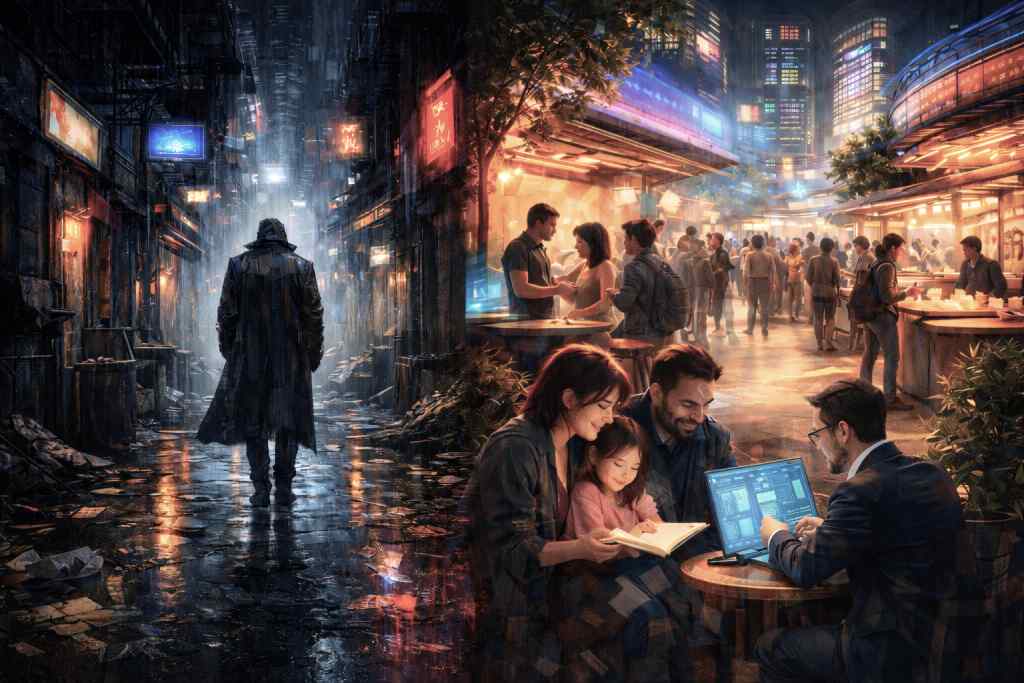
| Classic Cyberpunk | Postcyberpunk |
|---|---|
| Alienated loners in dystopian futures | Characters integrated into society, often with jobs |
| Emphasis on technology’s alienating effects | Recognition that “technology is society” |
| Grim, deadly serious tone | Room for humor and self-awareness |
| Metallic implants and cyberware | Shift toward biotechnology and nanotechnology |
The table makes the distinction look clean, but I think the actual books are messier. Snow Crash has plenty of alienation alongside its satire, while The Diamond Age has moments of real darkness. The categories help us see patterns, but they are not boxes to put books in. We must think of them as lenses instead.
Where cyberpunk characters existed on the margins, postcyberpunk characters were participants. They might work within systems to defend an existing social order or try to build something better. The worlds they inhabited were not necessarily dystopian; they could be complex, ambiguous, or even cautiously optimistic.
The emergence of postcyberpunk reflected a broader cultural shift. By the late 1990s, writers and readers had begun using computers, the internet, and digital devices in their daily lives. The massive social fragmentation predicted in earlier decades had not materialized. Postcyberpunk acknowledged that humanity had adapted to the “cyber” condition; it was no longer strange or alien but simply part of the background.
The Architects of Postcyberpunk
Person’s manifesto identified a range of writers who moved beyond classic cyberpunk’s templates. Bruce Sterling’s Islands in the Net (1988) anticipated the shift, while Ian McDonald’s Necroville (1994) absorbed even death into social systems. Ken MacLeod’s novels featured characters embedded in political struggles rather than isolated from them; Greg Bear’s work examined how nanotechnology becomes part of consciousness; and Greg Egan’s fiction imagined software-based selves who remain recognizably human. What unites them is a shared recognition: the future cyberpunk warned about has arrived, and the task now is learning to live in it.
Neal Stephenson: The Paradigm Shifter
Stephenson’s Snow Crash appeared at the moment cyberpunk was evolving into what critics would soon call postcyberpunk. The novel retains cyberpunk’s surface elements, but its tone is different. Where Gibson’s prose is lean and ominous, Stephenson’s is expansive and satirical. His protagonist, Hiro Protagonist, works as a pizza deliveryman for the Mafia. This is not alienation but absurdist engagement with a world gone strange.
The Diamond Age goes further. The novel follows Nell, a young girl who comes into possession of an interactive primer, a book that teaches her to think, create, and navigate a complex neo-Victorian society. The technology is not something to be feared or escaped but a tool for self-construction. Person’s description of postcyberpunk characters as those who “frequently have families, and sometimes even children” applies directly here. Nell’s story is about growth, education, and finding one’s place.
I think about the primer in The Diamond Age whenever I hear debates about technology in education. The book imagines a device that teaches a child to think, create, and question, not by delivering facts but by telling stories, asking questions, and adapting to the learner. It is the opposite of what most EdTech actually does. Stephenson saw a future we are still trying to build.
Richard K. Morgan: Cyberpunk Noir
Morgan’s Altered Carbon arrived after Person’s manifesto but fits its framework. The novel is set in a world where consciousness is stored on cortical stacks and can be downloaded into new bodies. The protagonist, Takeshi Kovacs, is a former soldier turned investigator. He is not an alienated loner in the classic cyberpunk mold but a professional navigating a corrupt system. The technology provides the background for questions about power, identity, and what survives when the body becomes optional.
Cory Doctorow: Post-Scarcity Politics
Doctorow’s Down and Out in the Magic Kingdom imagines a post-scarcity world where reputation is currency. The protagonist, Jules, is part of a collective trying to preserve Disney World as a living experience rather than a museum. He has a girlfriend, friends, and a role in his community. The conflict is not between a lone hero and an evil corporation but between competing visions of how to organize a world without material want. This is postcyberpunk’s “technology is society” taken to its logical conclusion.
Doctorow’s reputation economy now looks like an accurate description of how online platforms work. They run on likes, shares, and follower counts. We trade influence for access and status for opportunity. Doctorow imagined a system where reputation is the only currency. We are not there yet, but we are closer than we were when he wrote the book.
Charles Stross: Accelerating Futures
Stross’s Accelerando tracks three generations of a family through the technological singularity. Its characters are embedded in a world of accelerating change, but they adapt, evolve, and find ways to continue. The novel is dense with ideas but grounded in human concerns: love, parenthood, and legacy. It exemplifies Person’s observation that postcyberpunk frequently “skirts the edge of what can be described in late 20th century English” while remaining anchored in recognizable experience.
Malka Older: Bureaucracy as Adventure
Older’s Infomocracy trilogy (2016-2018) is a contemporary example of postcyberpunk thinking. Its protagonists work within a global political system, trying to make it function better. They attend meetings, analyze data, and struggle with compromise. This is engagement taken to its most literal extreme: the fight for a better world happens in offices and committee rooms as much as on the streets.
Reading Accelerando on a cross-country flight left me genuinely disoriented. The book moves so fast and throws so many ideas at you that you cannot hold onto any single one. But the family at its center keeps you grounded. Stross understood that postcyberpunk needed people and not just concepts.
The Genre Matures
The difference between cyberpunk and postcyberpunk is not a break but an evolution. Classic cyberpunk gave us the tools to imagine a future saturated with technology. It taught us to see how deeply systems of information and control could penetrate everyday life. But their characters remained outsiders, alienated from worlds they could only observe or flee.
Postcyberpunk starts from a different premise: technology is no longer an intrusion but the background against which ordinary life happens, and its characters have jobs, families, and commitments as they navigate systems rather than trying to burn them down. This shift reflects where we actually are—the anxieties of the 1980s about corporate power, surveillance, and the erosion of self have not disappeared but have become ordinary.
The writers covered here move beyond the outsider stance of classic cyberpunk. Their characters do not fight the world but find ways to live within it—Nell builds a self through her primer; Doctorow’s figures manage reputation economies; Stross’s families adapt across generations; and Morgan’s Kovacs navigates corrupt institutions as a professional. These are not stories of rebellion but of accommodation, negotiation, and survival within systems that cannot be escaped.
Someone asked me if postcyberpunk was just a way of giving up, of accepting that the bad systems will win. I said no. Accommodation is not the same as surrender. Nell does not rebel against the neo-Victorians, but she does not become one either. She becomes herself, using their tools for her own purposes. And that is a different kind of victory.
What makes postcyberpunk matter is its recognition that there is no outside to the system. The future is not something to be resisted or welcomed but simply inhabited. The genre matures by accepting this condition and asking what kind of life remains possible within it. The questions are no longer about whether technology will change us but about who we become after it has.
Further Reading
- Cyberpunk derivatives on Wikipedia
- Optimism and Access: The Line Between Cyberpunk and Post-Cyberpunk by Malka Older, Reactor Magazine
- Cyberpunk vs Post-Cyberpunk on Reddit