Explore This Topic
- What is Cyberpunk? A Complete Introduction
- How Cyberpunk Genre Explores Technology in Fiction
- The Philosophy of Cyberpunk: Self, Knowledge, and Ethics in the Machine Age
- Cyberpunk and Critical Theory: Capital, Simulation, Ideology
- Hauntology in Cyberpunk: Gothic Materialism and The Haunted Future
- Global Cyberpunk: Afrofuturism, Techno-Orientalism, Indigenous Futurisms
- Postcyberpunk: Evolution of the Genre
My Reading Note
Years ago, I made a list of cyberpunk books to read. I included Gibson, Sterling, Stephenson, and others from that group. Recently, I looked at the list and wondered why all the authors were from North America. When I searched for writers outside those regions, I found cyberpunk produced in Japan, the Caribbean, and Indigenous communities. This article covers what I found.
Cyberpunk is typically taught as an Anglo-American phenomenon. The standard canon begins with William Gibson and Bruce Sterling in the 1980s, extends through Neal Stephenson in the 1990s, and stops there. Students come away with the impression that cyberpunk was a regional movement, a product of specific conditions in the United States and Britain at the end of the twentieth century.
However, from its earliest years, cyberpunk was already a global conversation. The genre’s central concerns—the relationship between technology and power, the experience of living under late capitalism, the question of who gets to imagine the future—have been taken up by writers and artists from other parts of the world, adapting cyberpunk’s tools to their own histories, traditions, and political realities.
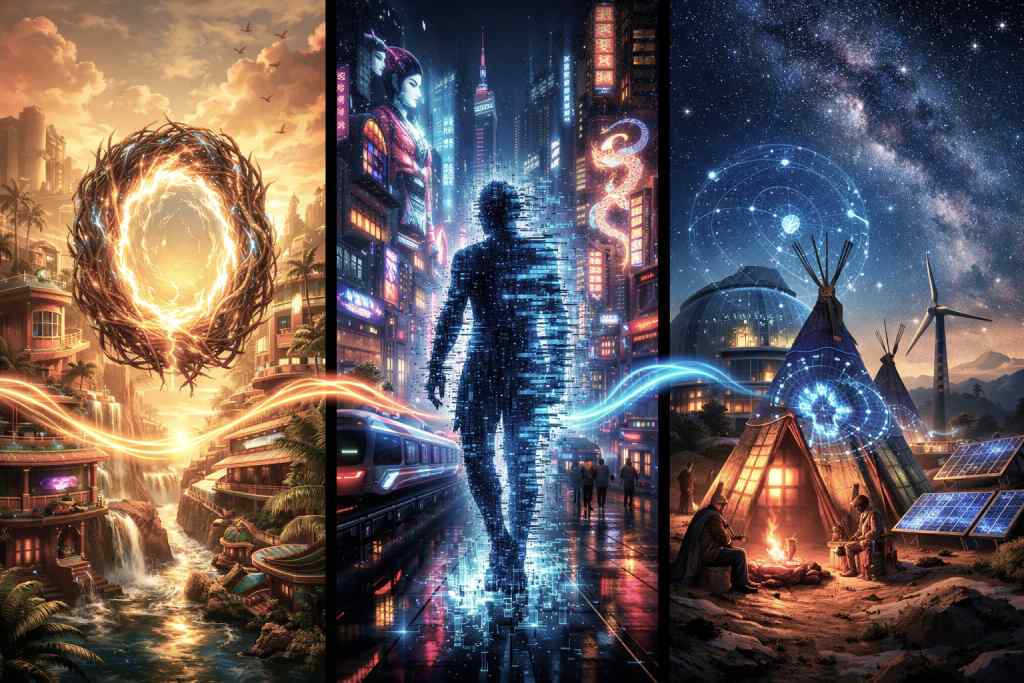
This article maps three major frameworks for understanding global cyberpunk. The first, Afrofuturism and Postcolonial Cyberpunk, examines how Black and diaspora writers use cyberpunk to address histories of colonialism and imagine futures rooted in African and Caribbean traditions. The second, Techno-Orientalism and Asian Cyberpunk, traces the two-way exchange between Western representations of Asia and the cyberpunk traditions that developed in Japan, China, and Korea. The third, Indigenous Futurisms, explores how Indigenous creators imagine futures grounded in traditional knowledge systems rather than Western science.
When I first started reading cyberpunk criticism, I noticed that most scholars acknowledged these frameworks existed, but few treated them as central. They were footnotes, asides, or separate chapters at the end of books. This article puts them at the center because I think that is where they belong. The global conversation is not a supplement to cyberpunk because it is what cyberpunk has always been.
Afrofuturism and Postcolonial Cyberpunk
The Oxford Bibliographies entry on cyberpunk now includes “Afrofuturism and Postcolonial Cyberpunk” as a major category. This recognition came late, but it matters because writers outside the usual canon have been using the genre’s tools to tell their own stories all along. They did not need permission from the mainstream, but the label helps readers find them.
Louis Chude-Sokei’s nonfiction book, The Sound of Culture (2015), traces a connection that cyberpunk rarely acknowledged: the way Western culture imagined robots and artificial intelligence was defined by older ideas about slavery. The figure of the machine that serves, the being that is not quite human, the labor that requires no payment—these images have a history that reaches back to the slave trade. When cyberpunk asks what makes someone human, it inherits a question that was never only philosophical.
Before reading Chude-Sokei, I had not considered that the questions AI raises about personhood, rebellion, and proving one’s humanity were also asked about enslaved people. Once he makes the connection, it seems obvious: the same questions have simply been asked about different beings.
Nalo Hopkinson’s novel Midnight Robber (2000) shows what happens when cyberpunk moves to the Caribbean. The story takes place on a planet settled by Caribbean people, and the language shifts into Creole, forcing the reader to slow down and listen differently. The technology draws on Afro-Caribbean spirituality instead of Western science. Portals between worlds work like doorways from old stories, not like computers. The novel does not simply add Caribbean content to a familiar form but asks whether the form might need to change.
Reading Midnight Robber for the first time, I realized how much cyberpunk assumes a certain kind of reader. Someone comfortable with standard English, with Western references, and with a particular way of thinking about technology. Hopkinson’s novel did not just add Caribbean content. It made me question all the other assumptions I had been carrying without noticing.
K. Ceres Wright takes a different approach in her novel Cog (2014), which she calls “cyberfunk.” Where Gibson’s sprawl is dark and rain-soaked, Wright imagines futures with sunlight and melanin. She uses familiar cyberpunk ideas about augmented humans and programmed soldiers to ask questions about freedom from a Black perspective. The result is not a rejection of cyberpunk but a claim that the genre can accommodate more than its originators imagined.
I find the term “cyberfunk” useful beyond Wright’s work. It names something I had felt but could not articulate: that cyberpunk’s default mood is gloom and that gloom comes from a particular cultural place. Writers from other places might imagine futures that feel different because they come from different conditions.
Afrocyberpunk cinema has developed in parallel with the literature. Scholars point to films by Neill Blomkamp, Jean-Pierre Bekolo, and others that take cyberpunk’s visual language and use it to tell stories about postcolonial Africa. These are not imitations of Western originals but adaptations and transformations, something made to serve a purpose that the original movement never imagined. The genre keeps expanding, and these filmmakers are part of why.
Techno-Orientalism and Asian Cyberpunk
The phenomenon that would later be called “techno-Orientalism” emerged in the 1980s and 1990s. Western culture began imagining Asia, particularly Japan, as both the source of the future and a threat to it. Asian faces appeared on gleaming technology, Asian cities became backdrops for dystopian visions, and Asian bodies were portrayed as somehow more machine-like, more suited to the coming world. Gibson’s early work helped establish this imagery through his Sprawl trilogy, which drops references to Japanese brands and Singaporean streets that feel exotic and ominous at once. The critic Wendy Hui Kyong Chun argues that this “high-tech Orientalism” served a specific purpose: it helped Western readers orient themselves to a future where technology had outpaced their understanding. Asia became a way to visualize the strange new world without having to explain it.
I remember reading Neuromancer in college and assuming the Asian references were there because Japan really was the center of tech in the 1980s. That was true, but Chun’s argument made me see something else. The way Gibson used those references as atmosphere, threat, or exotic decoration was doing cultural work I had not noticed before.
Japanese creators read American cyberpunk and found something useful in its distorted mirror. The critic Takayuki Tatsumi, in his book Full Metal Apache (2006), describes how Japanese writers and filmmakers used cyberpunk to process their own experience of rapid technological change. They borrowed from the Americans, but the Americans had already borrowed from them, creating a two-way exchange that redefined the genre on both sides of the Pacific.
Tatsumi’s book lays out a more complicated picture of cultural influence than the usual story. Japanese creators read American cyberpunk and found themselves reflected back in strange ways. But the Americans had already drawn on Japanese culture to create those images. The result was a cycle of borrowing and response that started well before the 1980s and continues today.
This exchange produced works like Katsuhiro Otomo’s manga and film Akira (1988) and Masamune Shirow’s Ghost in the Shell (1989). These are not imitations of Western cyberpunk but something else. Akira takes place in a rebuilt Tokyo after a mysterious explosion destroys the old city. Its themes are universal, but its visual language comes from Japanese storytelling traditions. Ghost in the Shell asks questions about identity that Western cyberpunk also asked, but it arrives at different answers. Where Gibson’s characters struggle to maintain individuality against the system, Shirow’s characters seem more comfortable with the idea that the self might be distributed across networks, merged with others, or dissolved into something larger.
More recent work has extended this tradition. Bong Joon-ho’s Snowpiercer (2013) began as a French graphic novel from 1982 with a “very European, Cyberpunk-ish” art style. Bong adapted it into a Korean-language film shot in the Czech Republic with an international cast. The result is a work that circulates across continents, picking up new meanings in each location. Critics have compared it to Ridley Scott’s Blade Runner (1982) and noted its debt to the cyberpunk video game Bioshock in both visual design and narrative structure.
Critics have pointed out that Snowpiercer examines a class system that refuses to die no matter the circumstances. The film constantly asks whether a person must accept their preordained place in society for the sake of balance and harmony. I find this observation useful because it connects the film back to cyberpunk’s core concerns about power and hierarchy, but it does so through a story that could only have been made by someone looking at those questions from outside the usual Hollywood framework.
Chinese science fiction has developed along a different path. Cixin Liu’s Three-Body Problem trilogy engages consciously with translated Western fiction, but it imagines futures that do not center the West at all. The books have inspired creators working in cyberpunk modes, including the team behind the Worldopo project, who cite Liu’s concepts as direct influences. These developments suggest that Asian cyberpunk is not a single thing but many things, each responding to its own historical moment while also speaking to audiences far beyond its origin.
Indigenous Futurisms
Indigenous futurism refers to speculative work by Indigenous people that expresses Indigenous perspectives, epistemologies, and experiences. The term gained wider recognition after Grace L. Dillon’s 2012 anthology Walking the Clouds brought together Indigenous science fiction from multiple traditions. The movement challenges a pervasive assumption that runs through mainstream culture: that Indigenous peoples belong to the past and have no place in the future.
“What makes Indigenous science fiction different from mainstream science fiction is that we’re relying on our own traditional knowledge systems as opposed to just Western science,” explains Blaire Morseau, a citizen of the Pokagon Band of Potawatomi Indians and a leading scholar in the field. Her work examines how the Potawatomi people utilize celestial knowledge and ceremonial practices to reclaim sovereignty and envision futures rooted in Indigenous knowledge systems. The question is not how Indigenous people fit into futures designed by others, but what futures look like when designed by Indigenous people themselves.
The relationship between Indigenous futurisms and cyberpunk is particularly rich. Corinna Lenhardt’s chapter in The Routledge Companion to Cyberpunk Culture analyzes texts like Misha’s Red Spider White Web (1990) and Daniel H. Wilson’s Robopocalypse (2011), showing how Indigenous cyberpunk writers challenge stereotypes by placing their own identities and cultures inside the genre. They do not simply add Indigenous characters to existing cyberpunk stories but use the genre’s tools to tell different kinds of narratives. These works place “survivance”—a combination of survival and resistance—at their centers, using cyberpunk’s dystopian frameworks to address the very real dystopian legacies of settler colonialism.
Before reading Morseau, I never noticed how science fiction imagines futures without Indigenous people. The idea that they belong to the past is so ingrained that it took an Indigenous scholar pointing it out for me to see it. After she pointed it out, I began to notice it more often.
The movement extends beyond literature. The anthology Beyond the Glittering World (2025) collects work by twenty-two Indigenous women and two-spirit writers, while Jarrel De Matas’s Caribbean Futurism and Beyond (2025) examines how Caribbean writers address technology and climate disaster through local frameworks. University courses on Indigenous futurisms at Simon Fraser and George Mason now treat these subjects as established fields. For Indigenous creators, imagining the future is a way to ensure they continue to exist.
Toward a Global Cyberpunk
These three frameworks—Afrofuturism and postcolonial cyberpunk, techno-Orientalism and Asian cyberpunk, and Indigenous futurisms—are not separate conversations but overlapping ones. They share a common theme: they take the tools of cyberpunk and use them to tell stories that the original movement left out. They ask what the genre looks like when the people imagining the future are either non-white, non-Western, or do not assume technology will serve their interests.
What unites them is a refusal to accept the futures handed down by others. Each framework insists that there is no single future, only futures, plural and contested. Each draws on local knowledge, traditional practices, and specific histories to imagine what comes next. Each uses cyberpunk’s dystopian language to address dystopias that are not fictional but lived.
The canon taught in universities and repeated in online lists is not wrong. Gibson, Sterling, and Stephenson produced essential work, but they are not the whole story. The writers and artists covered here have been working alongside them all along, adapting the genre’s tools for their own purposes, producing futures that look different because they come from different places. Cyberpunk has always been a global conversation. It took Western criticism longer to notice, but these writers were there from the start. The genre’s future lies in recognizing that.
Postcolonial Criticism: Theory and Analysis
New Historicism: Reading Literature in its Cultural Moment
I recommend these old posts because they provide the theoretical and historical background this article builds on. The piece on “Postcolonial Criticism” introduces the questions about representation, voice, and power that run through the discussions of Afrofuturism and Indigenous Futurisms. The guide to “New Historicism” offers a method for understanding how cyberpunk texts from different regions are defined by their specific cultural and political moments. And the article on “Chinese Science Fiction” gives context for Cixin Liu’s work and its place in global speculative fiction, which connects directly to the discussion of Asian cyberpunk.
Further Reading
- What’s next for the Afrofuturist movement? by Tola Onanuga, Huck Magazine
- On Techno-Orientalism by Leo Kim, Real Life Magazine
- Taking the Fiction Out of Science Fiction: A Conversation About Indigenous Futurisms by Grace Dillon and Pedro Neves Marques, e-flux journal