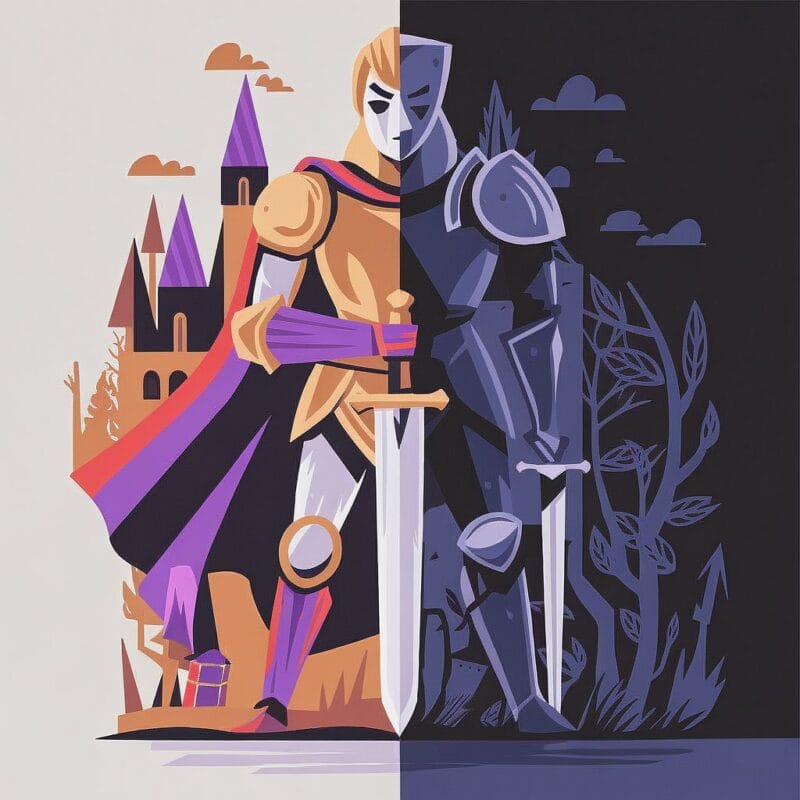
Paraprosdokian is a figure of speech in which the latter part of a sentence introduces an unexpected shift in meaning. Oscar Wilde’s line, “I can resist everything except temptation,” is a textbook example. It starts off sounding like a confession and ends in witty contradiction. Its appeal lies in its ability to reframe a sentence, with its final phrase forcing the reader to reconsider how the opening must be read.
The effectiveness of paraprosdokian, however, isn’t limited to simply stating a contradiction. It performs an act of controlled confusion by tapping into the reader’s instinct to predict, then interrupts that prediction with something jarring, which could be humorous but could also be biting or gently tragic. By messing with tone and authority, this subversive potential of language reveals how writers manipulate the flow of narrative not just for clarity, but for instability and tension.
What Defines Paraprosdokian
A sentence qualifies as paraprosdokian only when several conditions are met. First, the opening establishes a clear expectation because the reader anticipates a certain direction or conclusion. Second, the closing words redirect that expectation—the sentence must compel a revised reading of what came before. Third, the reversal occurs within the sentence itself. The effect cannot depend on speaker identity, narrative context, or external framing.
A practical test clarifies the distinction. If removing the final clause leaves the sentence essentially unchanged in sense, the figure is absent.
The Mechanics of Subversion
What makes paraprosdokian powerful is its rhythm. It lures with familiarity and delivers something that cuts across the grain. Its success depends on control of tone and timing. A flat delivery amplifies its effect, whereas a dramatic pause can turn it theatrical. Either way, the device provokes momentary confusion, then clarity, then re-evaluation.
In rhetorical terms, the first part of the sentence builds a frame. The second part breaks it. And in that break lies its effect—comic, ironic, or revelatory. While it is often compared to irony or sarcasm, paraprosdokian differs in its structural reliance on syntax and sentence progression. Its essence is timing, not tone alone.
Paraprosdokian as a Literary Device
Though paraprosdokian is commonly associated with stand-up routines or aphorisms, it has a long history in literary writing. Its use in literature is not merely for show. It plays a functional role in revealing character, directing tone, and redirecting interpretation without the need for exposition.
In more recent literature, paraprosdokian has taken on subtler forms, often embedded in interior monologue or free indirect discourse. Writers in the postmodern era, in particular, use the device to inject tonal instability without abandoning narrative cohesion.
Another clear literary example appears in George Orwell’s Animal Farm (1945). The commandment “All animals are equal, but some animals are more equal than others” is a textbook paraprosdokian. It begins as a moral assertion and twists into a satirical indictment of hypocrisy. The reversal encapsulates the novel’s political critique with elegant brevity.
Characters who speak in paraprosdokian often display cynicism, guardedness, or a sharp internal logic. These rhetorical reversals hint at deeper reservations about sincerity or conventional modes of speech. The technique serves as a marker of emotional distance or intellectual agility.
Techniques Often Confused with Paraprosdokian
Several related devices overlap in effect while operating through different means. Dramatic irony relies on audience awareness rather than sentence structure. Aphorism compresses observation into concise form without requiring redirection. Satirical bluntness shocks through direct statement rather than through strategic timing within a sentence. Contextual inversion derives its power from narrative placement rather than from syntax.
Kafka’s opening sentence in The Trial, for instance, produces disorientation through juxtaposition. The dry understatement of legal absurdities creates sentences that routinely shift from procedural calm to existential unease. A line such as “Someone must have been telling lies about Josef K., he knew he had done nothing wrong but, one morning, he was arrested.” begins as neutral exposition, then unravels into something more disturbing. The sentence establishes tension without forcing a revised reading of its opening clause through its ending.
Why the Term Is Commonly Misapplied
Many lines create surprise or unease without meeting the formal standard. Their effects arise through implication, irony, or character context rather than structural reversal. A frequently cited case illustrates the problem: In Henry VI, Part 2 (c. 1591), the line “The first thing we do, let’s kill all the lawyers” presents a tactical suggestion before spinning into dark jest. The pragmatic “first thing we do” is reinterpreted as darkly comic extremism by the final verb phrase, but its power lies in its ambiguity—is this comedy or political threat?
Jonathan Swift also used paraprosdokian with a deadpan precision that made his satire sharper. In A Modest Proposal (1729), his suggestion to cook and serve children “as we do roasting pigs” arrives at the end of a sentence delivered in the language of policy. The reversal doesn’t just shock—it exposes the cruelty hidden in rational discourse. The sentence holds its composure while dismantling any illusion of moral distance.
The disturbance here is immediate and memorable, yet the sentence does not redirect its opening through placement or timing. Its impact depends on dramatic context and implication rather than sentence mechanics. The effect emerges at once rather than retrospectively. Such lines remain powerful, yet they belong to a different rhetorical category.
Further Reading
- A Word, Please: Explaining paraprosdokians and other turns of phrase by June Casagrande, Los Angeles Times
- Read Ray’s column. You’ll learn what a paraprosdokian is. Plus, he’s not talking politics. by Ray Mosby, Clarion Ledger
- As a grammarian contrarian, I love opposites. But what about alternyms? by Adam Lewis, The Guardian
- If You’re A Logophile Or Lexiphile, You’ll Like Paraprosdokians by Jonathan Becher, Forbes