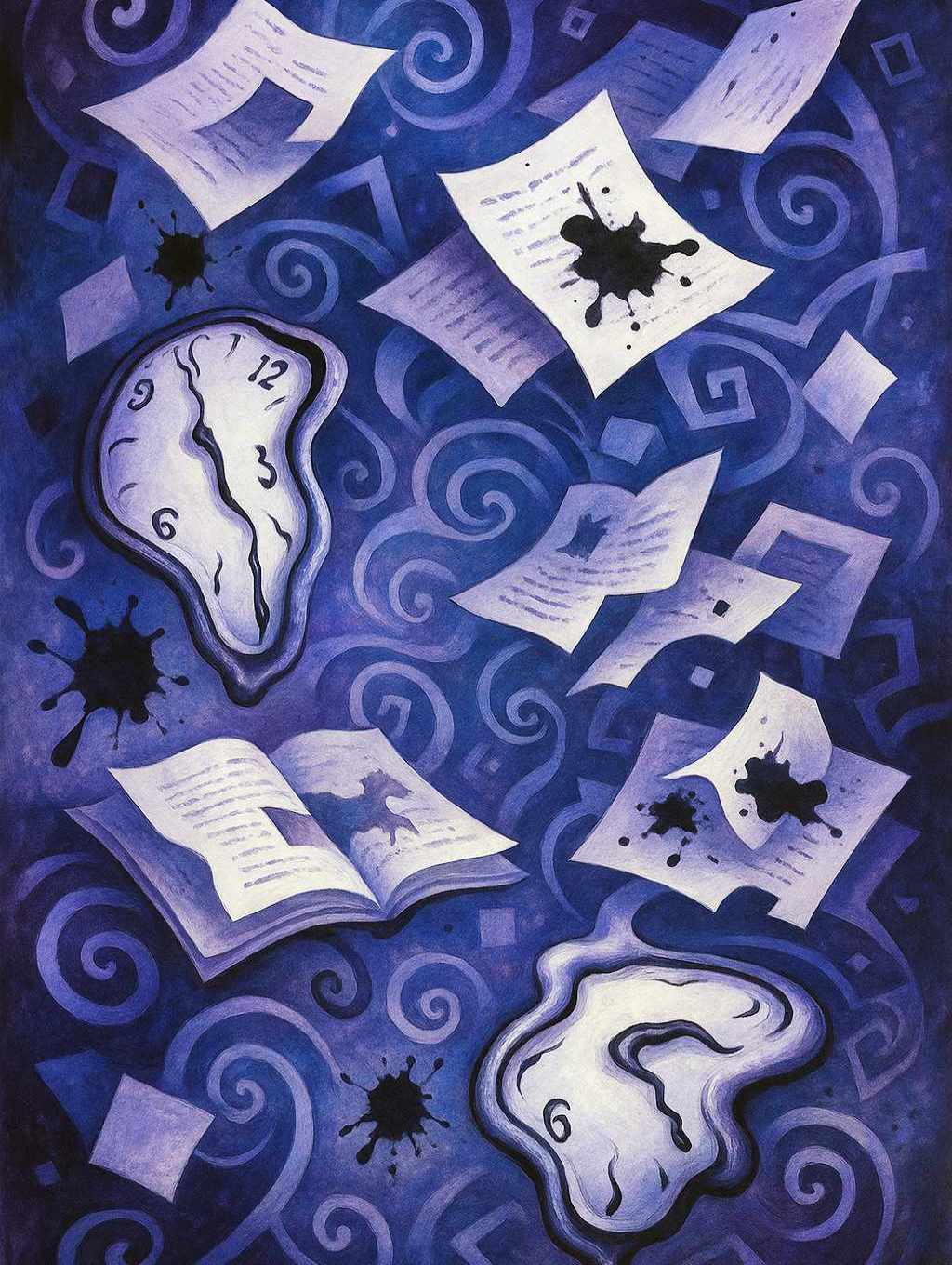
The anti-novel operates by negation, actively rejecting the fundamental attributes of conventional fiction. Rather than seeking the unity and continuity of traditional modes, it challenges the entire enterprise by dismantling cohesion in plot, psychological development, linear time, and narrative conclusion.
This narrative mode deliberately splinters the expected form, prioritizing disorientation over narrative flow. The structural defiance targets the deepest assumptions of storytelling: the necessity of ultimate resolution and the prescribed order required for characters to evolve. Its function is a profound critique that addresses the social and philosophical premises inherent in literary structure. By questioning the illusion of narrative control, the anti-novel makes its inherent difficulty the central message.
Concepts
The term “anti-novel” gained traction in mid-20th century European criticism, particularly in relation to the nouveau roman in France, but its lineage extends further. Anti-novels can appear within any period where literature becomes disenchanted with its own mechanisms, when the traditional form begins to feel complicit, exhausted, or false.
This mode of writing has no single aesthetic. Some anti-novels lean on abstraction and structure; others explode into language that dissolves the concept of representation altogether. What unites them is a shared impulse: to challenge the very premise of the novel as a source of narrative certainty.
Disruption of Narrative Coherence
One of the defining traits of the anti-novel is its resistance to sequential storytelling. Instead of presenting a series of events that follow causally or emotionally, the anti-novel may offer fragments, lists, digressions, or repetitions. The structure may be cyclical, disordered, or entirely absent. This defiance is not an oversight but a critique of the illusion that life or thought proceeds in neat chronological lines. Many anti-novels deny the reader the satisfaction of momentum by ignoring the conventions of storytelling as a mode of persuasion.
By fragmenting or dissolving narrative structure, the anti-novel proposes a different relationship to time and causality. Events may recur without resolution or emerge without producing clear outcomes. The writing draws attention to gaps, false starts, and moments of stasis. In place of a plot that moves forward, the anti-novel may create a field of impressions that is recursive, fragmentary, and methodologically opaque. This disorientation is central to its project.
Anti-Characterization
The anti-novel often withholds the sense of character familiar to traditional fiction. Instead of fully imagined individuals with names, desires, and psychological traits, it may present anonymous voices, flat figures, or interchangeable identities. The purpose is not to withhold character detail for the sake of mystery, but to question the premise that identity is coherent or narratively useful. Character becomes a surface, an outline drawn by language, not a self that exists independently of it.
In many anti-novels, characters diffuse into patterns of speech, conceptual functions, or textual effects. The narrative may withhold giving them motivation, background, or interior life. You may even refrain from calling them characters at all. This refusal upends the assumption that fiction is primarily a mirror of human psychology. Instead, the anti-novel asks what fiction becomes when people are not treated as knowable entities but as unstable presences within language.
Self-Reflexivity and Textual Exposure
A common feature of the anti-novel is its self-reflexivity. Many such works suspend their own progress to comment on their construction, doubt their authority, or expose their mechanisms. Footnotes, false starts, typographical anomalies, and direct addresses to the reader are often used to challenge immersion. These techniques remind the reader that fiction is fabricated, that it arises not from reality but from choices made by an author manipulating structure.
This self-reflexivity can be subtle or overt. Some texts draw attention to their physical structure: chapters without order, missing pages, or variable formats. Others destabilize the narrative voice, allowing conflicts and reversals to emerge unchecked. The result is a kind of fiction that makes no effort to conceal its own construction. It forces the reader to encounter the work as an object that declares its own artificiality.
Rejection of Realism
The anti-novel often opposes realism, not through embracing fantasy, but by revealing the constructed nature of representation. Instead of building a believable world filled with relatable characters, it may offer a surface of language that declines to signify clearly. Description becomes either hyper-specific to the point of disorientation or stripped down to abstraction. The goal is not to depict a world but to question the methods by which fiction claims to do so.
In place of rich settings or recognizable emotion, the anti-novel may present detachment or opacity. Language is foregrounded, functioning as a substance to be formed, broken, or questioned. The familiar tools of storytelling, such as dialogue, setting, and motivation, become strange, unreliable, or absent. The anti-novel achieves its power through omission, restraint, and intentional gaps; its effect is rooted in absence.
Affinity with Experimental Fiction and Anti-Fiction
Although they differ in emphasis, the anti-novel shares many characteristics with experimental fiction. Both refuse inherited literary forms, though the anti-novel often pushes further by denying even the semblance of story. Experimental fiction may still suggest character and sequence, whereas the anti-novel often extinguishes them. The two forms overlap, but the anti-novel takes the disobedience further, often reaching into a full rejection of fictionality.
The term anti-fiction further complicates this field. Anti-fiction implies an even more radical departure wherein fiction empties itself of all fictional traits, ignoring story, coherent form, and even meaning. The anti-novel frequently operates on this boundary, hovering between form and rejection. While experimental fiction can be inventive, the anti-novel is subtractive. The anti-novel questions what fiction can become; it examines the essential elements that persist after conventional narrative structure is removed.
Prime Examples
Joke Postings by Rachael Allen (2022)
Although it is formally classified as a novel, this work flattens narrative expectations through poetic disordering. Allen divides memory and social interaction into a collage of lines that read as detached utterances, suggesting character without delivering identity and evoking story without recounting events. The language rejects causality at every turn.
In this short and often overlooked work, there is no traditional story, just tonal shifts and cultural impressions that evoke a kind of digital derangement. The refusal to stabilize tone or intention opposes the idea that a book must shape experience into something coherent. Rather than creating character through psychological build-up or narrative development, Allen’s speaker flickers in and out. The book belongs fully to the anti-novel tradition in its refusal to offer plot, center, or structure.
The Skin is the Thickest Part by Teresa Carmody (2015)
Carmody’s book is structured less as a novel and more as a theory-poem in fictional fragments. The structure is recursive, looping back motifs of touch, voice, and flesh without coalescing into a plot. There are textual reiterations that return the reader to images of skin, sensation, and touch. The prose is willfully recursive, circling motifs without narrative progression, refusing to yield comprehension in any linear or developmental way.
The novel’s flat, simple style is a strategy. The narrative shifts into a conceptual terrain where the characters’ thoughts and physical reality merge. The author achieves this unconventional storytelling by purposefully omitting traditional elements—like realistic characters, action, and settings. This leaves the reader with a still, mirror-like surface of language that simply shows you what is there, never undergoing internal change or advancing the plot.
Paul Takes the Form of a Mortal Girl by Andrea Lawlor (2017)
Although frequently analyzed for its queer speculative elements, Lawlor’s novel subtly defies narrative norms. The protagonist, a shapeshifter named Paul, traverses gender, style, and voice, making the novel a hybrid of picaresque, erotica, queer theory, and camp pastiche. Each chapter reinvents tone and reference, making continuity intentionally incoherent. The protagonist’s transformation across gender, genre, and tone deconstructs the notion of fixed identity central to realist fiction.
The novel works as an anti-novel because it breaks the rule that a character’s identity must remain fixed. The author uses Paul as a figure to show how both the story’s type and the character’s gender change frequently, skipping the deep psychological analysis and the usual step-by-step plot. Every time Paul transforms, it challenges the basic idea that a main character should have a single, unchanging personality from beginning to end.
Interior Chinatown by Charles Yu (2020)
Yu frames his book as a screenplay, using that constraint to critique typecasting, both in cinema and in fiction. The protagonist is not named but assigned roles: Generic Asian Man, Kung Fu Guy, etc. These categories replace identity, mirroring how fiction—like film—constructs its subjects through code. The screenplay format breaks realism and forces the reader to interpret each line as both literal and symbolic.
The anti-novel works by blurring the line between what characters do (performance) and who they are (personhood). The characters are trapped by the book’s own rules, and the way it is written makes that entrapment worse. It skips the typical ending, and instead of showing characters grow, it replaces that growth with raw exposure to the facts of the book. The characters’ identities aren’t found by them; they are assigned and simply acted out.
Autoportrait by Édouard Levé (2005)
This book assembles thousands of disconnected declarative statements, all attributed to the author but devoid of narrative linkage. There is no story, no revelation, only an accumulation of events. Each line stands alone, yet the repetition and duration of the structure suggest a kind of failure: that autobiography cannot form a whole, single identity.
Levé’s work removes fiction by insisting on truth, but it also destroys it by rejecting any order of events. The book is neither novel nor memoir, but a straightforward listing of facts. Autoportrait is a clear example of the anti-novel because it attacks narrative structure and challenges the idea of internal unity. It shows that both storytelling and identity are only creations of arrangement.
The Waitress Was New by Dominique Fabre (2005)
Fabre’s novel offers one of the most subtle expressions of the anti-novel. Told from the perspective of Pierre, a middle-aged Parisian barman, the story unfolds across a few uneventful days in which nothing decisive occurs. There is no inciting incident and no major revelation. The narrative simply lingers in routine and observation. The flatness is intentional and not a failure of invention; it is a subtle critique to fiction’s presumed need for conflict or forward motion.
The anti-novel element lies in its structure of stillness. Time is measured not by development, but by gestures: wiping glasses, exchanging small talk, and waiting for the evening crowd. Fabre writes with careful restraint, avoiding metaphor, psychological analysis, and narrative escalation. This creates a portrait not of a man in crisis, but of life deprived of dramatization. The novel achieves this by replacing dramatic tension with a meditative regularity that asserts its own form of comprehension.
Final Note
The anti-novel is best defined as a conscious rebellion against the norms of fiction. It is a genre that does not accidentally misuse storytelling rules; it understands them completely and chooses, willfully, to dismantle them. By employing unusual language, non-chronological order of events, or sidelining usual techniques, the anti-novel opposes conventional narrative.
The act of ignoring convention is not for the sake of novelty but to assert the essential story elements that remain in the absence of typical narrative machinery. This makes the anti-novel one of the most intellectually challenging and self-aware literary styles. The difficulty readers often encounter is, in fact, the central message.
Further Reading
Dark Matter: Modernism and the Anti-Novel by David Rose, 3:AM Magazine
I Anti-Review Evan Lavender-Smith’s Anti-Novel, From Old Notebooks by Edwin Turner, Biblioklept
Ninety-Nine Footnotes: On Dag Solstad’s Armand V by Bradley Babendir, Bomb Magazine
Is there such a thing as an anti-novel? on Reddit