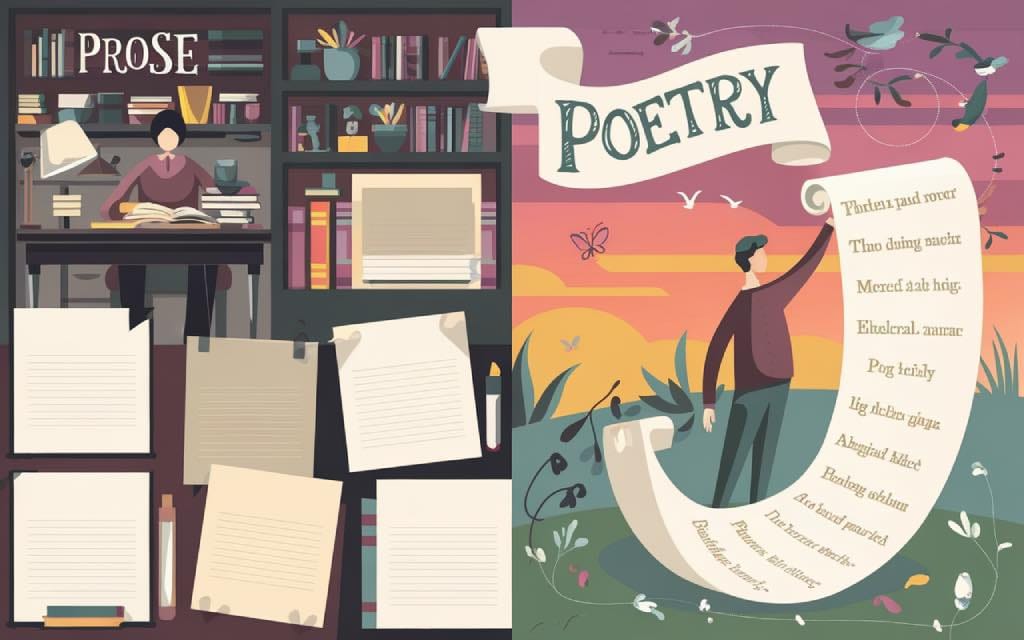
Prose and poetry offer two unique ways of writing. Prose employs extended sentences and paragraphs to convey ideas clearly, while poetry uses rhythm and vivid imagery to evoke moods and sensations. Examining these forms reveals not only what the differences between them are but also their similarities that unite them in their own unique ways of celebrating language.
Prose
Definition and Characteristics
Prose is the standard form of written language, structured by the conventions of grammar and the paragraph rather than the poetic line. It echoes the rhythms of everyday speech and prioritizes clarity of communication. Its primary features distinguish it from verse:
- Grammatical structure: Meaning is guided by conventional syntax and punctuation.
- Paragraph-based flow: Ideas develop in blocks of text, without the intentional line breaks of poetry.
- Flexible rhythm: Cadence arises from sentence length and word choice, not from metrical patterns.
This form supports a vast range of works, from novels and essays to reports and articles. Within prose, authors build imagery, construct arguments, and tell stories using structures that can be either linear or nonlinear, expansive or concise, always relying on the careful selection and arrangement of words.
Forms and Structure
Prose appears in multiple genres, each with a distinct aim:
- Narrative prose: Novels and short stories create immersive worlds populated by complex characters
- Expository prose: Texts that explain and inform through logical progression
- Persuasive prose: Speeches and opinion pieces designed to present and defend ideas
Language and Style
Prose values direct language and measured pace. Ernest Hemingway’s concise paragraphs demonstrate how simplicity and precision can evoke profound ideas. Every sentence is crafted to advance the narrative and clarify complex concepts.
Poetry
Definition and Characteristics
Poetry transforms language into a concentrated art form. It harnesses devices such as rhythm, meter, and sound to evoke sensations:
- Figurative language: Metaphors, similes, and symbolism convey nuanced ideas
- Sensory imagery: Detailed descriptions paint vivid pictures
- Variable form: Structures range from tightly constrained sonnets to the openness of free verse
These elements give poets the capacity to compress complex emotions into succinct expressions.
Forms and Structure
The versatility of poetry is evident in its many forms:
- Sonnets: Fixed 14-line compositions with set rhyme schemes, exemplified by Shakespeare’s work
- Haiku: Brief poems following a 5-7-5 syllable pattern, originating in Japan
- Free verse: Unrestricted forms that prioritize individual rhythm, as seen in Walt Whitman’s lines
Language and Style
In poetry, every word is selected for its sound and resonance. Robert Frost’s depictions of nature and Emily Dickinson’s spare lines show how carefully chosen language can evoke moods without excess. Poetic construction relies on intentional line breaks and rhythmic pacing to build meaning.
Shared Techniques and Impact
Both prose and poetry tackle universal themes, e.g., love, loss, identity, and our connection with nature, though their methods differ. They share a common toolkit:
- Imagery: Crafting detailed pictures with words
- Figurative devices: Using comparison to make abstract ideas tangible
- Rhythmic flow: Guiding thought through carefully measured language
Literary works in either form can influence perspectives and spark thoughtful discussion. Louise Glück’s The Wild Iris (1993) demonstrates how poetic reflections on nature and existence challenge conventional storytelling. Similarly, F. Scott Fitzgerald’s The Great Gatsby (1925), discussed in Susan Bell’s The Artful Edit (2013), blends narrative clarity with lyrical language to probe themes of ambition and transience.
The varied techniques of prose and poetry provide essential tools. Prose unfolds ideas through clear, methodical passages, whereas poetry compresses experience into rhythm and imagery. Exploring the difference between prose and poetry deepens our understanding of how each form communicates thought and feeling. Recognizing what distinguishes prose from poetry, and acknowledging their shared strengths, reveals how both celebrate the power of language to reflect the complexities of life.