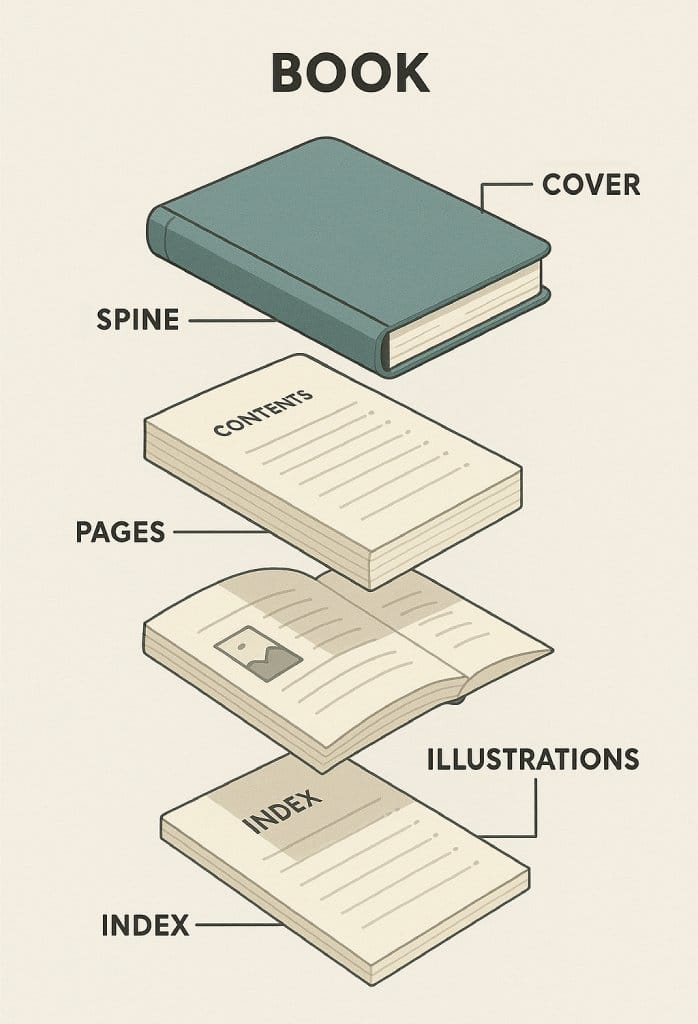
You know the author and the title. But do you know the colophon from the frontispiece? The world of a book extends far beyond its main text. The paratext, those features that surround the work, guides how we understand a story before we even reach page one.
We often think of a book as just its story, but it’s so much more. It’s a physical object, a designed artifact, and a carefully curated package. Every element, from the dedication to the index, is an intentional choice that directs a reader’s journey.
Let’s break down the anatomy of a book.
The Front Matter: The Opening Act
Before the story begins, you’re guided through the preliminary pages, known as the front matter.
- Half-Title Page: That almost blank page with just the title? It’s not a mistake. It’s a subtle, elegant way to introduce the book.
- Frontispiece: A decorative illustration or photograph on the left-hand page facing the title page. Common in older editions, it sets a visual tone.
- Copyright Page: The verso (reverse) of the title page. This is the book’s DNA—its publication history, ISBN, and copyright information. This is also where you’ll often find the colophon, a publisher’s emblem, or a note on the typeface.
- Epigraph: A short quotation or snippet of poetry. It’s a thematic key, offering a clue or setting a mood for the entire work.
- Preface vs. Foreword: A foreword is typically written by someone other than the author (an expert or another writer), lending credibility. The preface is the author’s own statement about the book’s purpose, scope, and origins.
The Body: Where the Story Lives
This is the main text, but even here, design elements play a role.
- Running Head & Footer: The content repeated at the top (running head) or bottom (footer) of each page, usually the title, author, or chapter name.
- Pull Quote: A striking, memorable line from the text, often given special graphic treatment to draw the eye and highlight a key theme.
The Back Matter: The Supporting Evidence
Once the story ends, the conversation isn’t over. The back matter provides context, definition, and further exploration.
- Afterword: A concluding section that often reflects on the narrative’s aftermath or its writing process.
- Appendix: Supplementary material that enriches the text, like maps, letters, or timelines.
- Glossary: A lifesaver in fantasy or historical fiction, this is a list of specialized terms with definitions.
- Bibliography/Works Cited: A list of sources the author consulted, a testament to the research behind the work.
- Index: An alphabetical list of names, places, and subjects with page numbers. The mark of a great nonfiction book is a detailed, useful index.
The Physical Object: More Than Just Paper
A book is a tactile experience.
- Dust Jacket: The removable paper cover. Open the book and you’ll see the inside flaps, which often contain summaries and author bios.
- Spine: The part that faces out on your shelf that bears the title, author, and publisher’s logo.
- Headband: Those little fabric tabs at the top and bottom of a hardcover’s spine. They’re a decorative holdover from traditional bookbinding that adds a touch of class.
- Gutter: The inner margin where the pages are bound. A well-designed book has a gutter wide enough that you don’t have to crack the spine to read the text.
Why does this matter? Understanding these terms equips us to be more mindful readers. We begin to see the book as a complete work of art and craftsmanship. The next time you pick up a book, take a moment to appreciate its paratext. You might just find an added richness to the story waiting for you in the margins.
Further Reading
Parts of a Book: Quire, Colophon, and More by Merriam-Webster