My Reading Note
A few years ago, I found myself stuck between two kinds of books. On one side of my desk sat self-help manuals promising clear answers to questions I could not even formulate. On the other side lay novels and essays that offered no answers at all but somehow made my confusion feel less isolating. I did not know how to choose between them, and I suspected that choosing was the wrong framework. This article asks what happens when we stop picking sides and start asking how any book can help.
What is literature for?
Readers have always turned to literature for guidance. Some reach for Marcus Aurelius’s Meditations to learn how to face adversity. Others find in George Eliot’s Middlemarch (1871) a source of wisdom about marriage and ambition that no self-help book has ever matched. Still others seeking explicit methods for change pick up James Clear’s Atomic Habits (2018) or M. Scott Peck’s The Road Less Traveled (1978). These books belong to different genres but share a common use: they are read as tools for living.
This article is not an argument about whether self-help books deliver what they promise or whether literature surpasses them in value. Instead, it asks a different set of questions: what happens when we read any book, whether a Stoic manual, a Victorian novel, or a contemporary guide to habits, as a source of guidance? And what does the act of interpretation do to the reader who practices it?
The argument is that interpretation itself is a form of self-help. The reader who learns to ask what a text means for their own life is not passively receiving advice but actively constructing meaning and testing possibilities. This is not a skill that belongs only to professors or critics, for it is a practice available to any reader who approaches a book with a single question: what can I take from this?
The Limits of Advice
Advice works well for problems: a leaky faucet needs a plumber, a blank page needs a first sentence, and a fitness goal needs a routine. Self-help books offer step-by-step methods for these difficulties, and they serve them well. But not every difficulty is a problem. Grief, for example, has no checklist, and a crisis of meaning cannot be resolved by a numbered list. The question of how to live does not yield to a seven-step plan. Because these are predicaments and not problems. They can be endured, reframed, or reinterpreted, but they cannot be solved.
I spent months browsing through shelves of self-help books looking for advice on what to do with my life, but none of them gave me an answer. Then I picked up a novel by chance, and a few sentences in it made my confusion feel less like a personal failure. That was not a solution to what I felt at that time, but it was the first thing that helped. It sent me back to both genres with a different set of questions.
Traditional self-help struggles with predicaments because its tools are designed for problems. Actionable takeaways, research citations, and numbered lists work well for fixing a leaky faucet or building a habit, but when applied to grief or a crisis of meaning, they often feel reductive or dismissive. This is simply a limit of the form, not an indictment of the genre.
The Practice of Interpretation
To read for guidance is to engage in an act of interpretation. This practice begins with a simple recognition that books do not merely contain ready-made meanings waiting to be extracted; a text becomes significant when a reader relates it to their own concerns, experiences, and questions. The value of a book, therefore, lies not only in what it says but also in what it enables a reader to see.
Interpretation differs from instruction. While instructions aim to reduce uncertainty by prescribing a course of action, interpretation, by contrast, seeks understanding. When readers turn to Aurelius during a period of adversity or to Didion in the aftermath of loss, they are rarely searching for a procedure to follow. They are searching for language, perspective, and orientation. They want help understanding what is happening to them.
This is why books from radically different genres can serve similar purposes. A philosophical meditation, a novel, a memoir, and a self-help manual may share little in form, yet each can provide a framework through which experience becomes intelligible. The practice of interpretation, therefore, involves several related activities: readers identify patterns between a text and their own lives, test interpretations against experience, and revisit familiar works as their circumstances change. Through this process, books become companions in reflection rather than repositories of advice.
A Framework for Reading Literature as Self-Help
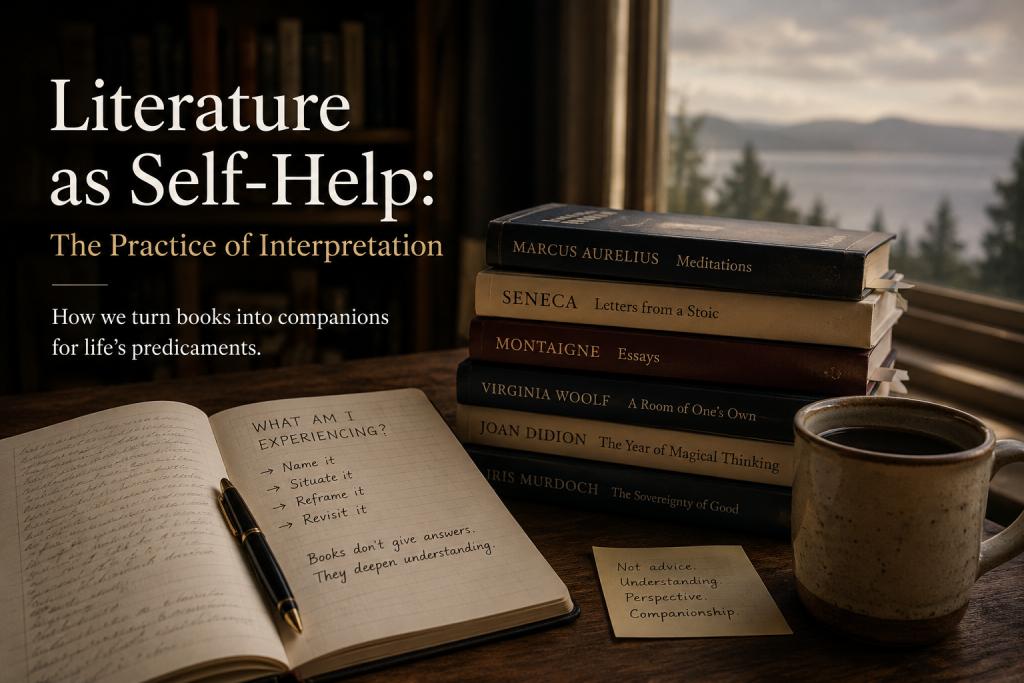
If literature can help readers navigate life’s predicaments, how does it do so? The answer lies not in any particular genre but in a mode of reading. Whether one turns to philosophy, memoir, fiction, or self-help, books become useful when they are read as tools for interpretation. This process can be understood through four interrelated practices: naming experience, situating experience, reframing experience, and revisiting experience.
- Naming Experience: Many books help readers identify and articulate experiences that previously felt vague, confusing, or inexpressible. A reader encountering grief in Didion, despair in Kierkegaard, or alienation in Pessoa often recognizes something that had remained unnamed. The first use of literature is therefore diagnostic: it provides language for what we are living through.
I first learned the word “anomie” from a textbook. But I first saw what it looked like in a novel, where a character drifted through a city without purpose or attachment. The textbook gave me a definition, but the novel described to me the experience. A reader needs both, but literature supplies what the dictionary alone cannot.
- Situating Experience: Once an experience has been named, literature helps place it within a broader human context. Readers discover that their anxieties, ambitions, losses, and moral struggles are neither unique nor unprecedented. Through philosophy, fiction, memoir, and essays, individual lives become connected to larger histories, traditions, and patterns of human experience. This practice reduces isolation and builds a foundation of solidarity.
- Reframing Experience: With naming and situating in place, literature offers ways of understanding the same experience differently. Aurelius reframes adversity as an opportunity for discipline; Frankl reframes suffering through the lens of meaning. Such reframing does not change external circumstances, but it can transform the significance attached to them. The reader learns to see their predicament through a new interpretive lens.
I once dismissed Marcus Aurelius’s Meditations as repetitive. Years later, after a period of professional difficulty, I reread the same passages and found them lucid. The text had not changed. I had simply grown ready for what it offered.
- Revisiting Experience: Unlike advice, interpretation is rarely complete. Readers return to books at different stages of life and discover new meanings because they themselves have changed. A text that once seemed obscure may become illuminating years later. Literature remains useful because interpretation is an ongoing practice rather than a finished achievement.
These four practices do not constitute a method for solving problems. Rather, they offer a way of engaging with predicaments—those enduring questions of identity, meaning, and moral judgment that accompany human life. Read in this way, literature becomes more than a source of information or aesthetic pleasure. It becomes a resource for self-understanding and a companion in the work of living.
Mapping the Tradition
The works below span more than two millennia and include philosophy, literature, memoir, letters, and essays. They differ widely in form and historical context, yet each addresses a common concern: how human beings understand themselves and orient their lives. Read together, they reveal a tradition in which books serve not only as sources of knowledge or aesthetic experience but also as occasions for reflection, judgment, and self-examination. The categories that follow highlight recurring themes within that tradition and offer support to the previous framework in the practice of interpretation.
Foundations of Self-Examination
These texts establish the idea that the self is something to be examined, interpreted, and cultivated.
| Work | Author | Year |
|---|---|---|
| The Analects | Confucius | c. 475–221 BCE |
| Meditations | Marcus Aurelius | c. 180 CE |
| Confessions | Augustine | c. 397–400 |
| Essays | Michel de Montaigne | 1580 |
| Self-Reliance | Ralph Waldo Emerson | 1841 |
| The Varieties of Religious Experience | William James | 1902 |
The Problem of Becoming a Self
These works ask what it means to become oneself rather than merely occupy a social role.
| Work | Author | Year |
|---|---|---|
| Either/Or | Søren Kierkegaard | 1843 |
| Notes from Underground | Fyodor Dostoevsky | 1864 |
| A Room of One’s Own | Virginia Woolf | 1929 |
| The Ethics of Ambiguity | Simone de Beauvoir | 1947 |
| The Wisdom of Insecurity | Alan Watts | 1951 |
| The Courage to Be | Paul Tillich | 1952 |
Literature as a Guide to Inner Life
Works that readers repeatedly use for self-understanding despite not belonging to the self-help genre.
| Work | Author | Year |
|---|---|---|
| Middlemarch | George Eliot | 1871–1872 |
| In Search of Lost Time | Marcel Proust | 1913–1927 |
| Siddhartha | Hermann Hesse | 1922 |
| The Prophet | Kahlil Gibran | 1923 |
| Letters to a Young Poet | Rainer Maria Rilke | 1929 |
| The Book of Disquiet | Fernando Pessoa | 1982 |
I have never read The Prophet straight through. I usually open it when I am stuck, read a few pages, and close it. The book works in fragments, and I have learned that fragments are enough to carry me forward.
Meaning, Suffering, and Human Predicaments
These texts address questions that cannot be solved but must be lived.
| Work | Author | Year |
|---|---|---|
| The Death of Ivan Ilyich | Leo Tolstoy | 1886 |
| The Trial | Franz Kafka | 1925 |
| The Myth of Sisyphus | Albert Camus | 1942 |
| Man’s Search for Meaning | Viktor Frankl | 1946 |
| The Denial of Death | Ernest Becker | 1973 |
| The Year of Magical Thinking | Joan Didion | 2005 |
Moral Vision and Life Among Others
Texts concerned with judgment, responsibility, community, and human relations.
| Work | Author | Year |
|---|---|---|
| Nicomachean Ethics | Aristotle | c. 340 BCE |
| Walden | Henry David Thoreau | 1854 |
| The Art of Loving | Erich Fromm | 1956 |
| The Little Virtues | Natalia Ginzburg | 1962 |
| The Fire Next Time | James Baldwin | 1963 |
| The Sovereignty of Good | Iris Murdoch | 1970 |
Philosophy as Therapy
The closest ancestors of modern self-help.
| Work | Author | Year |
|---|---|---|
| Tao Te Ching | Laozi | c. 4th century BCE |
| Letters from a Stoic | Seneca | c. 65 CE |
| The Conquest of Happiness | Bertrand Russell | 1930 |
| Zen and the Art of Motorcycle Maintenance | Robert M. Pirsig | 1974 |
| The Uses of Enchantment | Bruno Bettelheim | 1976 |
| The Consolations of Philosophy | Alain de Botton | 2000 |
I have read Epictetus during three different crises, and each time I took away a different lesson. The text had not changed, but I had. This is the difference between instruction and interpretation: instruction prescribes a single action, while interpretation continues to yield new insights as the reader’s circumstances change.
What Literature Offers
The framework outlined above is less a method for choosing books than a way of approaching them. A reader need not begin with philosophy, nor with the classics, nor even with books traditionally associated with self-improvement. Any work can become useful when read through the lens of interpretation.
One practical approach is to read with questions rather than expectations. Instead of asking what a book can teach, readers might ask what experience it helps illuminate. What does it name? What assumptions does it challenge? What larger context does it reveal? How might its meaning change when revisited years later? Such questions transform reading from the passive consumption of information into an active practice of reflection.
I used to finish self-help books and forget everything within a week. Then I started reading a few pages of Meditations each morning without any goal. I retained less but applied more. The difference was reading for orientation instead of for instruction.
This perspective also changes how books are evaluated. The most valuable books are not always those that provide the clearest advice or the most actionable insights. Some of the works that remain with readers for decades offer few solutions and many uncertainties. Their value lies in the quality of attention they cultivate and the perspectives they make available.
Seen in this light, the distinction between literature and self-help becomes less rigid than it first appears. Both arise from a common human desire to understand how to live, and the difference lies primarily in emphasis. Self-help tends to privilege instruction, while literature often privileges interpretation. Both address the same enduring concerns, and readers move between them for that reason.
The tradition surveyed in this article suggests that reading has long served purposes beyond information, entertainment, or aesthetic appreciation. Books help people think through experiences, test values, confront uncertainty, and imagine alternative ways of being. They offer orientation rather than certainty and reflection rather than resolution. Their usefulness lies in helping readers understand life’s deepest predicaments more fully, not in solving them. Understanding does not solve the problem, but it alters how the reader meets it. That alteration is its own kind of help.
The Case of Life-Changing Books: A Critical Inquiry
The Year of Magical Thinking by Joan Didion: A Deep Literary Analysis
This article argues that interpretation is a form of self-help, and the posts I have linked above explore that claim from different angles. My earlier inquiry into “Life-Changing Books” examined why some texts leave a lasting mark while others fade, a question that runs through this article’s argument about interpretation as a practice. The piece on “Philosophical Fiction” asked whether novels can carry ideas without turning abstract, which is exactly what this article claims literature does when read for guidance. And the analysis of “Didion’s The Year of Magical Thinking” shows that idea in action, for that memoir helps readers by making their own disorientation recognizable, not by offering instruction. These three posts circle the same problem from different directions: why we read for help, how fiction carries thought, and what a single well-crafted sentence can do.
Further Reading
- The Best Self-Help Books aren’t Actually Self-Help Books by Josiah Gogarty, GQ
- ‘I’ve read 1,000 self-help books – this is the one self-improvement mistake you’re probably making’ by Ellen Scott, Good Housekeeping
- The power of good literature, the limits of self-help books by chicgirlmoment, Substack
- Does reading literature help us better understand ourselves?