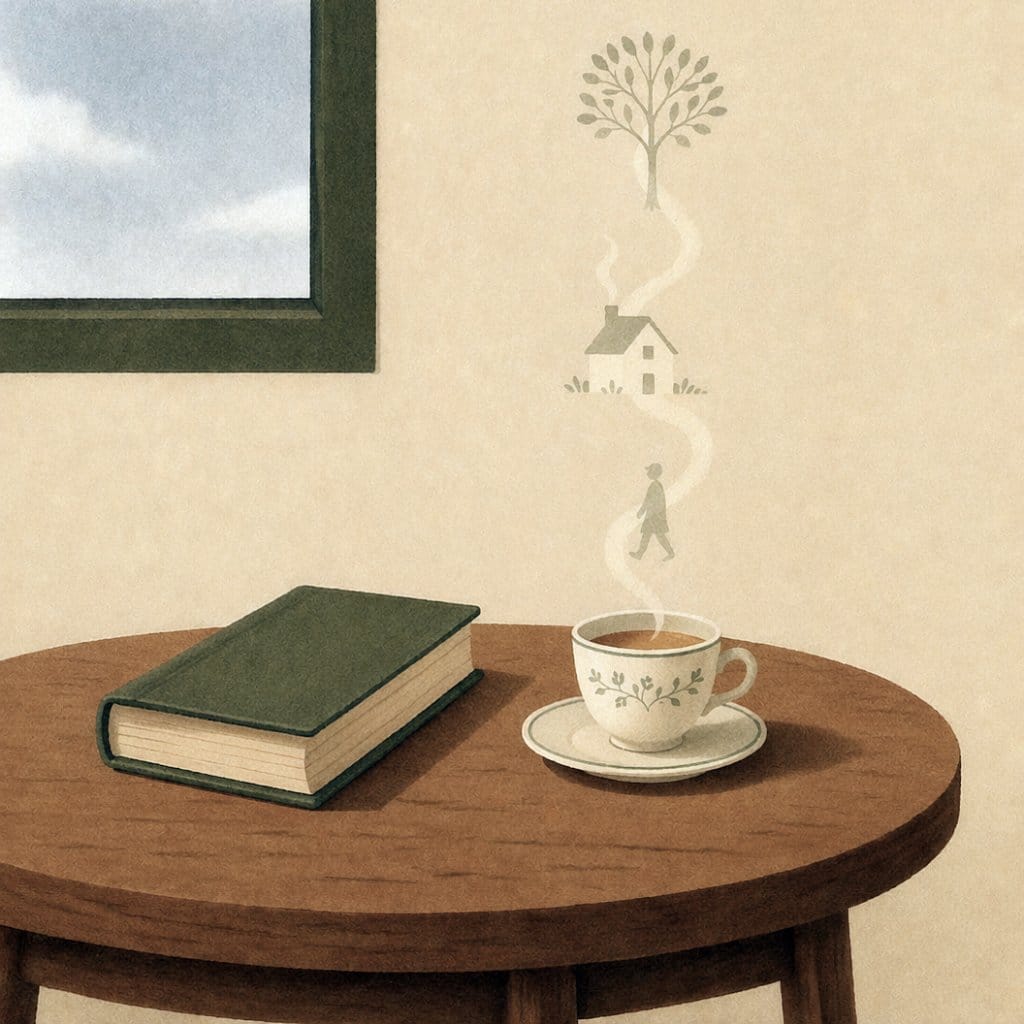
My Reading Note
I first encountered the term “slice of life” in a discussion about anime, not a literature class. Someone recommended a show where nothing happens, and I asked why anyone would watch it. Their answer—that the lack of events matters—has proven difficult to dismiss. This guide tries to understand why.
Slice of life is a genre of naturalistic representation that depicts ordinary, everyday experiences with minimal plot progression or dramatic conflict. The term derives from the French tranche de vie (“slice of life”), which emerged in 19th-century French literary and theatrical discourse, particularly among Realist and Naturalist writers. It referred to the artistic aim of presenting a fragment of life as it is lived—unembellished and without imposed narrative structure. The phrase later entered English as “slice of life” and now applies broadly to literature, film, television, and comics.
A slice-of-life story has minimal exposition, few dramatic peaks, and often lacks a traditional resolution. The emphasis falls instead on atmosphere, character observation, and the accumulation of small details. A typical plot follows a cause-and-effect chain: this happens; therefore, that happens. A slice-of-life narrative proceeds by addition: this happens, and then this happens, and then this happens. The reader experiences a stretch of ordinary time rather than a story with a destination.
Key Characteristics
| Feature | What It Means |
|---|---|
| Everyday situations | The setting is familiar; the events could happen to anyone |
| Minimal conflict | No villain, no ticking clock, no world at stake |
| Open endings | The narrative stops rather than concludes |
| Emphasis on atmosphere | Mood, place, and sensory detail carry the reader’s attention |
| Small details as revelation | A character’s nature emerges through accumulated gestures, not grand speeches |
A slice-of-life story trusts the reader to find meaning without being told where to look. The author presents, and the reader interprets.
A Brief History
The roots of slice of life lie in the naturalism movement of late nineteenth-century France. André Antoine’s Théâtre Libre (founded 1887) staged plays that rejected the well-made plot in favor of unvarnished domestic scenes, while critics such as Jean Jullien introduced the notion of theater as a tranche de vie. Émile Zola, the movement’s leading theorist, argued in his essays on the “experimental novel” that literature should observe and record reality with something like the detachment of a scientist.
In English literature, slice-of-life techniques appear in the short stories of Anton Chekhov, whose plots often end without resolution, and in James Joyce’s Dubliners (1914), where small moments of daily life produce what Joyce called “epiphanies.” John Steinbeck’s Of Mice and Men (1937) follows a simple, almost meandering structure before its devastating final scene. Alice Munro, throughout her career, perfected the slice-of-life short story, finding entire worlds in a single afternoon.
The genre found new life in twentieth-century television. Paddy Chayefsky’s teleplays of the 1950s brought slice-of-life naturalism to the small screen. Seinfeld, famously described as “a show about nothing,” built an empire on the premise that ordinary social absurdities could sustain endless episodes. In anime and manga, slice of life became a dominant genre, with works such as Yokohama Kaidashi Kikō and Yotsuba&! celebrating ordinary moments over epic battles.
Why Readers Love Slice of Life
The appeal of slice of life is not obvious. A reader accustomed to suspense, romance, or adventure may find the genre slow, aimless, or frustrating. Yet its devoted readers return for several reasons.
First, slice of life creates intimacy. Without a plot to advance, the narrative lingers. The reader spends time with characters in their ordinary states, not their exceptional ones. This prolonged proximity builds a sense of knowing that no high-stakes adventure can match.
Second, slice of life grounds the extraordinary. When a fantasy or science fiction novel adopts slice-of-life techniques, it makes the impossible feel inhabitable. A story about a robot running a countryside café remains fantastical in its premise, yet the ordinary pace makes that premise believable.
Third, slice of life respects the reader’s intelligence. The genre does not explain its significance. It presents a scene, such as a woman washing dishes, a child walking home from school, or an old man feeding pigeons, and trusts that the reader will supply the meaning. This trust is a form of respect.
The first time I read a slice-of-life novel, I kept waiting for something to happen. By the second time, I realized something was happening the whole time. I was just looking for the wrong kind of something.
Notable Examples in Literary Fiction
| Work | Why It Fits |
|---|---|
| James Joyce, Dubliners (1914) | Ordinary moments produce sudden flashes of insight |
| Alice Munro, Too Much Happiness (2009) | Domestic detail as revelation; endings that avoid closure |
| Marilynne Robinson, Gilead (2004) | A dying pastor’s journal; the plot is the act of remembering |
| Rachel Cusk, Outline (2014) | A narrator who barely speaks; the novel is what she hears from others |
Slice of Life vs. Related Terms
| Term | Difference |
|---|---|
| Naturalism | A philosophical movement that treats characters as products of environment and heredity; slice of life is a technique within naturalism |
| Kitchen sink realism | A British working-class movement of the 1950s-60s; slice of life is broader in class and setting |
| Slow cinema | A film movement defined by long takes, minimal editing, and slow pacing; the literary equivalent shares its patience but not its formal constraints |
| Anecdote | A short, often humorous account of an incident; slice of life can sustain novel length |
How to Read Slice of Life
Readers trained on plot-driven fiction may struggle with slice of life. Three questions offer a method.
- What accumulates? In a plot-driven novel, the reader tracks causation. In a slice-of-life work, the reader tracks repetition and variation. A character makes tea in chapter one, burns the toast in chapter three, and sits in silence at an empty table in chapter seven. The tea, the toast, and the silence are not events. They are a pattern. The pattern is the meaning.
- Where is the tension? Slice of life has no villain, no ticking clock, and no life-or-death stakes. The tension lies in the gap between what a character shows and what a character feels. A woman washes dishes while her marriage ends in the next room. The drama is in the plate and the running water.
- Why does this scene matter? Slice of life never answers this question directly. The reader must answer it alone. If the scene leaves no trace, the work has failed. If the scene lingers, the work has succeeded.
A reader who answers these three questions has learned to read slice of life on its own terms.
Why It Matters
The slice of life genre teaches patience, attention to detail, and the value of the unremarkable. In a literary culture that often prizes high stakes and rapid pacing, slice of life offers an alternative: the slow accumulation of small truths. It trusts the reader to find significance without being told where to look. That trust is the genre’s greatest gift.
A Moveable Feast by Ernest Hemingway
My previous post on “Naturalism in Literature” traces the nineteenth-century movement that insisted on objective, unvarnished depictions of ordinary life. Slice of life inherits that commitment to the everyday but strips away naturalism’s deterministic pessimism. My review of “Hemingway’s A Moveable Feast” examines a memoir built from small moments (café conversations, a walk along the Seine) where the plot is simply the accumulation of days. That book exemplifies slice of life better than most novels classified under the genre. Lastly, my article on “Realistic Fiction” defines the broader category of plausible, everyday storytelling, and slice of life occupies one corner of that territory: the corner where plot stops advancing and simply lingers.
Further Reading
- Slice of life on Wikipedia
- What is the meaning of “slice of life”? on Quora
- Is there a “slice of life” genre in literature? on Reddit