Explore This Topic
- Choosing a Narrative Structure: A Writer’s Blueprint
- Three-Act Structure: Components and Functions
- The Hero’s Journey: Mapping Transformational Arc
- The Fichtean Curve: Structuring for Unrelenting Momentum
- The Seven-Point Structure: Reverse-Engineering Your Plot
- Freytag’s Pyramid: The Structure of Tragedy
The Seven-Point Structure is a strategist’s blueprint for plotting. It operates on a fundamental inversion: defining the story’s climax and resolution first, then engineering the necessary prior events. This reverse-engineering method solves a specific structural challenge by ensuring every major plot point exists to make the ending feel both surprising and inevitable.
The method guarantees logical necessity from the outset, which solves a common plotting problem. A writer might craft an exciting chase scene or a clever revelation without a clear path to a consequential climax. The structure ensures such a middle event becomes a necessary step toward the predetermined ending.
The Core Mechanism: Working Backward from the End
The power of the Seven-Point Structure derives from its foundational inversion. A writer begins by defining the story’s conclusion: the Climax (Point 6) and the Resolution (Point 7). With this destination fixed, the preceding five points are engineered as the necessary preconditions to reach it. This strategic focus on causation transforms plotting.
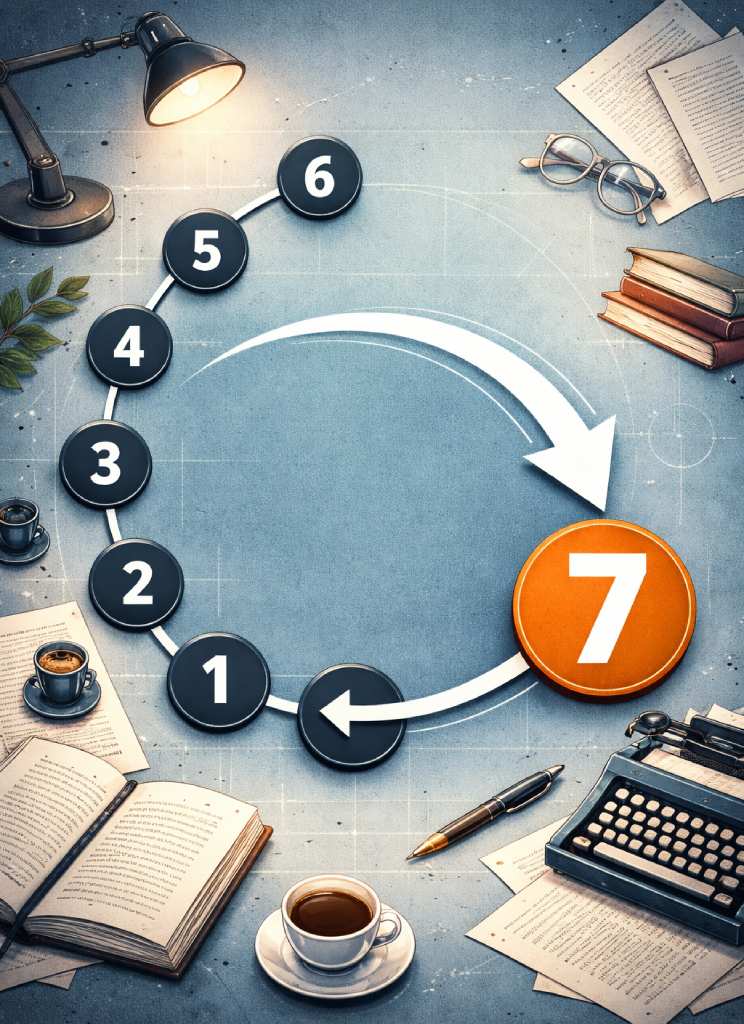
This method constructs a chain of logical inevitability. The “Hook” (Point 1) establishes a status quo for “Plot Turn 1” (Point 2) to disrupt. “Pinch 1” (Point 3) applies pressure, forcing the protagonist to the “Midpoint” (Point 4) shift from reaction to action. “Pinch 2” (Point 5) intensifies the conflict, enabling “Plot Turn 2” (Point 6) to provide the final means for the “Climax.” The “Resolution” (Point 7) demonstrates the new world resulting from that climax. Every point functions as a link engineered backward from this fixed ending.
The Seven Points: A Strategic Sequence
The seven points are not just a list of events but a sequence of strategic objectives. Each point serves a specific function in the chain of causation leading to the climax.
- Hook (Point 1): Establish the Specific Normal World. Present the protagonist’s status quo in a way the story’s central problem will directly challenge.
- Plot Turn 1 (Point 2): Launch the Central Conflict. Initiate the story’s core problem, which engages the protagonist within the central conflict.
- Pinch 1 (Point 3): Apply Direct Pressure. Raise the stakes and narrow the protagonist’s options through a setback, which compels a specific response.
- Midpoint (Point 4): Shift from Reaction to Action. Deliver a pivotal event that alters the protagonist’s relationship to the conflict, moving them from a passive to an active role.
- Pinch 2 (Point 5): Apply Maximum Pressure. Intensify the conflict to its peak, often through a major setback for the protagonist, eliminating simpler alternatives.
- Plot Turn 2 (Point 6): Provide the Final Means. Supply the protagonist with the crucial insight, tool, or motivation necessary for the final confrontation.
- Climax (Point 7): Execute the Final Confrontation. This is the direct, decisive engagement where the protagonist uses the means from Point 6 to resolve the central conflict established in Point 2. (Note: In some interpretations, the “Resolution” is the outcome of the “Climax.” For a clean seven-point list, the final point is typically the Climax. The Resolution is its immediate consequence.)
Practical Application: Using the Structure as a Diagnostic
The primary value of the Seven-Point Structure lies in its function as a plot diagnostic. Writers can apply it to test an existing outline or draft for logical integrity and narrative drive.
The Checklist Method
Use the seven points as a checklist. For each point, ask: “Does my story have a clear beat that serves this specific function?” A missing or weak “Pinch 1” (Point 3) often explains a sagging middle act, as insufficient pressure fails to force the protagonist to the vital Midpoint shift. A vague “Plot Turn 2” (Point 6) frequently results in a climax that feels unearned or deus ex machina, as the protagonist lacks the necessary means for confrontation.
Identifying Plot Holes
The structure reveals cause-and-effect failures. If the climax does not directly resolve the “Central Disruption” established in “Plot Turn 1,” the story’s logic is broken. The model demands that each point enable the next, creating a closed loop of inevitability. This makes it an exceptional tool for revision, transforming subjective feelings of “something’s off” into identifiable structural gaps.
The Strategist’s Tool
The Seven-Point Structure provides a strategic tool for writers who require logical precision in their plots. Its method of reverse-engineering from a defined climax ensures a narrative where every major beat functions as a necessary link in a chain of causation. This transforms the structure into a powerful diagnostic for testing a plot’s integrity and drive.
For stories centered on character transformation or the sustained escalation of tension, other models may offer a more organic fit. To compare this strategic blueprint with structures like the Hero’s Journey or the Fichtean Curve, see the central guide: Choosing a Narrative Structure: A Writer’s Blueprint.
Further Reading
- The 7-Point Story Structure + Variations: A Blueprint For Plotting in Any Genre by B.K. Bass, Campfire Publishing
- 10 Ways to Reverse Engineer Your Plot by Shirley Jump, Writers in the Storm
- How the Seven-Point Story Structure Can Help Your Writing by ryanlanz.com
- Dan Wells’ seven-point story structure on Reddit