My Reading Note
My fixation with the Oxford comma started with a productive misreading. A poet omitted the final comma, which welded separate images into a single, arresting metaphor. In that moment I realized that this punctuation has a common yet critical function: to prevent accidental conflation by governing the reader’s path through the sentence.
The Oxford comma occupies a distinct and curious position in modern discourse. This small mark, placed before the final conjunction in a series, acts as a potent cultural signifier. The debate surrounding it crystallizes the fundamental tension between prescriptive and descriptive views of language.
This article moves past the simplistic question of usage to examine the comma through a writer’s fundamental rhetorical choice. This choice defines the writer’s relationship with the reader along a spectrum: one pole commits to explicit clarity, the other appeals to implicit trust. The decision remains philosophical, governed by the text’s cognitive and contextual requirements.
The Case for Explicit Clarity: Processing Fluency and the Burden of Ambiguity
The primary argument for the Oxford comma is grounded in processing fluency—the cognitive ease with which our brains parse information. The comma acts as a cognitive courtesy, a visual cue that segments items and reduces syntactic load. Its omission forces the reader to perform a micro-analysis, a backtracking process to establish grouping.
The infamous Maine dairy lawsuit, which hinged on the lack of an Oxford comma and cost a company $5 million, is not an outlier. It is the logical conclusion of prioritizing typographical economy over cognitive certainty. In legal, technical, or any text where referential precision is paramount, omitting the comma is not a style choice. It constitutes professional negligence.
We can formulate a testable principle: the Oxford comma becomes essential as list items grow more syntactically complex and referentially ambiguous, and as the shared knowledge between writer and reader diminishes. A simple list like “apples, oranges and bananas” functions without the comma due to shared context.
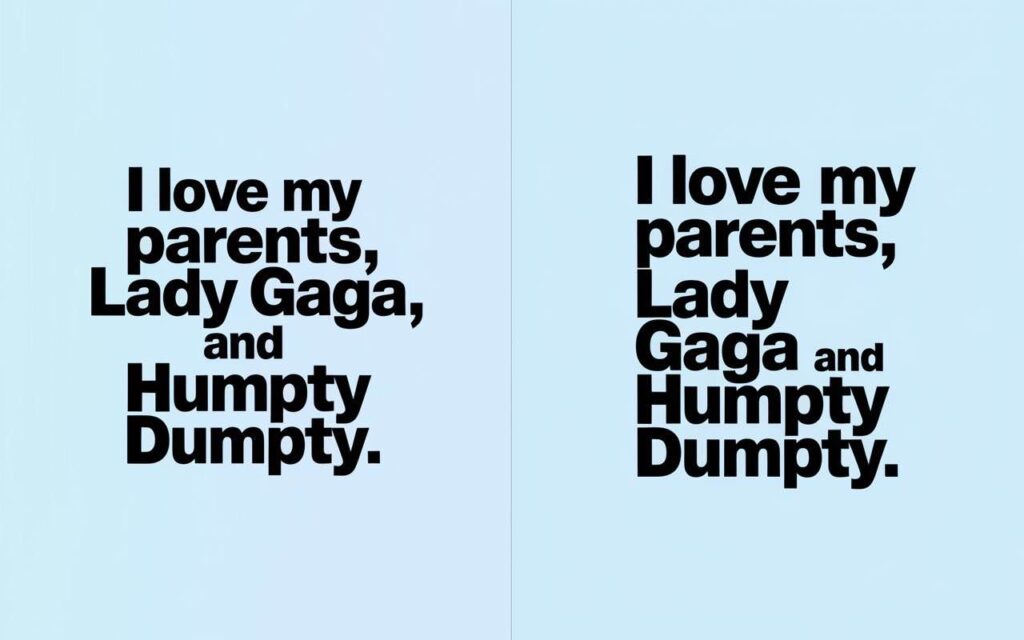
A classic illustration of this ambiguity is the list “I love my parents, Lady Gaga and Humpty Dumpty.” Without the Oxford comma, the sentence can be misread to suggest Lady Gaga and Humpty Dumpty are the speaker’s parents. Adding the comma—”I love my parents, Lady Gaga, and Humpty Dumpty”—clarifies that three distinct entities are loved.
The Case for Implicit Trust: A Corrective View on Rhythm and Minimalism
A corrective analysis must address the absolutist mandate for the comma. Its opponents, particularly in journalistic and literary traditions, champion implicit trust. Omitting the final comma is a stylistic gesture that prioritizes rhythmic flow, pace, and aesthetic minimalism. It signals a belief that a well-constructed sentence, guided by cadence and context, should not require such a handhold.
This position is not mere laziness but a different philosophy of composition. The Associated Press (AP) Stylebook’s traditional rejection of the serial comma stemmed from the material constraints of print newspapers, that a saved character per line mattered. This historical accident evolved into a stylistic principle favoring lean, rapid prose.
I find the British stylistic aversion to the Oxford comma fascinating. It reflects a cultural preference for linguistic economy and an assumption of readerly sophistication that can, in the best cases, create a more elegant and trusting prose rhythm. In the worst, it produces the Maine lawsuit.
Synthesis and the Writer’s Strategic Choice
The choice to use the Oxford comma is a strategic one, a tool for rhetorical positioning. The writer deciding on its use is answering a fundamental question: what is the nature of their contract with this specific reader in this specific context?
- Explicit Clarity Mode: Deploy the comma in technical documentation, legal texts, academic writing, or any prose where unambiguity is the highest virtue. The comma positions the writer as a careful guide, leaving nothing to chance.
- Implicit Trust Mode: Omit the comma in poetry, lyrical prose, journalism, or fast-paced narrative where rhythm and concision are prioritized. This positions the writer as a collaborator, encouraging the reader to meet the text halfway by relying on shared syntactic intuition.
The debate, therefore, transcends punctuation. It is about authority, trust, and the distribution of interpretive labor between writer and reader.
Writing Styles: Elements and Types
To observe the tangible impact of using the Oxford comma, I apply the framework to a foundational concept explored elsewhere on this blog: the anatomy of writing styles. That analysis dissects elements like syntax, pacing, and rhythm—precisely the writing domains that the Oxford comma influences.
My Reading Recommendations: To ground this theoretical play in expert wisdom, read Lynne Truss’s Eats, Shoots & Leaves (2003) for a witty, passionate defense of punctuation’s importance. For the deeper linguistic philosophy, David Crystal’s Making a Point (2015) is indispensable.
The framework of explicit clarity and implicit trust offers a new lens through which to read not just sentences, but entire stylistic approaches. Applying it to the literary explainer I provided above reveals the presence or absence of the Oxford comma as a concentrated expression of larger stylistic commitments.
Further Reading
- Oxford commas? Let common sense prevail by David Marsh, The Guardian
- Going, Going, And Gone?: No, The Oxford Comma Is Safe … For Now by Linda Holmes, NPR
- The Oxford Comma Should Be Considered a Standard, Not a Preference by Maddie Khaw, The La Salle Falconer
- Should we use the Oxford comma sometimes, all the time, or never? on Quora