My Reading Note
After reading Franzen’s novel Freedom again, I noticed Richard Katz kept pulling my attention away from the Berglunds, the novel’s main characters. Katz is often cruel and rigid, yet the novel seemed to reward his unwillingness to engage in any earnest struggle. That unease sent me searching for similar figures, starting with Amalfitano in Bolaño’s 2666 and Caravaggio in Ondaatje’s The English Patient. This article asks whether their brilliance is genuine or merely a way to make detachment seem profound.
The “brilliant but detached” male intellectual has a long history in fiction. Nineteenth-century Russian literature gave readers the “superfluous man,” e.g., Eugene Onegin and Grigory Pechorin, educated nobles paralyzed by introspection and alienated from society. Those characters were protagonists whose inaction brought tragic consequences.
A shift occurred in late twentieth-century literary fiction. The detached intellectual moved from the center to the margins. He became a supporting character orbiting a more entangled (often female) protagonist. This shift changed his role. Detachment ceased to be a source of suffering and became a luxury. As a supporting character, he could critique the world without entering it, judge without compromising, and appear profound while avoiding the moral and emotional consequences that the protagonist endured.
This essay examines three such figures: Óscar Amalfitano, Richard Katz, and Caravaggio. They show distinct modes of withdrawal, outshine their novels’ nominal centers, and reveal something uncomfortable about the reader’s preference for clarity over confusion. The question is not simply why these characters are memorable, but what their memorability says about the limitations of the protagonists they overshadow.
A Taxonomy of Detachment
The three characters occupy different positions on the spectrum of withdrawal. Amalfitano’s detachment is pathological, a mind breaking under pressure. Katz’s detachment is performative, a curated persona of dismissal. Caravaggio’s detachment is tactical, a survival mechanism formed by torture and loss. Together, they cover the range of ways contemporary fiction uses the intellectual male outsider as a corrective to the protagonist’s earnest entanglement.
I have always been suspicious of clean taxonomies. These three modes bleed into one another. Caravaggio performs sometimes, while Amalfitano chooses his isolation in small ways. But the distinctions hold well enough for analysis, provided the reader does not mistake the map for the territory.
Amalfitano: Intellectual Breakdown
Óscar Amalfitano appears across multiple sections of Roberto Bolaño’s 2666 (2004). He is a Chilean literature professor living in Santa Teresa, a Mexican city where women are murdered at an accelerating rate. He has a daughter, Rosa, whom he fears losing. His wife, Lola, abandoned the family years earlier. By the time the reader meets him, his mind is already coming apart.
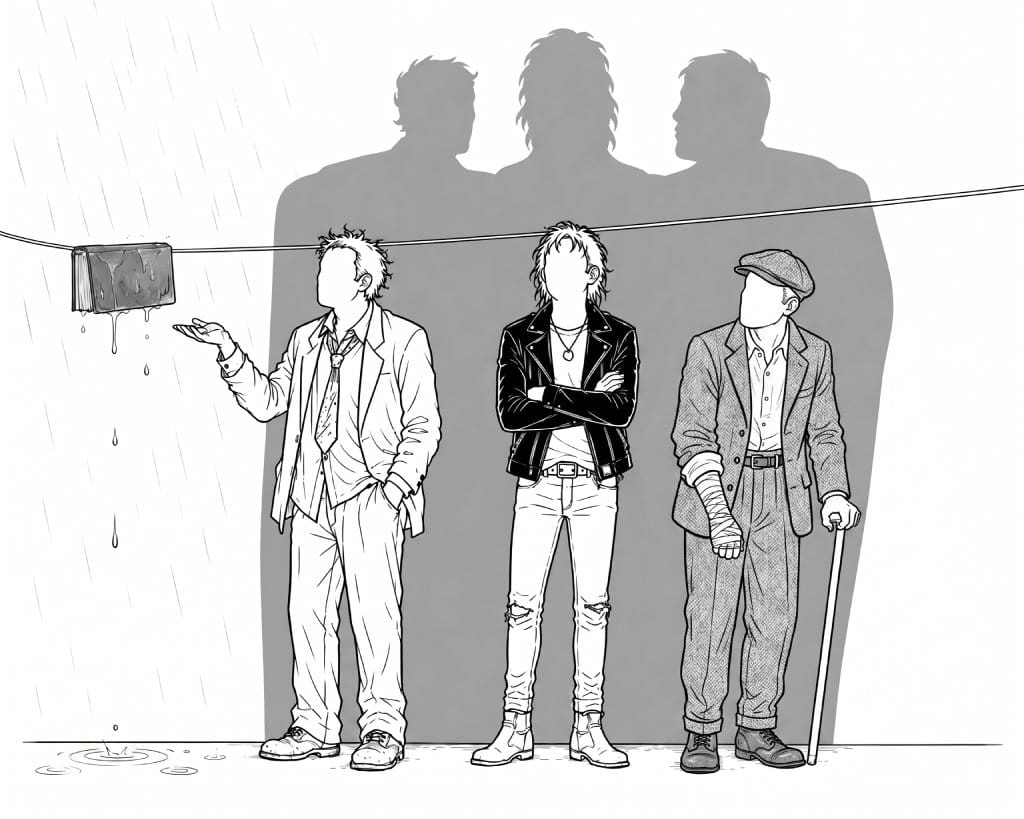
The image that haunts readers is the geometry book. Amalfitano hangs a copy of Rafael Dieste’s Testamento geometrico on a clothesline. He does this because the book got wet, but the act becomes a ritual. He stares at the book drying in the sun; he draws nonsense diagrams in its margins. And he hears voices. The novel never explains whether this is philosophy, madness, or both.
I find that most readings treat Amalfitano’s geometry book as a symbol of academic futility. But the book is also a practical object. He hangs it to dry after the rain. The mundane detail undercuts the grand philosophical reading. His detachment is partly incompetence, not insight. That incompetence makes him more interesting, not less.
Amalfitano’s detachment is involuntary. He does not withdraw from the world out of intellectual superiority. His mind withdraws from him instead. The violence of Santa Teresa, the murders, and the sense of impunity, press against his consciousness until it begins to fail. In analyzing his function, the reader sees that he holds the novel’s central question more directly than any protagonist. The critics in Part One search for the novelist Archimboldi, and the detectives in Part Three pursue a suspect, but Amalfitano simply waits, and his waiting is more honest than their searching because he admits through his breakdown that no resolution is coming.
What makes Amalfitano overshadow the novel’s other figures is the purity of his despair and his indifference to any outcome. The critics have ambition while the detectives have their procedure. Amalfitano has only the geometry book and the voices. He is more legible because he has abandoned the pretense of a solution to a pressing problem.
Amalfitano’s daughter Rosa has no interiority in the novel. She is watched, not heard. That absence bothers me more than the geometry book. A female character reduced to a prop for a male intellectual’s breakdown is not a cost I am willing to overlook.
Katz: Performance Cynicism
Richard Katz appears in Jonathan Franzen’s Freedom (2010) as the college friend of Walter Berglund and later the lover of Walter’s wife, Patty. He is a rock musician who rejects commercial success, an environmental skeptic who dismisses Walter’s conservation work, and a sexual partner who avoids monogamy. His most famous line in the novel distills his entire persona: “I don’t do vision. I don’t do belief.”
In Katz’s case, his detachment is curated. Unlike Amalfitano, whose breakdown is involuntary, Katz chooses his own withdrawals. He chooses to live in a rundown house in Minnesota rather than take a lucrative tour. He chooses to sleep with Patty and then walk away. He chooses to mock Walter’s earnestness rather than engage with the substance of his arguments. Every rejection is a performance, which is consistent.
The problem with Katz is that his cynicism is too quotable. The reader can extract dozens of lines that sound like wisdom: “Few things gratified depressives, after all, more than really bad news.” “I admire your capacity for admiring.” “Integrity’s a neutral value. Hyenas have integrity, too. They’re pure hyena.” These lines work as aphorisms that fit on T-shirts. They give the reader the illusion of having understood something without the effort of working through the novel’s actual moral complications. It sometimes feels like the novel’s gimmick. Katz offers relief from the Berglunds’ earnest struggles without offering an alternative way to live.
I have quoted Katz to friends and have used his lines in conversation. That admission embarrasses me now because the lines do not hold up outside the novel’s context. In the book, they sound like wisdom. In real life, they sound like a person avoiding getting serious about anything that matters.
In contrast, Walter Berglund carries the novel’s environmental argument. He fails repeatedly, compromises his ideals, and ends the novel broken but changed. Patty Berglund, on the other hand, carries the novel’s marital and psychological arc. She narrates her own sections, admits her failures, and then slowly reconstructs herself. Both characters are ambiguous, compromised, and finally unrecognizable from where they began. Katz is none of these things, because he is static from his first appearance to last. Sometimes, stasis is misread as integrity.
Readers remember Katz because he answers no questions and takes no risks. His clarity through detachment is an illusion, but it is a pleasing illusion. The reader, exhausted by the Berglunds’ confusion, flees toward Katz’s fixed position. Consequently, this flight serves as evidence of a minor figure overshadowing the protagonists.
I’ve heard Franzen say he identifies with multiple characters in Freedom, not just Katz as his mouthpiece. Still, Katz lands many of the novel’s sharpest satirical punches on culture and liberalism. The balanced sympathies feel strategically understated. If Katz isn’t Franzen’s dominant voice, why do his cynical lines resonate most powerfully?
Caravaggio: Pragmatic Withdrawal
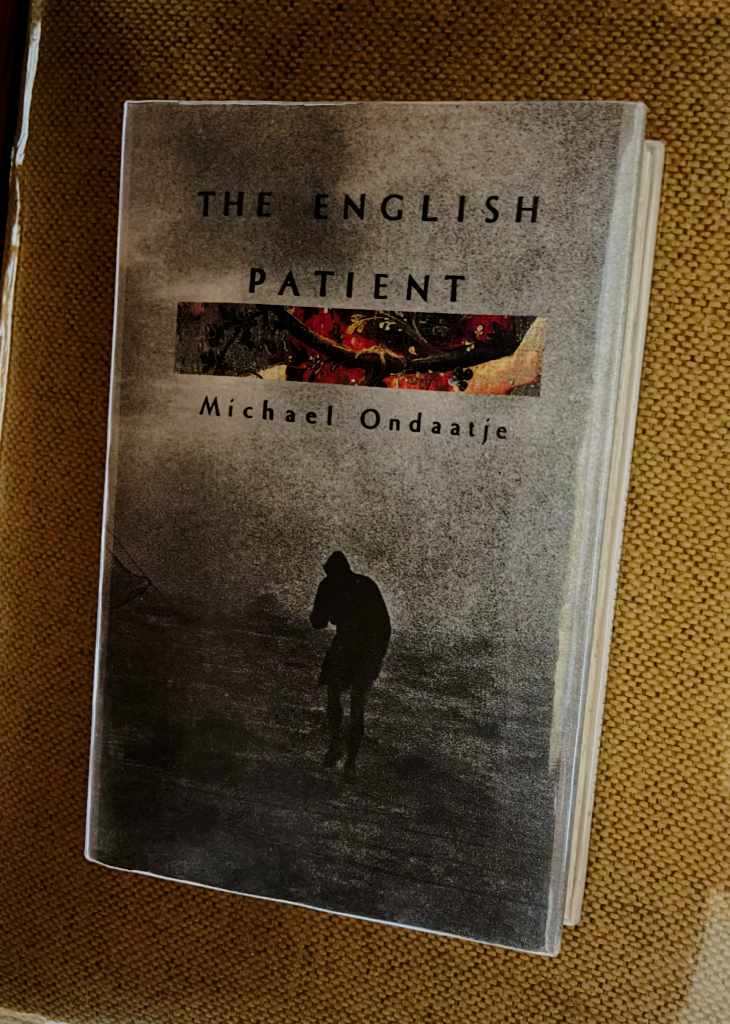
Caravaggio appears in Michael Ondaatje’s The English Patient (1992) as a Canadian thief, a morphine-addicted former British intelligence operative, and a close friend of Hana. He lost his thumbs during torture by German forces. He moves through the Italian villa with a mixture of surveillance and disguise and serves as one of the novel’s chief interrogators, pressing Almásy (the titular English patient) about the desert, the affair, and the betrayal.
Caravaggio’s detachment differs from the other two cases. It is neither involuntary breakdown (Amalfitano) nor curated performance (Katz), but rather tactical. He withdraws from trust, from his nation, and from having a fixed identity because those categories proved dangerous during the war. He steals identities the way other people change clothes, and his lies become a reflex. He observes without participating because participation cost him his thumbs.
Caravaggio’s morphine use is easy to romanticize. But Ondaatje shows him vomiting, sweating, and failing to control his dose. That physicality separates him from the other two. He is detached, but his body refuses to perform the detachment cleanly. The morphine scenes are the novel’s most uncomfortable passages for a reason.
The novel anchors its suspicion in Caravaggio. While Almasy speaks of love and the desert as transcendent, Caravaggio speaks of names, maps, and intelligence files. He asks the practical questions: Who are you? What did you do? Why should anyone believe you? His detachment is inquisitive, not passive. He withdraws from the romance of the story in order to test it.
What makes Caravaggio overshadow Hana and Almasy is his function as a reality principle. Hana nurses the patient out of grief and compassion, while Almasy remembers his affair out of longing and regret. Caravaggio offers neither; he offers only doubt. In a novel that risks drowning in lyricism, Caravaggio’s dry pragmatism keeps the story grounded. The reader may prefer the romance, but the reader also needs the questioner. Caravaggio supplies that need.
Unlike Katz, Caravaggio’s withdrawal is earned. The torture, the missing thumbs, and the years of espionage work justify his unwillingness to trust. The reader does not suspect him of performative cynicism because the novel shows the cost, which distinguishes him not only from Katz but also from Amalfitano, whose breakdown lacks a single cause. Caravaggio’s detachment is a scar, not intellectual posturing.
Caravaggio is the only one of the three who actively investigates the protagonist. I find that difference more significant than the morphine. Suspicion requires engagement instead of withdrawal. In my reading, his detachment is a method and not an escape to a position of superior indifference. He still participates by doubting, which separates him from Amalfitano’s waiting and from Katz’s performative detachment.
What Detachment Is Not
A common misreading of these characters treats them as compelling because they are complicated or tortured. This misreading fails under scrutiny: the appeal of Amalfitano, Katz, and Caravaggio lies in their legibility rather than complexity. Each holds a single, extreme position relative to the novel’s central tension.
Amalfitano embodies the impossibility of thought in the face of atrocity, Katz holds the suspension of earnestness, and Caravaggio signifies the necessity of suspicion; thus, their positions are straightforward, in contrast to the ambiguous nature of the protagonists. The literary critics in 2666 want fame and meaning, while Walter Berglund wants to save birds but fails. Patty Berglund wants love yet betrays herself, Hana wants to heal but cannot, and Almasy wants to remember but lies.
The reader tires of the ambiguity of the central characters, but each of these novels cannot resolve its own questions (that is the nature of literary fiction). However, a supporting character is able to hold a single position without contradiction. That clarity becomes a relief, and the reader turns toward it. The mistake, however, is to call that turn a judgment of quality. It is a judgment of legibility, nothing more.
I find myself uneasy with my own argument here. The reader turns toward legibility, yes, but that turn is not always a failure. Sometimes clarity is wisdom, not escape. Yet in these three novels, the clarity comes too cheaply. That is the distinction worth holding.
Where the Framework Fails
The taxonomy proposed here—intellectual breakdown, performance cynicism, and pragmatic withdrawal—does not explain every instance of the detached male intellectual. Caravaggio avoids the “gimmick” label more successfully than Katz because his withdrawal is visibly earned. A reader could argue that Caravaggio’s detachment is not a narrative shortcut but a realistic consequence of trauma. That argument has its own merit.
Katz, by contrast, faces no comparable trauma because his cynicism is self-induced. The novel provides no backstory of suffering that would justify his position. He is the clearest case of the gimmick operating without justification. Amalfitano sits between the two. His breakdown is earned by the accumulation of horror in Santa Teresa, but the novel uses his philosophy as atmosphere more than as action. The geometry book is iconic but never explained. That opacity is part of its power, but it also means the reader cannot fully trace the cause of his breakdown.
This partial failure of taxonomy strengthens the essay because not all detachment is equal. The distinction between earned and unearned withdrawal matters, wherein Caravaggio passes the test, Katz fails it, and Amalfitano sits somewhere in the middle. The reader’s preference for one over the other may correlate with how much the novel justifies the character’s distance.
This section nearly did not survive the drafting process. I kept wanting to defend Katz because he is funnier than Walter, and he is freer. But freedom without cost is not a serious literary achievement. Katz remains a pleasure to read, but the essay’s job is to name what that pleasure costs the character.
Methodological Anchor
In analyzing these three characters across three novels, this essay isolates supporting figures who meet three criteria. First, they lack protagonist status in their respective novels (Amalfitano anchors only one of five parts in 2666, Katz appears in less than twenty percent of Freedom, and Caravaggio holds no POV sections in The English Patient). Second, they occupy less page time than each of the novel’s central characters. Third, they attract outsized reader and critic fascination disproportionate to their textual presence.
Synthesis: Detachment as a Response to Hysterical Realism
James Wood’s 2000 essay “Human, All Too Inhuman” coined the term “hysterical realism” to describe a strain of contemporary fiction characterized by excessive plot, endless information, and performative energy. Wood named Zadie Smith’s White Teeth (2000) and Don DeLillo’s Underworld (1997) as examples, but the critique applies more broadly. The novels examined here are not hysterical (as Wood defined hysterical realism), but they were written during the same period and responded to the same feeling of exhaustion.
The detached male intellectual can be read as a formal counterweight to narrative excess. When novels risk becoming too busy, too crammed, or too noisy, the detached character offers stillness. His choice not to engage is not only a character trait but also a structural necessity, for the reader needs someone who is not struggling or suffering but is indifferent to the chaos around them. That someone provides a resting point, and Amalfitano, Katz, and Caravaggio serve that function effectively.
Wood’s essay on hysterical realism irritated me when I first read it. He seemed to be attacking novels for being ambitious. But he was right about the exhaustion. These detached intellectuals are not solutions to that exhaustion but they are rather the symptoms of it.
Character Analysis: Protagonists and Antagonists Explored
Character Complexity in Literary Fiction
Character Development: Key Questions for Writers
Before exploring how a supporting character can outshine a protagonist, it helps to understand the foundational machinery of character design. The three posts linked above establish that groundwork. The first, “Character Analysis,” offers a framework for identifying a character’s operative desire and the nature of their opposition. The second, “Character Complexity,” examines how credible contradiction and sustained interiority turn a persona into a narrative experiment. The third, “Character Development,” provides a practical blueprint for constructing the history, flaw, and worldview that make any figure—whether a lead or a marginal presence—feel necessary. Reading them in sequence will sharpen the analytical lens this new essay depends on.
Further Reading
- Looking for books with honourable and sweet supporting male characters. on Reddit
- Who are some great secondary characters in literature who overshadowed the main character? on Quora
- Young, disillusioned male protagonists on The Literature Network Forums